
Bothriolepis Facts for Kids
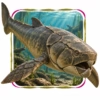
Bothriolepis was an armored fish that lived during the Devonian Period. It belonged to the antiarch placoderms, an extinct branch of early jawed vertebrates. Thick bony plates protected its head and the front of its body, while jointed armored pectoral appendages projected from the sides. Most species were small bottom feeders, although the giant Bothriolepis rex grew much larger.
Quick Bothriolepis Facts
- Animal Type: Extinct armored fish
- Group: Antiarch placoderm
- Known For: Bony head-and-body shield, jointed armored pectoral appendages, downward-facing mouth, worldwide fossils, and bottom-feeding lifestyle
- Lived During: Middle to Late Devonian, roughly 387–359 million years ago
- Diet: Algae, organic material, tiny crustaceans, and other small bottom-dwelling food
What You’ll Learn
Learn 10 armored bothriolepis facts for kids about bony plates, freshwater habitats, bottom feeding, fins, and Devonian life, with a quiz, glossary, and activity
Simple explanations make them great for children, families, teachers, and young fossil fans.
10 Fun Bothriolepis Facts for Kids
1. Bothriolepis Was an Armored Fish
Bothriolepis belonged to Placodermi, an extinct collection of early jawed vertebrates with bony plates covering part of the body.
Kid Decode: It entered the Devonian wearing a shield before shields were fashionable.
2. Its Front Half Wore Heavy Armor
Large interlocking plates protected the head and trunk, while the rear body and tail remained more flexible.
Kid Decode: The front was a tank; the back was the swimming department.
3. It Had Jointed Armored Appendages
Its pectoral appendages were enclosed in bony plates and contained movable joints, giving them an unusual limb-like appearance.
Kid Decode: Each side carried a hinged armored paddle that looked borrowed from a tiny robot.
4. Its Mouth Faced Downward
The mouth opened on the underside of the head, an arrangement suited to collecting food from the seafloor or river bottom.
Kid Decode: Dinner was usually located below, so its mouth pointed toward the buffet.
5. It Probably Fed Near the Bottom
Sediment in fossil digestive tracts and jaw studies suggest that Bothriolepis searched the bottom for algae, organic matter, and tiny animals.
Kid Decode: It may have vacuumed and scraped its way through Devonian mud snacks.
6. Its Jaws May Have Carried a Tough Covering
Recent biomechanical work suggests that antiarch jaw bones supported a keratin-like sheath that could help scrape tough food such as algae.
Kid Decode: Its mouth may have used a hard beak-like edge instead of ordinary teeth.
7. Most Species Were Small
Many Bothriolepis species were only a few tens of centimetres long, making them compact inhabitants of Devonian waters.
Kid Decode: Most could fit across a school ruler with some fish left over.
8. One Species Was a Giant
Bothriolepis rex from Arctic Canada reached an estimated length of around 1.7 metres, far larger than most members of the genus.
Kid Decode: The armored fish family included one unexpectedly king-sized cousin.
9. It Lived Across the World
Bothriolepis fossils have been discovered on many ancient continents in freshwater, estuarine, and nearshore deposits.
Kid Decode: Its armor plates travelled through fossil history on a nearly global tour.
10. It Lacked Pelvic Fins
Unlike many jawed fishes, Bothriolepis had no true pelvic fins, although its ancestors probably possessed them.
Kid Decode: Evolution removed one fin set while keeping the armored side paddles.
The Weirdest Bothriolepis Fact
Bothriolepis combined a heavily armored front body with flexible rear parts and a pair of jointed, bone-covered pectoral appendages unlike the fins of modern fish.
Try This Bothriolepis Activity
Bothriolepis Drawing Activity
Draw Bothriolepis moving across a Late Devonian river bottom. Add a box-like shield over the head and trunk, jointed armored pectoral appendages, downward-facing mouth, flexible tail, algae, tiny crustaceans, muddy sediment, a small ordinary species beside giant Bothriolepis rex, and scattered armor plates.
Quick Bothriolepis Quiz
- Was Bothriolepis a dinosaur? Answer: No, it was an armored fish.
- What group did it belong to? Answer: The antiarch placoderms.
- Which part of its body carried the heaviest armor? Answer: The head and front of the trunk.
- Where was its mouth positioned? Answer: On the underside of the head.
- What did it probably eat? Answer: Algae, organic material, tiny crustaceans, and other small bottom food.
Mini Glossary
- Placoderm: An extinct early jawed vertebrate, often protected by bony plates.
- Antiarch: A placoderm group with a box-like armored trunk and jointed pectoral appendages.
- Pectoral Appendage: A paired side structure corresponding broadly to the front fins of fishes.
- Keratin: Tough material found in structures such as beaks, claws, hair, and nails.
- Devonian: A geologic period from about 419 to 359 million years ago, often called the Age of Fishes.
 Lyrebird Facts for Kids
 Cicada Facts for Kids
 Mynah Bird Facts for Kids
 Eurypterid Facts for Kids
More Animal Facts for Kids
Visit the full animal facts library or explore a focused animal group.
More Extinct Animal Facts for Kids
Discover dinosaurs, Ice Age giants, prehistoric sea creatures, recently extinct species, and other animals from the past.
Fact check note: Fact checked with Béchard and colleagues’ three-dimensional study of Bothriolepis canadensis, Lebedev and colleagues’ 2022 antiarch jaw analysis, Dupret and colleagues’ 2023 Bothriolepis research, and placoderm fin-evolution studies.

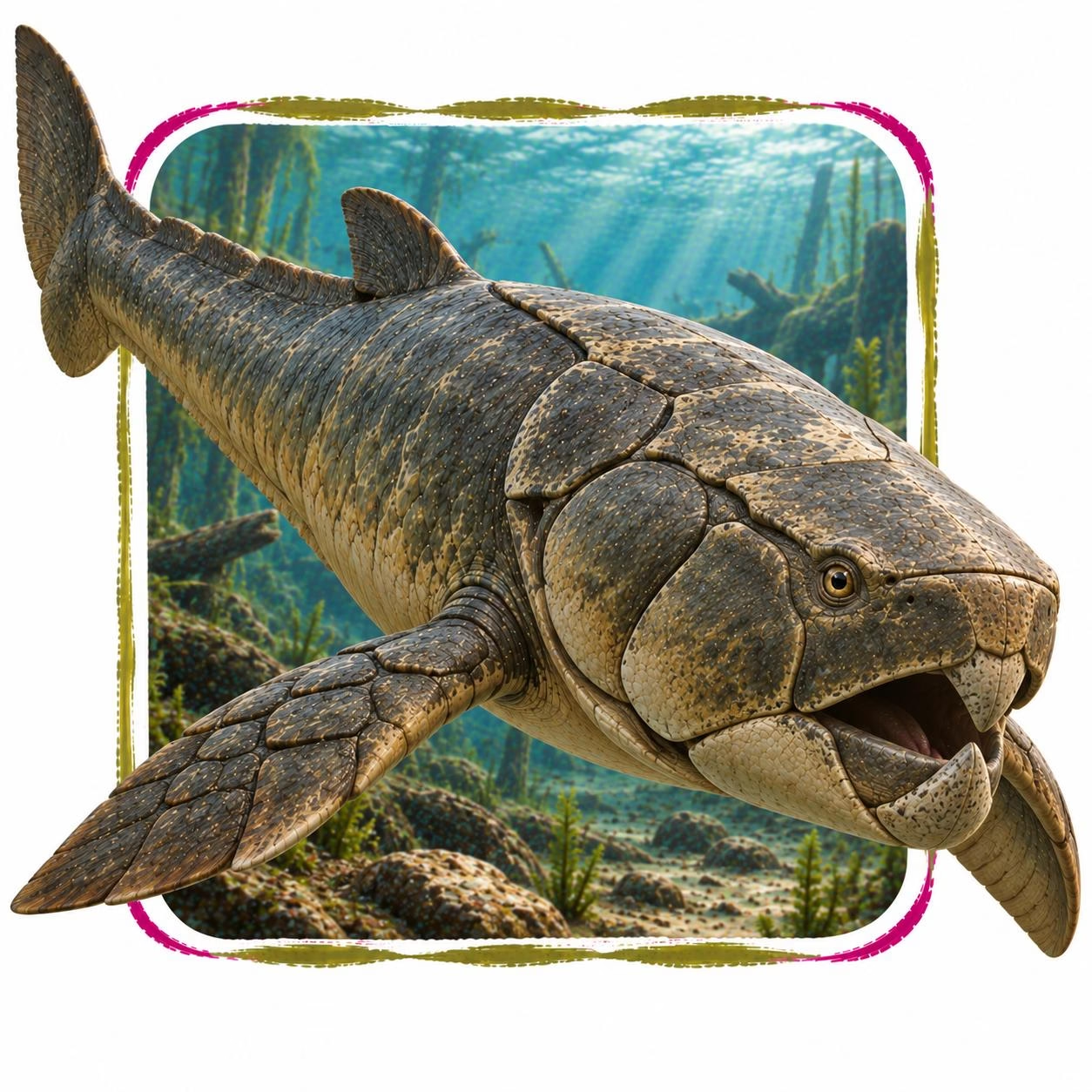
Bothriolepis in its natural Middle to Late Devonian rivers, lakes, floodplains, estuaries, coastal shallows, muddy bottoms, and nearshore waters across ancient continents habitat