
Brontornis Facts for Kids
Brontornis was an enormous flightless bird that lived in Patagonia during the Early and Middle Miocene. For many years it was portrayed as the heaviest terror bird, but its identity remains one of fossil-bird science’s liveliest puzzles. Some analyses place it near terror birds and seriemas, while others recover it among giant fowl related to Gastornis and Australia’s mihirungs. Its heavy legs show a slow, weight-supporting build, and recent work has strengthened the possibility that it ate plants rather than hunting like a classic terror bird.
Quick Brontornis Facts
- Animal Type: Extinct giant flightless bird
- Group: Brontornithid; exact relationships disputed
- Known For: Enormous body, graviportal legs, debated terror-bird identity, and possible herbivory
- Lived During: Early to Middle Miocene, roughly 18–12 million years ago
- Diet: Probably herbivorous, though carrion feeding and carnivory were historically proposed
What You’ll Learn
Explore 10 giant brontornis facts for kids about flightlessness, powerful legs, huge bodies, strong beaks, and prehistoric South America, with a quiz, glossary, and activity
These easy facts are made for kids, parents, teachers, and curious young learners.
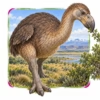
10 Fun Brontornis Facts for Kids
1. Brontornis Was Flightless
Its massive hindlimbs and weight-bearing proportions show that Brontornis could not fly and spent its entire life on the ground.
Kid Decode: The wings stayed grounded while the legs handled several hundred kilograms of bird.
2. It Was One of the Heaviest Birds Ever
Published estimates place Brontornis at roughly 319 to 400 kilograms, making it the largest known South American land bird by mass.
Kid Decode: It carried more bird on two legs than many large mammals carry on four.
3. It May Have Reached About 2.8 Metres Tall
Reconstructions suggest a height near 1.75 metres at the back and about 2.8 metres with the neck and head raised.
Kid Decode: Its raised head could look down from almost the height of a basketball hoop’s lower framework.
4. Its Legs Were Graviportal
Short, extremely thick foot and lower-leg bones were built to support weight rather than produce the long, rapid strides of a specialised runner.
Kid Decode: Its legs were pillars for carrying a giant, not springs for winning a sprint.
5. Its Family Tree Is Hotly Debated
Some studies place Brontornis close to phorusrhacids or other cariamiform birds, while a 2021 analysis recovered it among giant galloanserine birds.
Kid Decode: Its scientific family reunion still has two tables arguing over the seating plan.
6. It May Not Have Been a Terror Bird
Because its ankle and foot anatomy differs from definite phorusrhacids, several researchers remove Brontornis from the terror-bird family.
Kid Decode: The famous terror-bird badge may have been pinned onto the wrong giant.
7. Its Diet May Have Been Herbivorous
A broad, robust lower jaw and its possible relationship to plant-eating giant fowl support herbivory, although the incomplete skull makes its diet uncertain.
Kid Decode: This heavyweight may have been a walking plant processor rather than a giant feathered hunter.
8. Its Skull Is Poorly Known
Most fossils are hindlimb bones, while jaws and other skull pieces are incomplete or not securely associated with the main specimens.
Kid Decode: The legs tell a loud story, but the head keeps most of its secrets.
9. Its Bones Show Rapid Growth
A 2025 microscopic study found highly vascular fibrolamellar bone, indicating that Brontornis grew quickly and continuously while young.
Kid Decode: The giant built its heavyweight skeleton at surprisingly high speed.
10. It Lived in Miocene Patagonia
Fossils come from the Santa Cruz Formation of southern Argentina, where open woodlands, grasslands, rivers, and rich mammal communities formed a varied landscape.
Kid Decode: It strode through Patagonia among hoofed mammals, armadillos, sloths, and other remarkable birds.
The Weirdest Brontornis Fact
One of the world’s heaviest birds may not have been a terror bird or a predator at all, but a giant plant-eating relative of ancient fowl.
Try This Brontornis Activity
Brontornis Drawing Activity
Draw Brontornis walking through Miocene Patagonia. Add a huge flightless body, tiny wings, a long neck, extremely thick weight-bearing legs, broad feet, and a cautious beak reconstruction. Include two family-tree signs reading “terror-bird relative?” and “giant fowl relative?” plus leaves beside a question mark over its diet.
Quick Brontornis Quiz
- Could Brontornis fly? Answer: No, it was flightless.
- How much may it have weighed? Answer: Roughly 319 to 400 kilograms.
- How tall may it have stood with its head raised? Answer: About 2.8 metres.
- Is it certainly a terror bird? Answer: No, its relationships remain disputed.
- What diet is supported by some recent research? Answer: A mainly plant-eating diet.
Mini Glossary
- Flightless: Unable to fly.
- Graviportal: Built with thick limbs for supporting great body weight.
- Phorusrhacid: A member of the extinct predatory group commonly called terror birds.
- Galloanserine: A bird from the broad evolutionary branch containing fowl and waterfowl.
- Fibrolamellar Bone: Fast-growing bone tissue with many blood-vessel spaces.
 Antelope Facts for Kids
 Sun Bear Facts for Kids
 North American Beaver Facts for Kids
 Beelzebufo Facts for Kids
More Animal Facts for Kids
Visit the full animal facts library or explore a focused animal group.
More Extinct Animal Facts for Kids
Discover dinosaurs, Ice Age giants, prehistoric sea creatures, recently extinct species, and other animals from the past.
Fact check note: Fact checked with Alvarenga and Höfling’s 2003 phorusrhacid revision, Worthy and colleagues’ 2017 giant-flightless-bird phylogeny, Agnolin’s 2021 Brontornis reappraisal, LaBarge and colleagues’ 2024 gigantism analysis, and Marsà and colleagues’ 2025 paleohistology study.

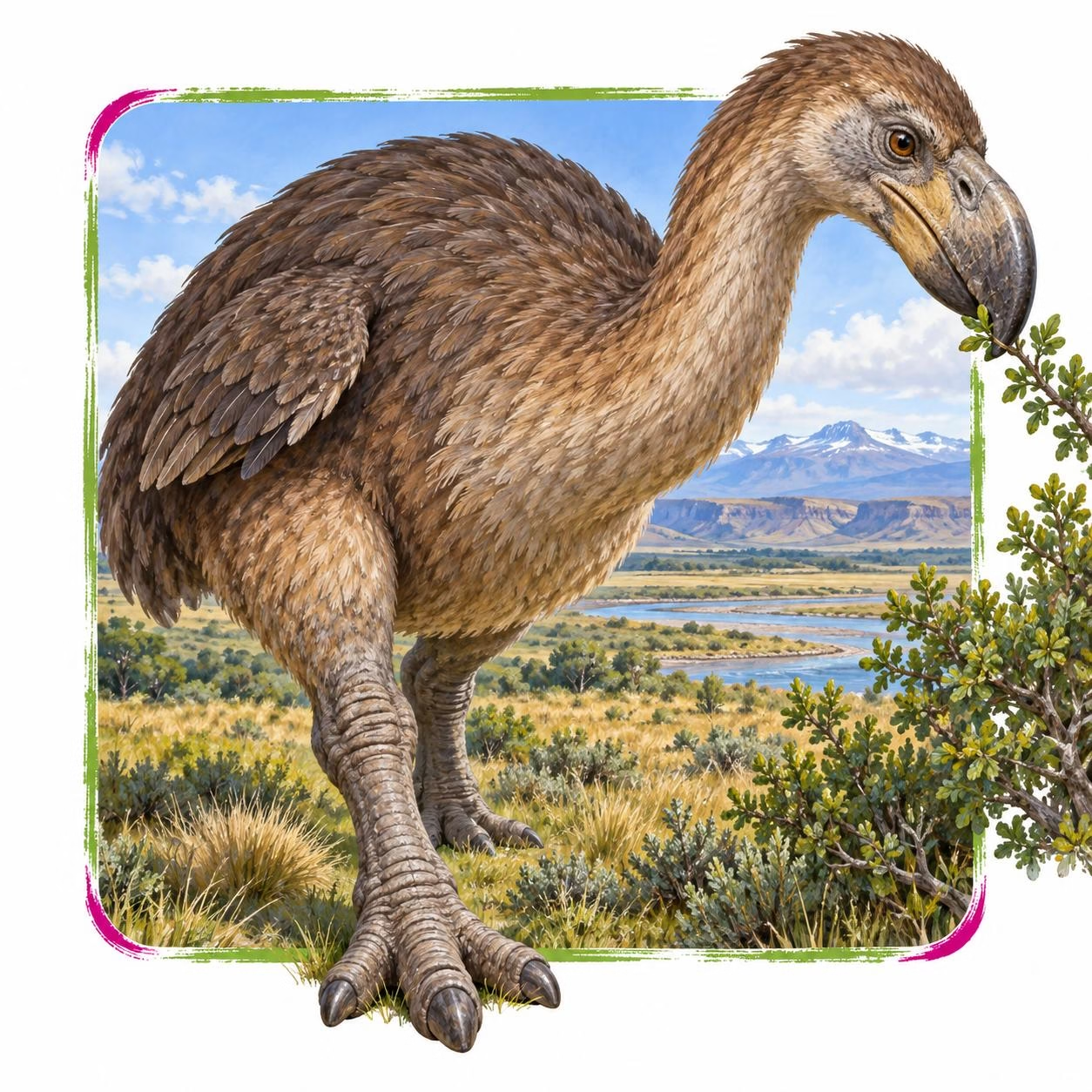
Brontornis in its natural Early and Middle Miocene open woodlands, grasslands, river floodplains, shrublands, and temperate plains of southern Patagonia habitat