
Embolotherium Facts for Kids
Embolotherium was a gigantic brontothere that lived in Mongolia during the Late Eocene. It was an odd-toed hoofed mammal related to the broader group containing rhinos, horses, and tapirs, but it was not a true rhinoceros. Its most remarkable feature was a long battering-ram-shaped structure formed from the nasal and frontal bones. The structure was hollow and connected with an enlarged nasal cavity, so scientists think it may have helped produce or amplify sounds rather than serving as a weapon.
Quick Embolotherium Facts
- Animal Type: Extinct odd-toed hoofed mammal
- Group: Brontothere
- Known For: Hollow battering-ram-shaped nasal structure, enormous skull, giant body, and possible sound resonance
- Lived During: Late Eocene, roughly 37–34 million years ago
- Diet: Leaves, shoots, and other vegetation
What You’ll Learn
Discover 10 giant embolotherium facts for kids about its unusual skull structure, massive body, plant diet, and prehistoric Asian habitats, with a quiz, glossary, and activity
These facts are explained simply for kids, parents, teachers, and curious little fact-finders.
10 Fun Embolotherium Facts for Kids
1. Embolotherium Was a Brontothere
Embolotherium belonged to Brontotheriidae, an extinct family of large odd-toed hoofed mammals.
Kid Decode: It joined the hoofed-mammal family parade through a branch that vanished completely.
2. It Was Not a Rhinoceros
Although its heavy body looked rhinoceros-like, Embolotherium was a brontothere rather than a true member of the rhino family.
Kid Decode: The silhouette suggested rhino, but the family-tree paperwork said brontothere.
3. Its Head Carried a Giant Bony Ram
A long structure projected upward and forward from the skull and was formed mainly from enlarged nasal and frontal bones.
Kid Decode: Its face looked as though a stone battering ram had grown directly from the nose.
4. The Ram Was Hollow
The nasal cavity extended high inside the bony projection, making it lighter and more fragile than the solid horns of some other brontotheres.
Kid Decode: The enormous head ornament contained more air space than battle-ready bone.
5. It Was Probably Not a Head-Butting Weapon
Because the ram was hollow and relatively delicate, scientists doubt that Embolotherium smashed it against rivals during combat.
Kid Decode: The fossil version of a battering ram may never have battered anything at all.
6. It May Have Amplified Calls
The enlarged nasal chamber may have acted as a resonator that deepened or strengthened calls used for communication.
Kid Decode: The giant could have announced itself with a low Eocene boom carried across the plains.
7. Its Skull Reached About Ninety-Two Centimetres
One large skull measured roughly 92 centimetres from the front to the rear of the skull base.
Kid Decode: Its head alone stretched almost as long as a small dining table is wide.
8. It Was One of the Largest Brontotheres
Postcranial bones indicate a massive weight-bearing animal that rivalled the biggest North American brontotheres and probably weighed several tonnes.
Kid Decode: It carried several tonnes beneath one of mammal history’s strangest noses.
9. It Had More Toes Than a Modern Rhino
Like other brontotheres, it retained four toes on each front foot and three toes on each hind foot.
Kid Decode: The front feet brought one extra toe to every heavy step.
10. Its Name Means Battering-Ram Beast
The name Embolotherium refers to the wedge- or battering-ram-like structure rising from its skull.
Kid Decode: The scientific name describes the head ornament before the rest of the animal even enters the room.
The Weirdest Embolotherium Fact
Its huge battering-ram-shaped structure was hollow and may have worked as a resonating chamber for powerful calls instead of as a weapon.
Try This Embolotherium Activity
Embolotherium Drawing Activity
Draw Embolotherium walking across a Late Eocene Mongolian plain. Add a gigantic heavy body, four toes on each front foot, three on each hind foot, a long skull, and a hollow battering-ram-shaped nasal structure. Include a cutaway showing the enlarged nasal chamber, sound-wave lines, shrubs, dusty river channels, and a “probably not for head-butting” clue card.
Quick Embolotherium Quiz
- Was Embolotherium a true rhinoceros? Answer: No, it was a brontothere.
- What formed its giant nasal ram? Answer: Enlarged nasal and frontal bones.
- Was the ram solid? Answer: No, it contained a large hollow nasal cavity.
- What may the ram have helped the animal do? Answer: Produce or amplify calls.
- Where did Embolotherium live? Answer: Mongolia and nearby parts of central Asia.
Mini Glossary
- Brontothere: A member of an extinct family of odd-toed hoofed mammals.
- Perissodactyl: An odd-toed hoofed mammal from the group containing horses, rhinos, and tapirs.
- Nasal Cavity: The air-filled space inside the nose and skull.
- Resonator: A structure that strengthens or changes a sound.
- Graviportal: Built with strong limbs for carrying a very heavy body.
 Shark Facts for Kids
 Prawn Facts for Kids
 Sea Turtle Facts for Kids
 Eotriceratops Facts for Kids
More Animal Facts for Kids
Visit the full animal facts library or explore a focused animal group.
More Extinct Animal Facts for Kids
Discover dinosaurs, Ice Age giants, prehistoric sea creatures, recently extinct species, and other animals from the past.
Fact check note: Fact checked with Osborn’s 1929 original Embolotherium description, Mihlbachler’s 2008 brontothere taxonomy and phylogeny, McLaughlin and colleagues’ 2010 postcranial report, and American Museum of Natural History brontothere resources.

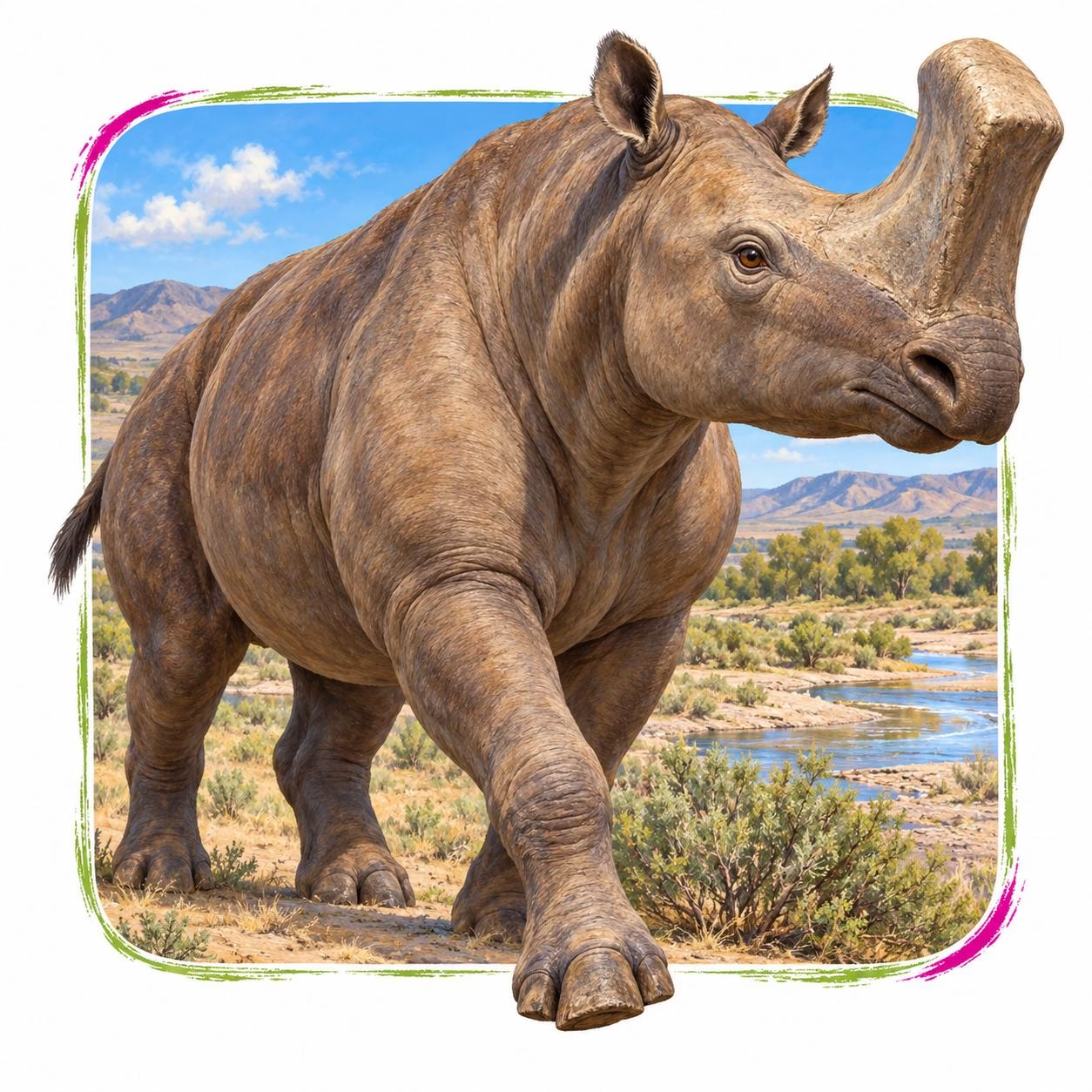
Embolotherium in its natural Late Eocene semi-arid floodplains, open woodlands, river valleys, shrublands, and dry continental plains of Mongolia and central Asia habitat