
Josephoartigasia Facts for Kids
Josephoartigasia was a gigantic plant-eating rodent that lived in what is now Uruguay during the Pliocene. The best-known species, Josephoartigasia monesi, is represented by an enormous skull about 53 centimetres long. It may have weighed around 480 to 500 kilograms according to a recent estimate, although older studies proposed much larger masses. Its huge continuously growing incisors could deliver a powerful bite and may also have worked like tusks for digging, cutting plants, or defense.
Quick Josephoartigasia Facts
- Animal Type: Extinct giant rodent
- Group: Dinomyid caviomorph
- Known For: Largest known rodent, 53-centimetre skull, giant incisors, powerful bite, and debated body mass
- Lived During: Pliocene, roughly 4–2 million years ago
- Diet: Leaves, fruit, roots, aquatic plants, and other vegetation
What You’ll Learn
Learn 10 enormous josephoartigasia facts for kids about giant size, huge incisors, rodent relatives, plant diets, and prehistoric South America, with a quiz, glossary, and activity
These facts are written simply for kids, parents, teachers, and curious young fact-finders.
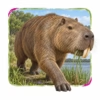
10 Fun Josephoartigasia Facts for Kids
1. Josephoartigasia Was a True Rodent
Josephoartigasia belonged to Rodentia, the mammal order containing mice, squirrels, beavers, porcupines, capybaras, and many others.
Kid Decode: It was a genuine rodent expanded to the scale of a large hoofed mammal.
2. It Was the Largest Known Rodent
Josephoartigasia monesi is generally regarded as the largest rodent yet discovered, even under newer lower mass estimates.
Kid Decode: The rodent size record belongs to an animal far beyond the reach of any ordinary mousetrap.
3. Its Skull Was Fifty-Three Centimetres Long
The nearly complete skull of J. monesi measures about 53 centimetres from front to back.
Kid Decode: Its head was roughly the length of a large travel suitcase.
4. Its Weight Is Strongly Debated
Older studies suggested averages near or above one tonne, while a 2022 analysis estimated roughly 480 to 500 kilograms.
Kid Decode: The animal remains enormous, but several imaginary hundreds of kilograms have wandered on and off the scale.
5. Its Incisors Grew Continuously
Like other rodents, Josephoartigasia had huge front incisors that continued growing throughout life and were worn down by use.
Kid Decode: Its giant teeth came with a permanent self-replacement schedule.
6. Its Incisor Bite Was Powerful
Computer modelling estimated a maximum bite force of about 1,389 newtons at the incisors.
Kid Decode: The front teeth could press with forces comparable to those of large meat-eating mammals.
7. Its Molar Bite Was Even Stronger
The same model estimated up to about 4,165 newtons at the third molar because rear teeth sit closer to the jaw joint.
Kid Decode: The back of its mouth turned plant processing into heavyweight engineering.
8. Its Incisors May Have Worked Like Tusks
The reinforced skull and forward-angled incisors may have helped dig roots, cut tough vegetation, defend against predators, or compete with rivals.
Kid Decode: Those teeth may have handled jobs usually assigned to tusks, shovels, and warning signs.
9. Its Closest Living Relative Is the Pacarana
Josephoartigasia belonged to Dinomyidae, a rodent family represented today only by the much smaller pacarana.
Kid Decode: Its living cousin looks modest because the extinct branch took the size dial and kept turning.
10. It Lived in Uruguay
The famous skull came from the Raigón Formation near the coast of Uruguay, in sediments linked with estuarine and wooded environments.
Kid Decode: Its giant head rested beneath a landscape where rivers, forests, and coastal waters met.
The Weirdest Josephoartigasia Fact
A recent bite model found that its rear teeth could generate more than 4,000 newtons of force, while its reinforced incisors may have doubled as tusk-like tools or weapons.
Try This Josephoartigasia Activity
Josephoartigasia Drawing Activity
Draw Josephoartigasia monesi beside a Pliocene Uruguayan estuary. Add a massive rodent body, a 53-centimetre skull, huge forward-angled incisors, ridged cheek teeth, strong jaws, leafy plants, roots, fruit, water-edge vegetation, a pacarana comparison, and two weight signs showing the modern lower estimate and older giant estimates.
Quick Josephoartigasia Quiz
- Was Josephoartigasia a true rodent? Answer: Yes, it belonged to the rodent order.
- How long was the skull of J. monesi? Answer: About 53 centimetres.
- How much did a recent study estimate it weighed? Answer: Roughly 480 to 500 kilograms.
- What may its incisors have done besides bite food? Answer: Dug roots, cut plants, defended the animal, or helped in contests.
- What is its closest living relative? Answer: The pacarana.
Mini Glossary
- Rodent: A mammal with continuously growing front incisors.
- Dinomyid: A member of the rodent family containing Josephoartigasia and the living pacarana.
- Incisor: A front tooth used for cutting or gnawing.
- Finite Element Analysis: A computer method used to test how structures handle forces.
- Estuary: A place where river water mixes with seawater.
 Chickadee Facts for Kids
 Crown-of-Thorns Starfish Facts for Kids
 Lorikeet Facts for Kids
 Megalania Facts for Kids
More Animal Facts for Kids
Visit the full animal facts library or explore a focused animal group.
More Extinct Animal Facts for Kids
Discover dinosaurs, Ice Age giants, prehistoric sea creatures, recently extinct species, and other animals from the past.
Fact check note: Fact checked with Rinderknecht and Blanco’s 2008 description of Josephoartigasia monesi, Millien’s 2008 mass reassessment, Cox and colleagues’ 2015 bite-force model, and Engelman’s 2022 body-mass analysis.

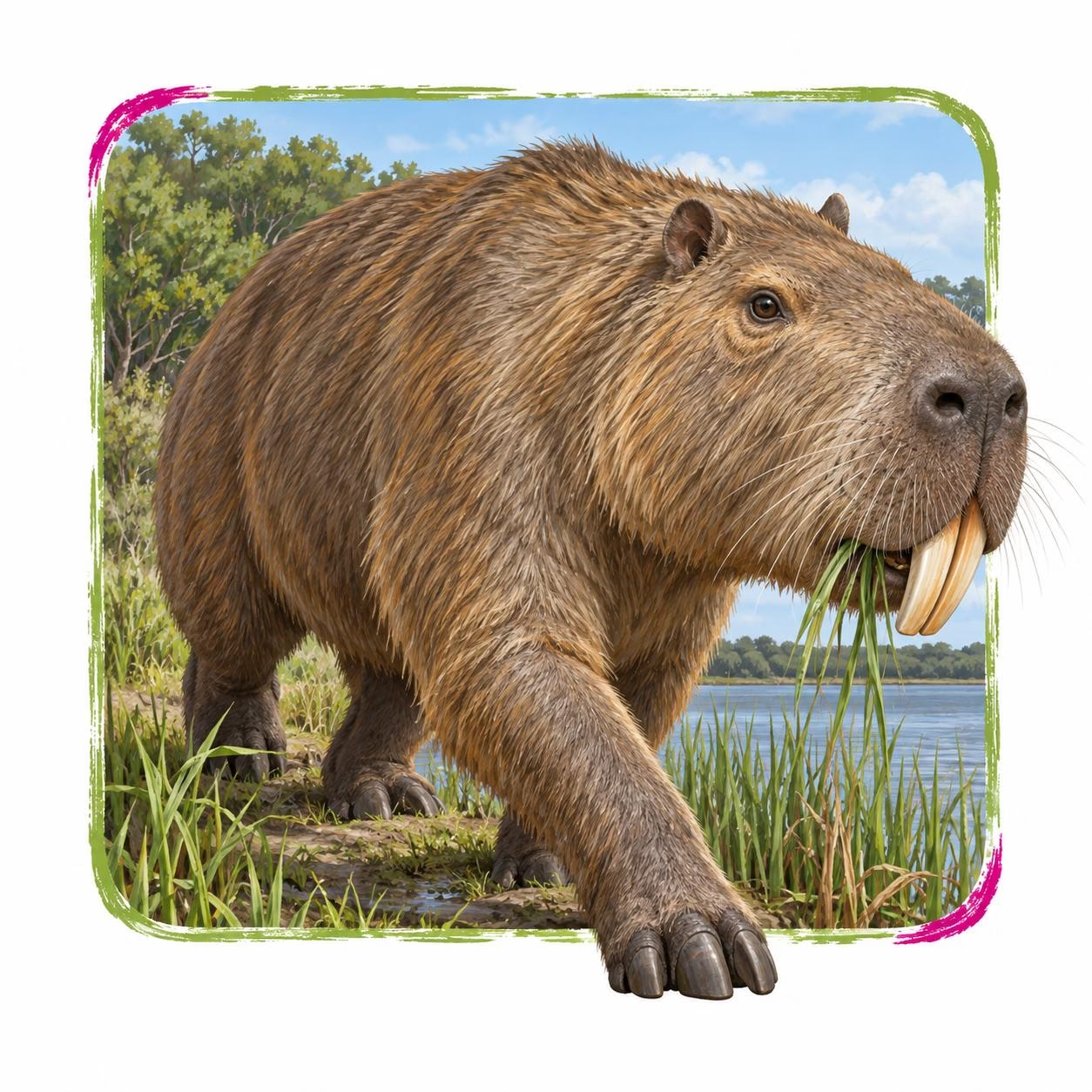
Josephoartigasia in its natural Pliocene estuaries, coastal woodlands, river margins, wetlands, forest edges, and plant-rich lowlands of Uruguay habitat