
Nodosaurus Facts for Kids
Nodosaurus was a four-legged armored dinosaur that lived in North America about 100 million years ago during the Cretaceous Period. Scientists know it from a partial skeleton found in Wyoming, so some features seen in illustrations are educated comparisons with better-known relatives. Its bony skin armor is real fossil evidence, but its skull has never been found.
Quick Nodosaurus Facts
- Scientific Name: Nodosaurus textilis
- Animal Type: Armored dinosaur
- Family: Nodosauridae
- Length: Often estimated at about 5 metres
- Time: About 100 million years ago in the Cretaceous Period
- Fossil Location: Wyoming, United States
- Diet: Herbivore
- Known For: Bony armor and an incomplete fossil skeleton without a skull
What You’ll Learn
Explore 10 armored nodosaurus facts for kids about bony plates, four strong legs, plant-eating, fossils, and Cretaceous life, plus a quiz, glossary, and activity
Clear explanations make these facts great for children, families, teachers, and young dinosaur explorers.
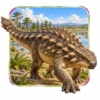
10 Fun Nodosaurus Facts for Kids
1. Nodosaurus Was an Armored Dinosaur
Nodosaurus belonged to the ankylosaur group and the family Nodosauridae. Rows of bony plates called osteoderms formed protective armor within its skin.
Kid Decode: Its body came with a natural set of bony shields.
2. Its Name Means Node Lizard
The name Nodosaurus comes from words meaning “node lizard” or “knobbed lizard,” a reference to the knob-like pieces of armor found with its skeleton.
Kid Decode: This dinosaur was named after the bumps in its fossil armor.
3. It Lived During the Cretaceous
Nodosaurus lived around 100 million years ago in the middle part of the Cretaceous Period. The land that became Wyoming was then part of a warm North American landscape near a great inland sea.
Kid Decode: Its neighborhood existed millions of years before Tyrannosaurus rex appeared.
4. It Walked on Four Legs
Its strong limb and foot bones show that Nodosaurus was a quadruped. Scientists reconstruct it with a broad, low body carried on four sturdy legs.
Kid Decode: Four solid legs supported one long, armored plant eater.
5. It Was About as Long as a Car
The Natural History Museum gives an estimated length of about 5 metres. The exact size is uncertain because the only known skeleton is incomplete.
Kid Decode: Head to tail, it may have stretched longer than many family cars.
6. Nodosaurus Ate Plants
Its place in the armored-dinosaur family shows that it was herbivorous. It probably cropped low vegetation such as ferns, cycads, and other available plants, although no Nodosaurus skull or stomach contents reveal its exact menu.
Kid Decode: Scientists know the broad menu was plants, but not the daily specials.
7. Its Tail Had No Club
Unlike some ankylosaurids, nodosaurids did not have a heavy bony club at the end of the tail. Armor and a low, strong body were probably its main protection.
Kid Decode: Armored does not always mean tail-clubbed.
8. One Partial Skeleton Defines It
The known Nodosaurus fossil includes vertebrae, ribs, parts of the pelvis and limbs, foot bones, and armor. Because the skeleton is incomplete, every reconstruction must label uncertain details honestly.
Kid Decode: A dinosaur can become famous even when much of its skeleton is missing.
9. Its Skull Is Still Unknown
No skull was recovered with the type specimen. Artists commonly give Nodosaurus a small nodosaurid-style head based on close relatives, but that head shape is an informed reconstruction rather than direct evidence.
Kid Decode: The face in a Nodosaurus picture is science’s best estimate, not a fossil portrait.
10. It Was Named in 1889
American paleontologist Othniel Charles Marsh described and named Nodosaurus textilis in 1889 from a specimen collected in Wyoming. The species name textilis refers to the woven or mesh-like arrangement of its armor.
Kid Decode: Even its species name points to armor that looked woven together.
The Weirdest Nodosaurus Fact
The spectacular armored dinosaur mummy often nicknamed “the nodosaur” is Borealopelta, not Nodosaurus. “Nodosaur” can mean any member of a whole family, while Nodosaurus is one particular genus known from a much less complete skeleton.
Try This Nodosaurus Activity
Fossil Evidence Detective
Draw a low, four-legged outline of Nodosaurus. Color the vertebrae, ribs, limb parts, and armor that fossils preserve in solid colors. Draw the missing skull and other uncertain features with dotted lines. Add labels for “direct fossil evidence” and “inference from relatives.” Do not add a tail club. This shows how paleontologists separate discoveries from careful reconstruction.
Quick Nodosaurus Quiz
- What protected the back of Nodosaurus? Answer: Bony plates called osteoderms.
- How did Nodosaurus walk? Answer: On four legs.
- Did it have a bony tail club? Answer: No.
- What important body part is missing from the known fossil? Answer: The skull.
- Was the famous Borealopelta mummy a Nodosaurus? Answer: No; Borealopelta was a different nodosaurid.
Mini Glossary
- Cretaceous Period: A span of geologic time from about 145 to 66 million years ago.
- Osteoderm: A bony plate that forms within an animal’s skin.
- Quadruped: An animal that normally walks on four limbs.
- Herbivore: An animal that eats plants.
- Type Specimen: The particular fossil used as the official example when a species is named.
 Sumatran Rhino Facts for Kids
 Roe Deer Facts for Kids
 Blue-Ringed Octopus Facts for Kids
 Carolina Parakeet Facts for Kids
More Animal Facts for Kids
Visit the full animal facts library or explore a focused animal group.
More Extinct Animal Facts for Kids
Discover dinosaurs, Ice Age giants, prehistoric sea creatures, recently extinct species, and other animals from the past.
Fact check note: Fact checked against the Natural History Museum Dino Directory entry for Nodosaurus; Yale Peabody Museum information for the type specimen YPM VP 1815; O. C. Marsh’s 1889 original description of Nodosaurus textilis; and modern geological work on the Frontier Formation. The fossil’s partial nature, preserved armor, Wyoming origin, four-legged body plan, approximate 5-metre estimate, and absence of a nodosaurid tail club were cross-checked. The age is rounded to about 100 million years because sources and formation correlations differ. Skull shape, exact armor layout, habitat details, and specific food plants are clearly identified as reconstructions or inferences.

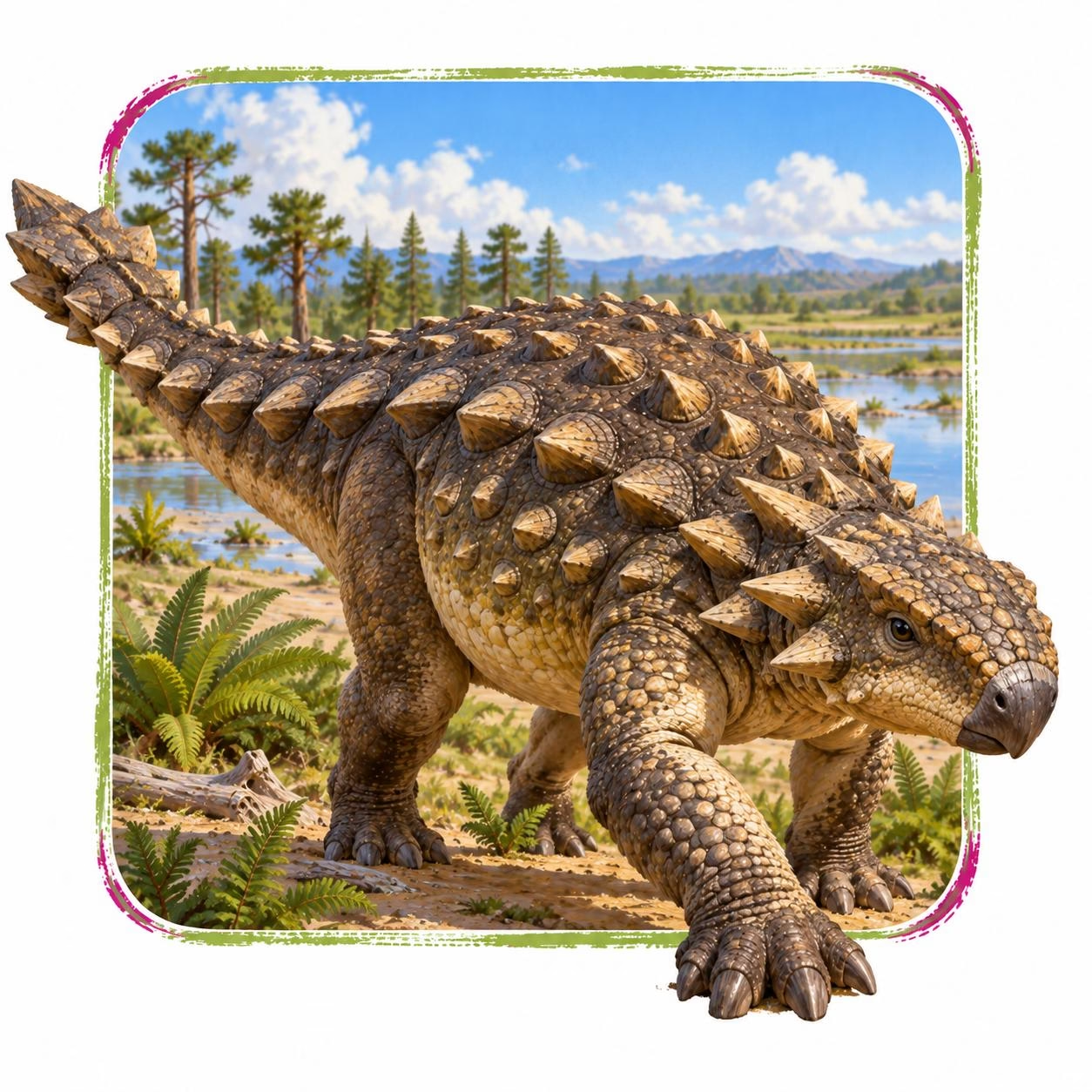
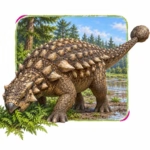
Nodosaurus in its natural Warm Cretaceous floodplains and coastal lowlands of western North America, inferred from the Frontier Formation habitat