
Palaeomastodon Facts for Kids
Palaeomastodon was an early elephantiform proboscidean that lived in North Africa during the Oligocene Epoch. It was not a modern elephant or true mastodon, but it showed several features that later became familiar in elephant relatives. Its skull probably supported a short muscular trunk, while an elongated lower jaw carried broad forward-pointing tusks beneath a pair of upper tusks.
Quick Palaeomastodon Facts
- Animal Type: Extinct proboscidean mammal
- Group: Early elephantiform
- Known For: Probable short trunk, upper and lower tusks, elongated jaw, ridged cheek teeth, and North African fossils
- Lived During: Oligocene, roughly 33–27 million years ago
- Diet: Leaves, twigs, and other plant material
What You’ll Learn
Learn 10 incredible palaeomastodon facts for kids about early trunks, tusks, sturdy bodies, plant diets, and elephant evolution, plus a quiz, glossary, and activity
Easy explanations make them perfect for children, families, teachers, and young fossil fans.
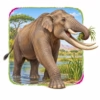
10 Fun Palaeomastodon Facts for Kids
1. Palaeomastodon Was an Elephantiform
Palaeomastodon belonged to Elephantiformes, an early proboscidean branch closer to later elephants than more primitive forms such as Moeritherium.
Kid Decode: It stood near a major bend in the road toward the elephant body plan.
2. It Lived in North Africa
Fossils are best known from the Fayum deposits of Egypt, with related material also reported from other parts of northern and eastern Africa.
Kid Decode: Its world lay among warm rivers, woodlands, wetlands, and desert-bound fossil beds.
3. It Was Not a True Mastodon
Despite its name meaning ancient mastodon, Palaeomastodon was not a member of the true mastodon family containing Mammut.
Kid Decode: The name points toward history, not a perfect family-tree label.
4. It May Have Stood About 2.2 Metres Tall
A large femur suggests that Palaeomastodon beadnelli reached about 2.2 metres at the shoulder and weighed more than 2.5 tonnes.
Kid Decode: This early elephant relative already carried several tonnes on column-like legs.
5. It Probably Had a Short Trunk
The nasal opening was pulled backward and surrounded by strong muscle attachment areas, supporting the presence of a muscular proboscis.
Kid Decode: The elephant nose was becoming a trunk, though probably not yet the full modern version.
6. It Had Upper and Lower Tusks
Paired tusks projected from both jaws, giving Palaeomastodon four enlarged incisor teeth.
Kid Decode: Its face arrived with twice the tusk locations of a living elephant.
7. The Lower Tusks Pointed Forward
Broad lower tusks sat close together at the end of the long jaw and projected ahead of the mouth.
Kid Decode: The lower jaw carried two ivory blades beneath the upper pair.
8. Its Lower Jaw Was Very Long
An elongated mandibular symphysis stretched forward, creating a much longer chin region than in modern elephants.
Kid Decode: Its chin kept travelling after the rest of the skull had nearly finished.
9. It May Have Had a Long Tongue
A deep groove along the top of the extended lower jaw has been interpreted as space for a long, mobile tongue.
Kid Decode: Trunk above and tongue below may have formed a two-part plant-gathering toolkit.
10. Its Cheek Teeth Had Ridges
Low-crowned lophodont premolars and molars carried transverse ridges that crushed plant food.
Kid Decode: Its back teeth turned leaves and twigs into manageable Oligocene mouthfuls.
The Weirdest Palaeomastodon Fact
Palaeomastodon probably combined a short trunk, a long tongue, and four tusks on one head, creating an elephant-like face that no living animal exactly matches.
Try This Palaeomastodon Activity
Palaeomastodon Drawing Activity
Draw Palaeomastodon beside an Oligocene Egyptian river. Add a 2.2-metre shoulder-height scale, sturdy legs, a probable short trunk, two upper tusks, two broad lower tusks, an elongated lower jaw, a long-tongue inset, ridged molars, palms, reeds, and warm woodland plants.
Quick Palaeomastodon Quiz
- Was Palaeomastodon a dinosaur? Answer: No, it was an early proboscidean mammal.
- Where are its best-known fossils found? Answer: The Fayum region of Egypt.
- How many pairs of tusks did it have? Answer: Two pairs, one upper and one lower.
- How tall may a large individual have stood? Answer: About 2.2 metres at the shoulder.
- What did its retracted nasal opening suggest? Answer: That it probably had a muscular trunk.
Mini Glossary
- Elephantiform: A proboscidean belonging to the branch containing later elephant-like forms.
- Proboscis: An elongated muscular nose or trunk.
- Mandibular Symphysis: The joined front section of the lower jaw.
- Lophodont: Having cheek teeth with raised ridges.
- Fayum: A fossil-rich region of Egypt famous for Oligocene mammals.
 Scarlet Macaw Facts for Kids
 Water Strider Facts for Kids
 Badger Facts for Kids
 Zuniceratops Facts for Kids
More Animal Facts for Kids
Visit the full animal facts library or explore a focused animal group.
More Extinct Animal Facts for Kids
Discover dinosaurs, Ice Age giants, prehistoric sea creatures, recently extinct species, and other animals from the past.
Fact check note: Fact checked with Andrews’ 1906 and 1908 descriptions of Fayum proboscideans, Tobien’s 1978 molar study, Larramendi’s 2016 body-size analysis, and Nabavizadeh’s 2024 review of proboscidean tusks and trunks.

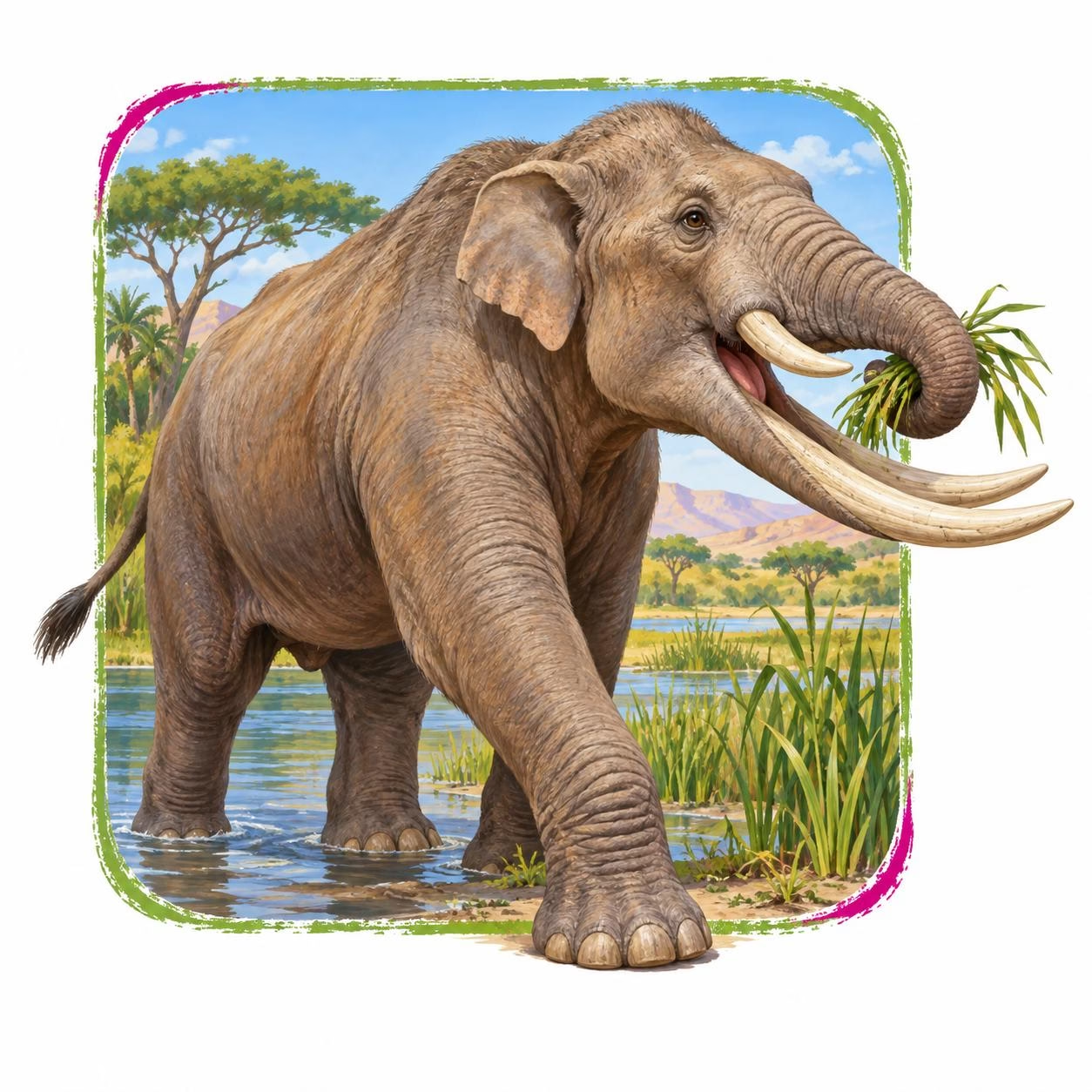
Palaeomastodon in its natural Oligocene river valleys, floodplains, wetlands, wooded lowlands, lake margins, and warm terrestrial habitats of North Africa habitat