
Pyrotherium Facts for Kids
Pyrotherium was a giant plant-eating South American mammal from the Late Oligocene. It looked somewhat elephant-like, but it was not an elephant or proboscidean. A massive skull, two pairs of upper tusks, one pair of lower tusks, ridged cheek teeth, and extremely robust weight-bearing bones made this fire beast one of the strangest large mammals in South American history.
Quick Pyrotherium Facts
- Animal Type: Extinct South American native ungulate
- Group: Pyrothere
- Known For: Six incisor tusks, possible short trunk, huge body, bilophodont teeth, and extremely dense limb bones
- Lived During: Late Oligocene, roughly 29–24 million years ago
- Diet: Leaves, branches, and other vegetation; species ranged from browsing to mixed feeding
What You’ll Learn
Learn 10 remarkable pyrotherium facts for kids about tusks, elephant-like appearance, strong legs, plant diets, and prehistoric South America, plus a quiz, glossary, and activity
Clear explanations make them fun for children, families, teachers, and young fossil explorers.

10 Fun Pyrotherium Facts for Kids
1. Pyrotherium Was a Pyrothere
It belonged to Pyrotheria, an entirely extinct group of large South American mammals.
Kid Decode: Its evolutionary branch ended without leaving a living animal that matches it.
2. It Was Not an Elephant
Pyrotherium evolved an elephant-like body, tusks, and possibly a trunk independently from true proboscideans.
Kid Decode: The silhouette copied an elephant while the family tree took a completely different road.
3. Its Name Means Fire Beast
The first fossils came from rocks rich in volcanic ash, inspiring a name built from words meaning fire and beast.
Kid Decode: The animal was not fiery, but its fossil bed certainly had volcanic flair.
4. Pyrotherium romeroi Was Enormous
Pyrotherium romeroi reached roughly 3 metres or more in length and has been estimated near 3,500 kilograms.
Kid Decode: It carried several tonnes through Oligocene South America on immensely strong limbs.
5. It Had Six Tusk-Like Incisors
Two pairs of upper incisors and one pair of lower incisors became enlarged into prominent tusks.
Kid Decode: Its face brought six ivory tools, a configuration no living elephant can match.
6. It May Have Had a Short Trunk
Retracted nostrils and rough areas for muscle attachment suggest a proboscis, but its exact length and shape are unknown.
Kid Decode: The skull leaves a trunk-shaped clue without preserving the trunk itself.
7. Its Skull Was Massive
The best-known Pyrotherium romeroi skull measured about 72 centimetres long and was built from thick robust bones.
Kid Decode: Its head was almost as long as a small dining table is wide.
8. Its Molars Had Two Ridges
Bilophodont cheek teeth carried two major transverse ridges that crushed plant material during chewing.
Kid Decode: Each back tooth worked like a pair of raised chopping bars.
9. Its Bones Were Extremely Dense
Long-bone microstructure shows thick compact tissue and heavy internal reinforcement suited to supporting enormous weight.
Kid Decode: The skeleton was less lightweight frame and more stone bridge engineering.
10. Its Diet Varied Between Species
Recent mesowear research identifies P. romeroi mainly as a browser, while P. macfaddeni probably ate a browse-dominated mixed diet containing more abrasive plants.
Kid Decode: Two fire beasts could carry similar tusks while choosing different sections of the plant buffet.
The Weirdest Pyrotherium Fact
Pyrotherium carried six tusk-like incisors and may have had a short trunk, yet these elephant-like features evolved in a mysterious South American group unrelated to elephants.
Try This Pyrotherium Activity
Pyrotherium Drawing Activity
Draw Pyrotherium crossing a Late Oligocene South American woodland. Add a giant heavy body, short powerful legs, a massive skull, four upper tusks, two lower tusks, a cautious short trunk, bilophodont molars in a cutaway, volcanic ash layers, leafy branches, and a “not an elephant” sign.
Quick Pyrotherium Quiz
- Was Pyrotherium an elephant? Answer: No, it belonged to the extinct order Pyrotheria.
- What does its name mean? Answer: Fire beast.
- How many tusk-like incisors did it have? Answer: Six, with two upper pairs and one lower pair.
- How heavy was P. romeroi estimated to be? Answer: Around 3,500 kilograms.
- What did recent tooth-wear research suggest about P. romeroi? Answer: It was mainly a browser.
Mini Glossary
- Pyrothere: A member of an extinct order of large South American mammals.
- Bilophodont: Having cheek teeth with two main transverse ridges.
- Incisor Tusk: An enlarged front tooth projecting beyond the mouth.
- Graviportal: Built with strong limbs for supporting great body weight.
- Mesowear: Tooth-wear evidence used to reconstruct an herbivore’s long-term diet.
 American Tree Sparrow Facts for Kids
 Cockroach Facts for Kids
 Bumblebee Facts for Kids
 Ouranosaurus Facts for Kids
More Animal Facts for Kids
Visit the full animal facts library or explore a focused animal group.
More Extinct Animal Facts for Kids
Discover dinosaurs, Ice Age giants, prehistoric sea creatures, recently extinct species, and other animals from the past.
Fact check note: Fact checked with Billet’s 2010 Pyrotherium skull study, Shockey and Anaya’s 2004 description of P. macfaddeni and pyrothere feet, Houssaye and colleagues’ 2016 bone-microstructure study, and Wilson and colleagues’ 2026 mesowear analysis.

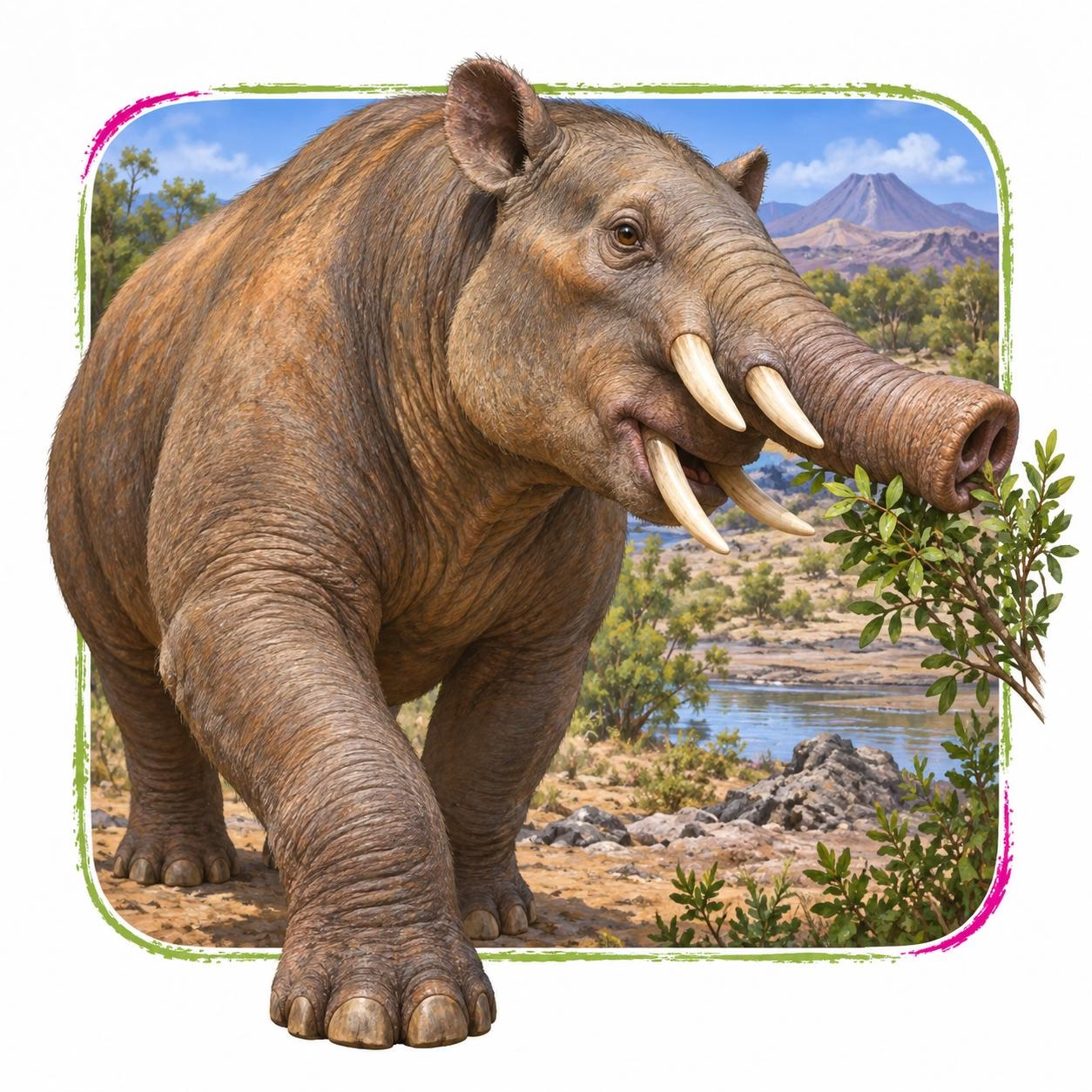
Pyrotherium in its natural Late Oligocene forests, wooded lowlands, semi-arid valleys, river basins, volcanic-ash landscapes, and terrestrial habitats of Argentina and Bolivia habitat