
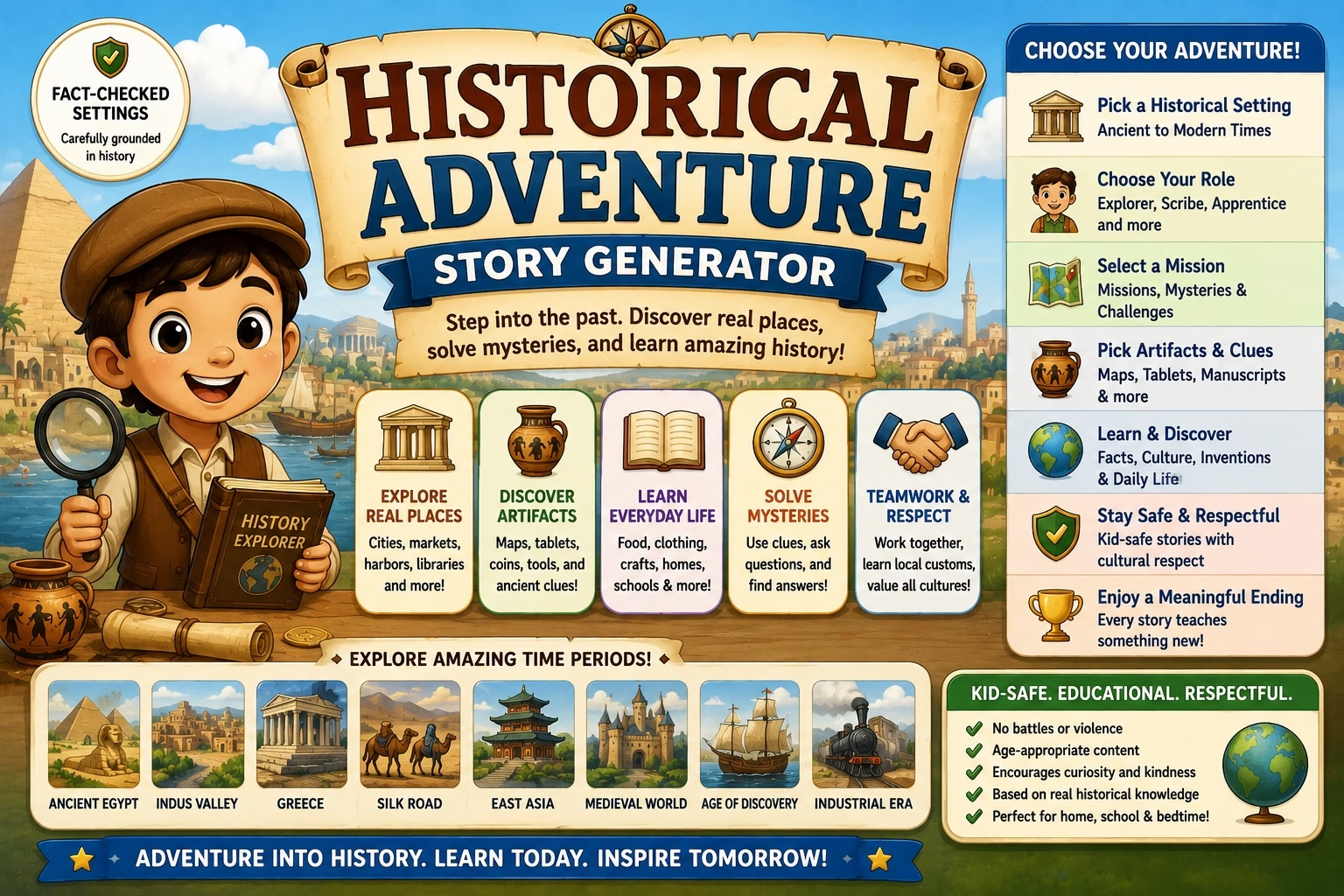
Historical Adventure Story Generator
Create a kid-friendly historical adventure with carefully grounded settings, everyday life, artifacts, trade, inventions, culture, mysteries, and age-appropriate history.
AI Historical Adventure Story Generator for Kids
Our AI historical adventure story generator creates personalized children’s stories set in carefully chosen places and periods from the past. Children can explore ancient cities, trade routes, libraries, workshops, farms, ports, observatories, markets, early railways, and other historically inspired settings.
Choose the historical period, child’s role, daily-life focus, mission, artifact, evidence type, lesson, language, reading level, and story length. The generator then creates a kid-friendly historical adventure shaped around those choices.
Explore ancient Egypt, the Indus Valley, Abbasid Baghdad, Great Zimbabwe, Edo Japan, the Silk Road, the early railway age, and more.
Use maps, pottery, manuscripts, artifacts, trade records, architecture, textiles, photographs, and other clues.
Stories emphasize everyday life, cultural respect, historical uncertainty, safe exploration, and multiple viewpoints.
Create a Personalized Historical Adventure
A personalized historical story places the child inside a carefully framed adventure from the past. They might become a junior scribe helper, market record assistant, map reader, artifact detective, astronomy observer, library helper, young navigator, or museum portal visitor.
The mission may involve tracing a trade route, identifying an artifact, organizing manuscripts, completing a city map, investigating an old measurement, preparing a festival, or discovering how water reached a historical community.
How the Historical Story Generator Works
Select the historical setting, story style, main location, child role, guide, companion, daily-life theme, learning focus, artifact, writing system, craft, transportation, evidence type, cultural-respect focus, safety boundary, lesson, and ending.
A manuscript mystery in Abbasid Baghdad will feel different from an Indus Valley city-map adventure, a Silk Road trading journey, a Great Zimbabwe architecture mystery, or an early railway story involving an old timetable.
Historical story details you can customize
- The child’s name and age group
- The civilization, place, and approximate period
- The child’s historical role
- The guide and local companion
- The historical mission and mystery
- The artifact, writing system, or craft
- The evidence and cultural-respect focus
- The lesson, language, reading level, and story length
Historically Grounded Stories for Kids
The generator is designed to produce historically grounded stories for kids rather than loose costume adventures. Stories should use period-appropriate transport, tools, clothing, food, architecture, materials, and social settings.
Modern slang, smartphones, engines, foods, scientific knowledge, and other later inventions should not appear unless the child is explicitly a time traveler noticing the difference.
Ancient Civilization Adventures
Children can explore historically inspired stories set in ancient Egypt, Mesopotamia, Nubia and Kush, the Indus Valley, ancient Greece, the Roman-era Mediterranean, Han China, Gupta-era India, Classic Maya cities, or the Inca road network.
Rather than centering every story on kings and rulers, the generator focuses on families, craftspeople, scribes, traders, farmers, builders, learners, navigators, and other people whose everyday work helped communities function.
Trade Route and Marketplace Stories
Historical trade adventures can explore marketplaces, caravans, river ports, harbors, merchant records, trade weights, textiles, maps, spices, pottery, and goods moving between communities.
The child may help identify a mixed-up market label, match a seal with a ledger, trace a route, or discover that an ordinary trade record reveals an important connection between distant places.
Historical Mystery Stories
A historical mystery can begin with a damaged map, missing manuscript page, unusual pottery pattern, misplaced artifact label, trade weight, railway ticket, carved symbol, or old photograph.
The child compares evidence, asks a knowledgeable guide, and learns that different clues may tell different parts of the story. Sometimes the responsible ending is not a perfect answer, but a clear explanation of what is known and what remains uncertain.
Everyday Life in the Past
Historical adventures can explore how people learned, traveled, traded, prepared food, managed water, made clothing, produced books, built homes, recorded information, and celebrated important occasions.
This daily-life focus helps children understand that history includes more than wars, rulers, and famous events. Ordinary people, family routines, tools, crafts, and community work also shaped the past.
Artifacts and Historical Evidence
Stories can include clay tablets, scrolls, manuscripts, maps, pottery, textiles, trade weights, coins, architectural plans, railway tickets, early photographs, and museum catalog cards.
The child may compare an object with written records, architecture, maps, or archaeological evidence. The story should never encourage children to remove artifacts, enter restricted sites, damage ruins, or treat sacred objects as treasure.
Myths, Legends and Historical Facts
Myths and legends can appear as stories, beliefs, or traditions connected with a culture, but they should not automatically be presented as verified historical events.
The generator also avoids claims about aliens building monuments, imaginary advanced civilizations, fabricated archaeological discoveries, or famous people revealing invented secrets.
Kid-Safe Historical Adventures
Historical settings may include difficult subjects, but this generator keeps the child away from battles, executions, dangerous voyages, hazardous workshops, forced labor, graphic illness, and other disturbing situations.
Children can observe, record, organize, investigate, ask questions, draw maps, compare evidence, and complete safe tasks beside responsible guides.
Culturally Respectful Historical Fiction
The generator should use respectful historical names, avoid labels such as “primitive” or “uncivilized,” and recognize that societies changed over time.
Historical empires and rulers should not be presented as uniformly heroic. Stories can acknowledge inequality, conquest, or injustice briefly and honestly without making those subjects into exciting entertainment or asking the child to solve adult historical problems.
Historical Story Ideas
- An Indus Valley city-map mystery
- A missing manuscript page in Abbasid Baghdad
- A Silk Road trade-route adventure
- An ancient Egyptian market-record mystery
- A Great Zimbabwe architecture investigation
- A Polynesian navigation observation story
- An Edo-period printing workshop mystery
- A Maya astronomy-chart adventure
- An early railway timetable mystery
- A museum portal story involving a mislabeled artifact
Historical Stories in Multiple Languages
This AI historical adventure generator supports English, Spanish, French, German, Italian, Portuguese, Dutch, and Arabic.
You can also select the reading level and story length, making it suitable for younger listeners, independent readers, classroom read-alouds, history projects, and multilingual learning.
Why Use an AI Historical Story Generator?
An AI historical story generator gives parents and teachers control over the period, setting, child role, daily-life theme, evidence, mystery, lesson, language, and ending.
The finished story can be used for classroom reading, history-unit introductions, museum preparation, homeschool activities, creative writing, bedtime, and discussions about how historians study evidence.
More Historical Adventure Ideas
- Trace an old trading route using two map fragments.
- Discover how water reached an ancient city.
- Correct a museum label using pottery and written records.
- Help organize books in a historical library.
- Investigate an object whose exact purpose remains uncertain.
Historical Adventure Story Generator FAQ
What is a historical adventure story generator?
It is an AI tool that creates personalized children’s stories set in historical places and periods using everyday life, artifacts, maps, crafts, evidence, mysteries, and age-appropriate learning.
Are the stories historically accurate?
The generator is instructed to use historically suitable details, avoid anachronisms, and acknowledge uncertainty. Important educational use should still include review against reliable museum, archive, or scholarly sources.
Which historical settings can I choose?
Options include ancient Egypt, the Indus Valley, Mesopotamia, Han China, Great Zimbabwe, Abbasid Baghdad, the Mali Empire, Edo Japan, Mughal India, the Silk Road, the early railway age, and more.
Can I create a time-travel story?
Yes. The child can visit the past, learn local customs, and observe historical life, but should not change major events or receive credit for real inventions.
Can the story include famous historical people?
The generator focuses mainly on everyday people. It avoids fabricated quotations, invented private conversations, and unsupported secrets involving real historical figures.
Are the stories safe for children?
Yes. Stories avoid graphic warfare, executions, torture, dangerous labor, serious disease scenes, cultural mockery, and children being placed inside violent historical events.
How does the generator handle uncertain history?
When evidence is incomplete or disputed, the story should explain that historians are uncertain or that more than one interpretation exists.
Can I make historical stories in different languages?
Yes. The generator supports English, Spanish, French, German, Italian, Portuguese, Dutch, and Arabic.
What details can I customize?
You can customize the historical period, place, child role, guide, mission, daily-life theme, artifact, craft, transportation, evidence, safety boundary, lesson, ending, language, reading level, and story length.