
Clam Facts for Kids
Clam is a broad everyday name for many bivalve mollusks with soft bodies protected by two hinged shells. Clams live in oceans, estuaries, rivers, and lakes, from sandy beaches and mudflats to deep water. Many burrow with a muscular foot and use siphons to move water, while their gills collect oxygen and tiny food particles. Because clam is not one formal scientific group, shell shape, size, diet, lifespan, movement, and reproduction vary enormously.
Quick Clam Facts
- Animal Type: Invertebrate
- Group: Broad common-name group within the bivalve mollusks
- Known For: Two hinged shells, gills, filter feeding, siphons, and burrowing feet
- Habitat: Oceans, estuaries, beaches, mudflats, rivers, lakes, and deep seafloors
- Diet: Mostly plankton, microscopic algae, bacteria, and suspended organic particles, with specialised exceptions
What You’ll Learn
Explore 10 fascinating clam facts for kids about shells, siphons, filter feeding, digging, and life in oceans and freshwater, plus a quiz, glossary, and activity
Clear explanations make them fun for children, families, teachers, and young nature explorers.
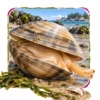
10 Fun Clam Facts for Kids
1. A Clam Has Two Hinged Shells
The word bivalve means two valves. A flexible ligament joins the shells at the hinge, while strong adductor muscles pull them tightly closed around the soft body.
Kid Decode: The clam lives inside a two-door house whose muscles act as the lock.
2. The Mantle Builds the Shell
A thin tissue called the mantle secretes calcium carbonate and proteins that enlarge and repair the shell. Growth lines may record changing seasons or conditions, but one visible ring does not always equal exactly one year.
Kid Decode: The animal grows its own stone-like house from the inside wall outward.
3. Gills Handle Breathing and Feeding
Water passing across the gills supplies oxygen. In many clams, mucus and tiny hair-like cilia also trap suspended food and carry it toward the mouth.
Kid Decode: One feathery organ works as both breathing equipment and a microscopic lunch net.
4. Siphons Work Like Underwater Snorkels
Many buried clams extend one siphon to draw water inward and another to release it. The siphons let the animal remain safely below the sediment while still breathing and feeding.
Kid Decode: Two soft tubes connect a buried clam to the watery world above the sand.
5. A Muscular Foot Can Dig
Many clams push a wedge-shaped muscular foot into sand or mud, expand it, and pull the shell downward. Some species dig rapidly, while others move slowly or live attached, wedged, or exposed.
Kid Decode: The shell may look stationary, but a hidden foot can operate a tiny underground elevator.
6. Most Clams Filter Tiny Food
Many clams filter plankton, microscopic algae, bacteria, and organic particles from water. The amount they process depends on species, temperature, currents, oxygen, and food availability.
Kid Decode: A clam turns passing water into a moving buffet of particles too small for us to see.
7. Clams Do Not Have a Radula
Most mollusks possess a rasping ribbon of teeth called a radula, but bivalves lost this structure during evolution. Filter-feeding gills replaced the need for scraping food with a tongue-like file.
Kid Decode: The clam skipped the tooth-ribbon and let its gills handle dinner instead.
8. Some Clams Make Pearls
An irritant or parasite can become coated with layers of shell material, producing a pearl. Many bivalves can form pearl-like objects, but perfectly round valuable pearls are rare and not every clam uses shiny nacre.
Kid Decode: A pearl is a biological wrapping job, not simply a grain of sand wearing glitter.
9. Giant Clams Farm Microscopic Partners
Giant clams contain photosynthetic algae-like partners inside their tissues. Sunlight helps these symbionts make nutrients, while the clam still filter feeds and supplies them with a protected home and useful chemicals.
Kid Decode: The giant clam runs a sun-powered garden inside its colourful living tissue.
10. Clam Babies Often Drift Before Settling
Many species release eggs and sperm into water, producing microscopic larvae that swim or drift before growing a shell and settling. Other clams brood young or use specialised reproductive strategies, especially in freshwater.
Kid Decode: A future burrower may begin life as a tiny traveller floating through the water.
The Weirdest Clam Fact
Some giant clams obtain part of their nutrition from microscopic photosynthetic partners living inside their tissues, turning sunlight into fuel within the body of a filter-feeding animal.
Try This Clam Activity
Clam Cutaway Drawing Activity
Draw a cutaway clam buried in sand. Label the two shell valves, hinge ligament, mantle, adductor muscles, gills, mouth, muscular foot, incoming siphon, outgoing siphon, and water-flow arrows. Add plankton, a drifting larva, a pearl-forming inset, and a colourful giant clam with microscopic sun-powered partners.
Quick Clam Quiz
- What does bivalve mean? Answer: An animal with two shell valves.
- Which organ makes a clam’s shell? Answer: The mantle.
- What do siphons move? Answer: Water entering and leaving the clam.
- What body part helps many clams burrow? Answer: A muscular foot.
- Do all clams make valuable round pearls? Answer: No.
Mini Glossary
- Bivalve: A mollusk protected by two hinged shell valves.
- Mantle: The tissue that surrounds the body and secretes the shell.
- Siphon: A tube that moves water into or out of the body.
- Adductor Muscle: A muscle that pulls the two shell valves closed.
- Symbiosis: A close relationship between organisms of different species.
 American Tree Sparrow Facts for Kids
 Blue-Tongued Skink Facts for Kids
 Portuguese Man o' War Facts for Kids
 Xiphactinus Facts for Kids
More Animal Facts for Kids
Visit the full animal facts library or explore a focused animal group.
More Extinct Animal Facts for Kids
Discover dinosaurs, Ice Age giants, prehistoric sea creatures, recently extinct species, and other animals from the past.
Fact check note: Fact checked with NOAA National Ocean Service’s bivalve overview, University of California Museum of Paleontology’s Bivalvia account, Smithsonian National Museum of Natural History material on pearl formation, and comparative molluscan research on gills, siphons, burrowing, larvae, and giant-clam symbiosis.

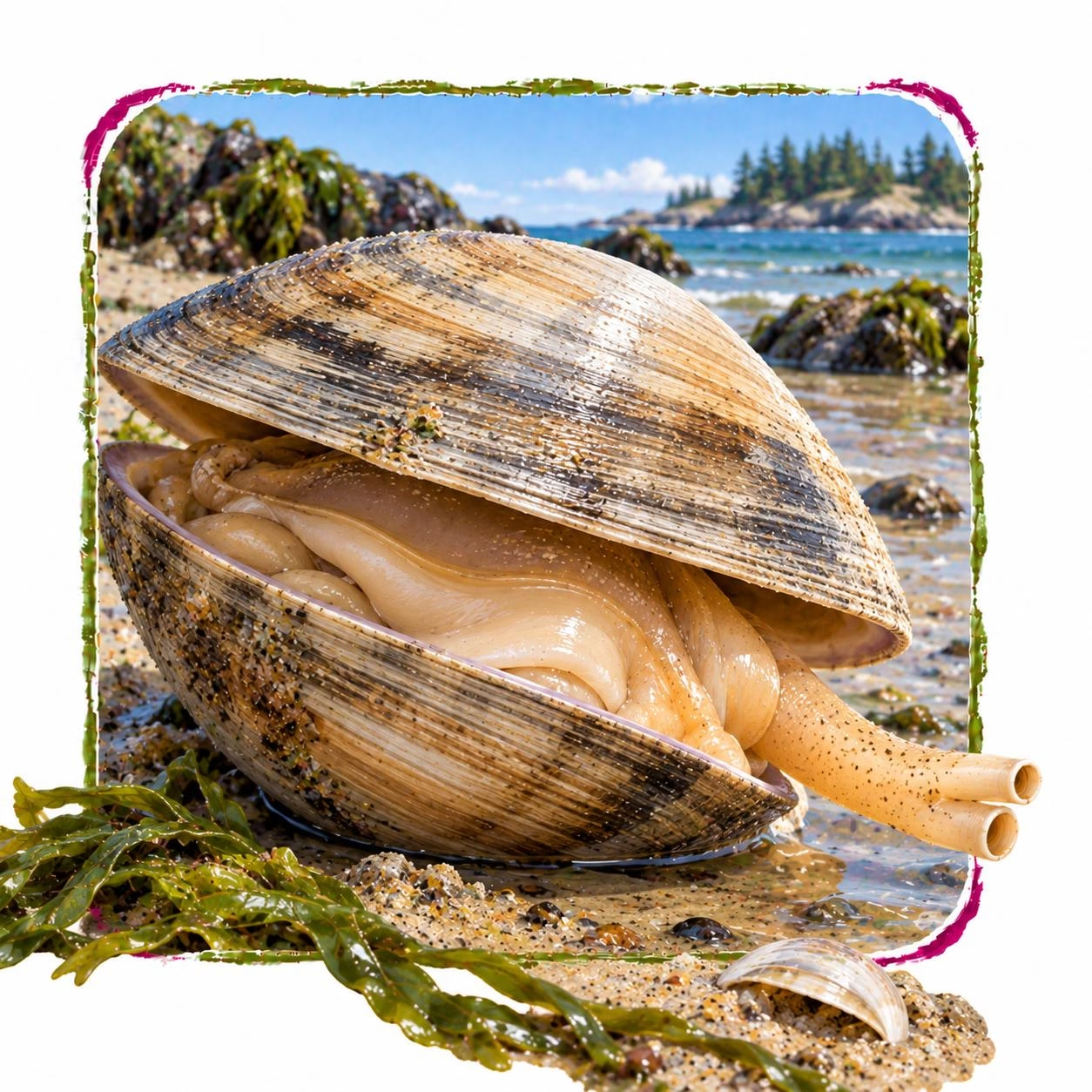
Clam in its natural Oceans, estuaries, sandy beaches, mudflats, rocky shores, deep seafloors, rivers, streams, and lakes worldwide habitat