
Axolotl vs Salamander: Salamander Species Comparison
An axolotl is a salamander, not a separate kind of amphibian. It is one unusual Mexican mole salamander that becomes capable of breeding while retaining larval features such as feathery external gills and a tail fin. Many other salamanders undergo more obvious metamorphosis, lose their external gills, and spend at least part of adulthood on land.
About Axolotl
- Type Amphibian
- Diet Carnivore
- Group Mole Salamander
- Known for Feathery external gills, lifelong aquatic living, neoteny, regeneration, wide heads, and Mexican lake history
- Special skill Keeping larval features as an adult and regenerating limbs, gills, and parts of several organs
About Salamander
- Type Amphibian
- Diet Carnivore
- Group Caudate
- Known for Adult tails, moist skin, crawling or swimming, diverse breathing methods, metamorphosis, and regeneration in many species
- Special skill Adapting to aquatic, terrestrial, arboreal, cave, or underground life and regenerating tissues in many species
Axolotl vs Salamander: Quick Answer
Every axolotl is a salamander, but most salamanders are not axolotls. Axolotls normally remain fully aquatic and keep external gills, a finned tail, and other juvenile traits as reproductive adults—a condition called neoteny. Other salamanders have many life cycles; most transform more fully, while some remain aquatic or retain larval traits too.
Where Do They Fit?
Follow the branches to see how Axolotl and Salamander are classified and related.
Axolotl vs Salamander: Quick Comparison
| Feature | Axolotl | Other Salamanders |
|---|---|---|
| Animal type | Amphibian | Amphibian |
| Animal group | One mole salamander species | The broad amphibian order Caudata |
| Known for | External gills, neoteny, aquatic life, and remarkable regeneration | Adult tails, diverse life cycles, moist skin, and many habitats |
| Main habitat | Cool freshwater canals and remaining wetlands around Xochimilco, Mexico | Moist forests, streams, ponds, caves, trees, and underground habitats |
| Adult lifestyle | Fully aquatic | Aquatic, terrestrial, semiaquatic, arboreal, or underground depending on species |
| Adult gills | Three feathery external gill branches on each side of the head | Often lost during metamorphosis, though some species retain gills |
| Metamorphosis | Normally remains neotenic and keeps larval features | Usually changes more fully, with important exceptions |
| Natural range | Extremely restricted area in Mexico City | Much of the Northern Hemisphere and parts of tropical America |
| Baby name | Larva or juvenile | Larva |
| Special skill | Regenerating limbs and complex tissues with little scarring | Many forms of regeneration, breathing, burrowing, climbing, and swimming |
How Are Axolotls and Other Salamanders Alike?
- Axolotls are salamanders, so both belong to the amphibian order Caudata.
- Both have long tails, moist permeable skin, and four limbs in their usual body plan.
- Both are ectotherms and require suitable environmental temperatures.
- Both are carnivores that eat worms, insects, crustaceans, mollusks, or other small animals.
- Both can regenerate damaged tissues, although the ability varies greatly by species and body part.
How Are Axolotls and Other Salamanders Different?
- Axolotls are one Mexican species, while salamander describes a diverse order containing many species.
- Axolotls remain aquatic throughout life, while many other salamanders live mainly on land as adults.
- Adult axolotls keep large external gills, while many salamanders lose external gills during metamorphosis.
- Axolotls naturally retain a larval-looking body as breeding adults, while most salamanders transform more completely.
- Wild axolotls have an extremely restricted range, while salamanders collectively occupy several continents.
Axolotl vs Salamander Showdown
Amphibian showdown: The broader salamander order wins size, speed, and strength because it includes giant river species and many agile land, stream, and tree specialists. The axolotl takes stealth with wild mottled coloring that blends into muddy vegetation. Social life is a tie because both are generally solitary. The axolotl wins swimming because its entire body remains specialized for aquatic life, and it takes our weirdest-fact prize for becoming a reproductive adult without giving up its feathery larval gills.
Fun Axolotl vs Salamander Facts
An Axolotl Is a Salamander
The axolotl’s scientific name is Ambystoma mexicanum, placing it among mole salamanders. Comparing an axolotl with a salamander is like comparing a penguin with a bird: the first animal is one unusual member of the larger group.
Adult Body with Larval Features
Neoteny means reaching reproductive maturity while keeping juvenile characteristics. An adult axolotl retains external gills, a fin running along the tail, aquatic skin, and a body form resembling the larvae of closely related salamanders.
Water Forever vs Many Life Routes
Axolotls normally remain in water from hatching through adulthood. Many other salamanders begin as aquatic larvae and later move onto land, while lungless salamanders may develop directly inside eggs and mudpuppies, sirens, and some others also remain aquatic.
Wild Axolotls Are Dark, Not Usually Pink
Wild axolotls are generally dark brown, gray, or olive with mottling that helps them blend into muddy water. Pale pink, white, golden, and other colors commonly seen online are mostly captive-bred color forms.
Axolotls Rebuild Complex Parts
Axolotls can regenerate limbs, gills, tail tissue, parts of the spinal cord, and portions of some organs. Scientists study how cells rebuild these structures with little scarring, although this research does not yet let humans regrow limbs.
Axolotl vs Salamander Quiz
- Is an axolotl a salamander? Answer: Yes.
- What are the feathery structures beside an axolotl’s head? Answer: External gills.
- What does neoteny mean? Answer: Reaching adulthood while retaining juvenile traits.
- Where are wild axolotls native? Answer: The freshwater wetlands and canals of Mexico City.
- Are wild axolotls normally bright pink? Answer: No; they are usually dark and mottled.
Axolotl vs Salamander FAQ
What is the main difference between an axolotl and a salamander?
An axolotl is one salamander species that normally remains aquatic and keeps external gills as an adult. Salamander is the broader group containing axolotls, newts, hellbenders, mudpuppies, sirens, and many land-dwelling species.
Does an axolotl ever become a salamander?
It is already a salamander from the moment it begins developing. It does not need to lose its gills or move onto land to belong to the salamander order.
Can axolotls breathe air?
Axolotls mainly use external gills and their skin in water, but they also develop lungs and may gulp air at the surface.
Can all salamanders regrow limbs like axolotls?
Many salamanders regenerate limbs or tails, but speed, accuracy, and the body parts involved differ by species, age, and health.
Why are wild axolotls endangered?
Their tiny remaining habitat is damaged by urban growth, pollution, altered water systems, and introduced fish that eat young axolotls or compete for food.
Animal Words to Know
- Neoteny: Reaching reproductive adulthood while retaining juvenile body features.
- External gill: A feathery breathing organ projecting outside the body.
- Metamorphosis: A major developmental change from larval form to adult form.
- Caudata: The amphibian order containing salamanders and newts.
- Regeneration: The biological rebuilding of a damaged or missing body structure.
Axolotl and Salamander Life-Cycle Activity
Axolotl and Salamander Life-Cycle Activity
Draw an adult axolotl underwater beside the life cycle of a tiger salamander. Keep feathery external gills and a tail fin on the adult axolotl. Show the tiger salamander as a gilled aquatic larva and then as a land-dwelling adult after metamorphosis. Add a bracket showing that the axolotl is also a salamander. Label axolotl, salamander, gills, larva, adult, and metamorphosis.
Meet Each Animal
Want the full fact file? Here are quick highlights from each animal’s own facts page.
Axolotl Fact Highlight
From the full animal facts page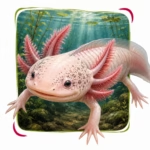
Salamander Fact Highlight
From the full animal facts page
More Animal Comparisons
Pick another animal matchup and keep exploring. Compare appearances, habitats, diets, abilities, and surprising differences.





Make an Animal Story
Turn this axolotl vs salamander comparison into a mysterious Mexican lake adventure with our free Animal Story Generator.
Source notes: References used for this comparison. See more See less
Try Another Matchup
Explore this comparison →