
Bengal Tiger vs Siberian Tiger: Warm-Mangrove-to-Cold-Forest Tiger Comparison
Bengal and Siberian tigers are regional populations of the same striped cat species, not two different tiger species. Bengal tigers live in South Asian habitats ranging from hot dry forest and tall grass to tidal mangrove. Siberian tigers are better called Amur tigers and live in cold temperate forests of Russia and northeastern China. Amur tigers are traditionally considered the largest and wear a paler, thicker winter coat; Bengal tigers often look richer orange and include the unusually water-adapted Sundarbans population.
About Bengal Tiger
- Type Mammal
- Diet Mostly large and medium hoofed mammals such as chital, sambar, wild pig, gaur, barasingha, nilgai, and young wild buffalo where available, plus smaller animals when opportunity requires; it stalks under cover, rushes from close range, and usually kills with a throat or neck bite
- Group Bengal tiger, the traditional South Asian tiger subspecies Panthera tigris tigris; all Bengal and Amur or “Siberian” tigers belong to the single living species Panthera tigris, while specialists continue to review whether mainland populations should be divided into several subspecies or grouped within P. t. tigris
- Known for A powerfully built tiger with males in many studied populations commonly around 180–260 kilograms and females often around 100–160 kilograms, although mass, length, and body condition vary greatly by sex, age, prey, habitat, season, and measurement method; very large historical or exceptional animals should not be treated as typical
- Special skill Orange-and-black disruptive stripes, padded paws, retractable claws, a flexible spine, powerful forelimbs and jaws, binocular night vision, sensitive whiskers, excellent hearing, a rough tongue, and an acute sense of smell support close ambush. Bengal populations add habitat-specific skills, from tall-grass stalking to routine channel swimming in the amphibious Sundarbans landscape.
About Siberian Tiger
- Type Mammal
- Diet Primarily wild boar and deer such as red deer, sika deer, and roe deer, with other mammals including musk deer and occasionally larger or smaller prey; like every tiger, it stalks silently, closes the distance under cover, then uses a short rush, forelimb grip, and powerful neck bite
- Group Siberian tiger, more accurately called the Amur tiger, traditionally Panthera tigris altaica; “Siberian” remains familiar but the surviving wild population is centered in the Amur–Ussuri region of the Russian Far East and northeastern China rather than spread across all of Siberia
- Known for The largest traditionally recognized tiger form, with a long heavy body and adult males often cited around 180–300 kilograms and females around 100–170 kilograms, while modern wild samples overlap strongly with large Bengal tigers; food supply, sex, season, and population history matter more than sensational record weights
- Special skill A paler winter coat with long dense fur, a thick belly layer, more white around the underside and face, broad furred paws that spread weight on snow, powerful shoulders, retractable claws, and an insulating fat layer help in severe cold. Long-distance travel, snow-path selection, camouflage in winter-bare forest, and the standard tiger swimming and ambush toolkit complete the adaptation set.
Bengal Tiger vs Siberian Tiger: Quick Answer
A Bengal tiger and a Siberian tiger are both Panthera tigris. The Bengal tiger lives in South Asia and uses forests, grasslands, floodplains, and mangroves. The “Siberian” tiger—more accurately the Amur tiger—survives in the colder forests of far-eastern Russia and northeastern China. Amur tigers are traditionally the largest form and have a paler, thicker winter coat, but their body sizes overlap with large Bengal tigers.
Where Do They Fit?
Follow the branches to see how Bengal Tiger and Siberian Tiger are classified and related.
Bengal Tiger vs Siberian Tiger: Quick Comparison
| Feature | Bengal Tiger | Siberian or Amur Tiger |
|---|---|---|
| Scientific identity | Panthera tigris tigris in traditional taxonomy | Panthera tigris altaica in traditional taxonomy |
| Species | Panthera tigris | Panthera tigris |
| Main wild region | India, Nepal, Bhutan, and Bangladesh | Russian Far East and northeastern China |
| Habitat clue | Tropical and subtropical forest, grassland, floodplain, dry forest, and mangrove | Cold temperate pine-broadleaf forest, river valleys, mountains, and snowy woodland |
| Size clue | Very large; males in many populations commonly around 180–260 kg | Traditionally the largest form; males often cited around 180–300 kg, with strong overlap |
| Coat clue | Often richer orange with dark bold stripes and a shorter warm-climate coat | Often paler, with a longer denser winter coat and more extensive pale underside |
| Main prey clue | Chital, sambar, wild pig, gaur, and other regional hoofed mammals | Wild boar, red deer, sika deer, roe deer, and other northern mammals |
| Water clue | Strong swimmer; Sundarbans tigers routinely cross tidal channels | Strong swimmer that can cross rivers and lakes |
| Snow clue | Some Himalayan-edge populations meet cool winters, but most do not live in deep-snow habitat | Broad furred paws, dense coat, and route choice help in snow |
| Other name clue | Royal Bengal tiger is a familiar regional name | Amur tiger is more accurate than Siberian tiger for the surviving range |
How Are Bengal and Siberian Tigers Alike?
- Both are Panthera tigris: warm-blooded carnivorous mammals in family Felidae with the same basic tiger skeleton, senses, roar, retractable claws, and ambush-hunting plan.
- Both have unique dark stripe patterns over orange-to-pale fur, white undersides, eye-like white ear spots, padded paws, powerful forelimbs, long canines, and rough tongues.
- Both are mainly solitary, communicate through scent and scratch marks, hunt mostly at twilight or night, and rely on a mother to raise and teach cubs for about two years.
- Both can swim well, cross rivers, cool off in water, and use dense vegetation or broken shadow to approach prey before a short explosive rush.
- Both are endangered by poaching, prey loss, habitat fragmentation, roads, and conflict with people, so connected protected landscapes are essential to their recovery.
How Are Bengal and Siberian Tigers Different?
- Bengal tigers live on the Indian subcontinent; Amur tigers live much farther north in the Russian Far East and northeastern China, and their natural breeding ranges do not meet.
- Bengal habitat stretches from hot dry forest and tropical jungle to tall floodplain grass and saltwater mangrove; Amur habitat is cold temperate woodland with snowy mountains and river valleys.
- Amur tigers are traditionally described as the largest tiger form, but modern wild Bengal and Amur size ranges overlap, so a subspecies label cannot predict every individual’s mass.
- An Amur tiger generally grows a longer, denser, paler winter coat and carries more cold-weather insulation; a Bengal tiger usually has a shorter, richer-orange coat suited to warmer climates.
- Bengal tigers often hunt chital, sambar, gaur, and wild pig; Amur tigers depend heavily on wild boar plus northern deer such as red, sika, and roe deer.
- Some Bengal tigers in the Sundarbans lead an amphibious life among tidal creeks and mangrove islands; Amur tigers cross water too, but their most distinctive challenge is traveling and hunting across cold, snowy, low-prey forest.
Bengal Tiger vs Siberian Tiger Adaptation Showdown
Warm-mangrove versus cold-forest adaptation showdown: Siberian or Amur tiger receives cautious size and strength wins because it is traditionally the largest tiger form and often has the heavier cold-climate build, but modern wild measurements overlap substantially with Bengal tigers. Speed is a tie because both use the same explosive tiger body plan and no standardized same-condition subspecies race exists. Stealth is a tie: Bengal stripes dissolve in grass, leaf shadow, and mangrove, while the paler Amur coat works in winter-bare forest and snow-dappled shade. Social behavior is a tie because both are mainly solitary with mother-cub families and flexible neighbor tolerance. Bengal tiger narrowly wins swimming because the Sundarbans population routinely crosses tidal channels and lives in an amphibious landscape, although every tiger is an able swimmer. Bengal tiger wins strangest adaptation for Sundarbans tigers living among salty tides, mud, mangrove roots, fish, crabs, and shifting islands. These fields compare adaptations, not combat.
Fun Bengal Tiger vs Siberian Tiger Facts
They Are Two Regional Tigers, Not Two Species
Bengal and Amur tigers can look different because distant populations adapted to different climates, prey, and landscapes. Yet both belong to Panthera tigris. Traditional taxonomy names Bengal P. t. tigris and Amur P. t. altaica. A newer proposal groups all mainland tigers under P. t. tigris, while the IUCN Cat Specialist Group says tiger subspecies classification remains under review because samples and genetic patterns do not make every boundary simple.
“Siberian Tiger” Is Better Called Amur Tiger
The familiar name suggests a cat spread across the enormous region of Siberia. Today’s breeding population is concentrated much farther southeast, around the Amur and Ussuri river landscapes of the Russian Far East and neighboring northeastern China. Conservationists therefore prefer “Amur tiger,” though Siberian tiger remains a widely understood search and common name.
Coat Length Changes With the Climate
An Amur tiger’s winter coat becomes long, dense, and relatively pale, with a thick underlayer and extra insulation around the belly and neck. Bengal tigers usually have shorter, richer-orange coats, though color and stripe width vary among individuals. Both still use dark stripes to break up the outline of the body; snow does not turn an Amur tiger white.
Some Bengal Tigers Live an Amphibious Mangrove Life
The Sundarbans is a maze of low islands, mudbanks, saline creeks, and tides shared by India and Bangladesh. Tigers there swim between islands and may take fish, crabs, monitor lizards, or other available food alongside mammal prey. This is a local Bengal adaptation, not a claim that every Bengal tiger lives in saltwater or eats the same menu.
A White Tiger Is a Color Variant, Not a Third Kind
White tigers come from a rare recessive color mutation historically recorded in Bengal tiger populations. They are not albinos because they retain dark stripes and pigment in their eyes and nose. Captive white tigers descend from a small founder line and can suffer harmful inbreeding; a white coat does not create a separate species or a cold-adapted “snow tiger.”
Bengal Tiger vs Siberian Tiger Quiz
- Are Bengal and Siberian tigers different species? Answer: No. Both belong to Panthera tigris.
- What is the more accurate modern name for a Siberian tiger? Answer: Amur tiger.
- Which tiger is traditionally considered the largest form? Answer: The Siberian or Amur tiger, although its size overlaps with Bengal tigers.
- Where do Bengal tigers live an unusually amphibious life? Answer: In the Sundarbans mangrove landscape of India and Bangladesh.
- Does a white tiger belong to a special snow species? Answer: No. It is a rare color variant associated with Bengal tiger ancestry.
Bengal Tiger vs Siberian Tiger FAQ
Is a Siberian tiger bigger than a Bengal tiger?
Amur tigers are traditionally considered the largest tiger form and receive a cautious typical-size win here. However, wild measurements overlap, large male Bengal tigers can outweigh smaller Amur tigers, and record claims often mix historical, captive, estimated, and measured animals.
Which is faster, a Bengal or Siberian tiger?
Neither gets a reliable speed win. Both are the same species with a muscular ambush body made for a short explosive rush rather than a long chase. Popular top-speed numbers were not collected in standardized subspecies races.
Why is the Siberian tiger called the Amur tiger?
The surviving population is centered in the Amur–Ussuri region of the Russian Far East and northeastern China, not across most of Siberia. Amur tiger is therefore a more precise geographical name.
Can Bengal and Amur tigers swim?
Yes. All tigers are strong swimmers. Bengal receives only a qualified comparison win because Sundarbans tigers routinely cross tidal creeks and live in a landscape that is nearly half water.
Could Bengal and Siberian tigers meet in the wild?
Not in their normal breeding ranges. Bengal tigers live on the Indian subcontinent, while Amur tigers live far to the northeast. They should never be brought together for a contest; this page compares natural adaptations.
Animal Words to Know
- Subspecies: A named population within a species; tiger subspecies boundaries are still being reviewed.
- Amur: The river region that gives the Siberian tiger its more accurate modern common name.
- Disruptive camouflage: A pattern, such as stripes, that breaks up an animal’s visible outline.
- Amphibious lifestyle: Regularly using both land and water, as Sundarbans tigers do among mangrove islands and creeks.
- Recessive: A genetic trait that appears only when an animal inherits the relevant version from both parents.
Bengal and Siberian Tiger Habitat Activity
Bengal and Siberian Tiger Habitat Activity
Draw a Bengal tiger in a warm South Asian forest or grassland and a Siberian tiger, also called an Amur tiger, in a snowy temperate forest. Give both dark stripes and powerful bodies, but make the Amur tiger’s winter coat paler, thicker, and shaggier. Add small maps for South Asia and the Russian Far East with northeastern China. Label Bengal tiger, Amur tiger, stripes, winter coat, habitat, and cub.
Meet Each Animal
Want the full fact file? Here are quick highlights from each animal’s own facts page.
Bengal Tiger Fact Highlight
From the full animal facts page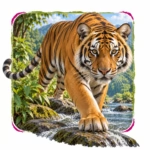
Siberian Tiger Fact Highlight
From the full animal facts page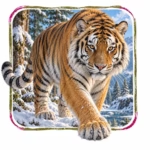
More Animal Comparisons
Pick another animal matchup and keep exploring. Compare appearances, habitats, diets, abilities, and surprising differences.



Make an Animal Story
Turn this Bengal tiger vs Siberian tiger comparison into a mangrove-channel and snowy-forest conservation adventure with our free Animal Story Generator.
Source notes: References used for this comparison. See more See less
Try Another Matchup
Explore this comparison →