
Boa vs Python: Constrictor Snake Comparison
Boas and pythons are nonvenomous constrictor snakes with muscular bodies, flexible jaws, and tiny pelvic spurs left from distant legged ancestors. They belong to different snake families and live across different natural ranges. The easiest life-cycle clue is that most boas give birth to live young, while every python species lays eggs.
About Boa
- Type Reptile
- Diet Carnivore
- Group Constrictor Snake
- Known for Powerful coils, live birth in most species, camouflage, and lifestyles ranging from tree climbing to burrowing and swimming
- Special skill Subduing prey by constriction and giving birth to live young in most species
About Python
- Type Reptile
- Diet Carnivore
- Group Constrictor Snake
- Known for Egg laying, maternal brooding, heat sensing in many species, powerful coils, and some of the world’s longest snakes
- Special skill Detecting warm prey in many species and warming or guarding a clutch of eggs
Boa vs Python: Quick Answer
Boas belong mainly to the family Boidae and most give birth to live young. Pythons belong to the family Pythonidae, and all lay eggs; females of many species coil around the clutch to guard or warm it. Both groups include ambush-hunting constrictors, and both range from small specialists to enormous snakes.
Where Do They Fit?
Follow the branches to see how Boa and Python are classified and related.
Boa vs Python: Quick Comparison
| Feature | Boa | Python |
|---|---|---|
| Animal type | Reptile | Reptile |
| Animal group | Boa family and close relatives | Python family |
| Known for | Live birth in most species and varied climbing, burrowing, or aquatic lifestyles | Egg laying, maternal brooding, and some extremely long species |
| Main habitat | Forests, deserts, grasslands, wetlands, rivers, and rocky areas | Forests, savannas, wetlands, deserts, farms, and rocky areas |
| Natural range | Especially diverse in the Americas, with species elsewhere too | Africa, Asia, and Australia; not naturally native to the Americas |
| Reproduction | Most give birth to live young, though some boa relatives lay eggs | All species lay eggs |
| Egg care | Not applicable to most live-bearing boas | Females of many species coil around and guard the clutch |
| Diet | Rodents, birds, lizards, frogs, fish, and other prey depending on species | Rodents, birds, reptiles, and mammals depending on species and size |
| Baby name | Snakelet or neonate | Hatchling |
| Special skill | Powerful constriction and highly varied lifestyles | Heat sensing in many species and maternal egg brooding |
How Are Boas and Pythons Alike?
- Both boas and pythons are nonvenomous snakes that usually subdue prey by constriction.
- Both swallow food whole with flexible skulls and expandable jaw connections.
- Both have muscular bodies, backward-curving teeth, and tiny external pelvic spurs in many species.
- Both use smell and tongue-flicking to investigate their surroundings.
- Both groups include excellent climbers, ambush hunters, and species with heat-sensing pits.
How Are Boas and Pythons Different?
- Boas and pythons belong to different evolutionary families.
- Most boas give birth to live young, while all pythons lay eggs.
- Female pythons commonly coil around their eggs, while most boas have no egg clutch to brood.
- Boas are especially diverse in the Americas, while pythons are native to Africa, Asia, and Australia.
- The reticulated python holds the living-snake length record, while the green anaconda, a boa, is the heaviest living snake.
Boa vs Python Showdown
Constrictor showdown: Size is a tie because the reticulated python wins for record length while the green anaconda, a boa, wins for weight. Speed, strength, stealth, and social life also depend too heavily on species for a fair family-wide winner. The boa takes swimming because its family includes the extremely aquatic anacondas. The python wins our weirdest-fact prize because females of some species can produce muscular heat while coiled around their eggs.
Fun Boa vs Python Facts
Live Young vs Eggs
Most boas retain developing young inside the mother’s body and deliver live snakelets enclosed in thin membranes. Every python lays eggs, creating one of the simplest general clues for separating the two families.
New World Stronghold vs Old World Range
Boa relatives are especially diverse in the Americas, although the wider boa lineage also occurs in Africa, Asia, Europe, and Pacific regions. Native pythons live in Africa, Asia, and Australia, with introduced populations elsewhere.
Both Carry Tiny Leg Clues
Many boas and pythons have small claw-like pelvic spurs beside the vent. These are connected to remnants of a pelvis and hind limbs inherited from ancient snake ancestors, and males may use them during courtship.
Length Champion vs Weight Champion
The reticulated python is the longest living snake species. The green anaconda belongs to the boa family and is generally considered the heaviest living snake, so the word biggest depends on whether length or mass is measured.
Some Python Mothers Warm Their Eggs
A brooding female python may coil tightly around her clutch. In certain species she repeatedly contracts her muscles to generate heat, helping keep the eggs warmer until the hatchlings emerge.
Boa vs Python Quiz
- Which snake group gives birth to live young in most species? Answer: Boas.
- Which snake group always lays eggs? Answer: Pythons.
- How do both groups usually subdue prey? Answer: By constriction.
- Which family includes the heavy green anaconda? Answer: The boa family.
- Which species holds the record as the longest living snake? Answer: The reticulated python.
Boa vs Python FAQ
What is the main difference between a boa and a python?
They belong to different snake families. Most boas give birth to live young, while every python species lays eggs.
Are boas and pythons venomous?
No. They have teeth but no venom-delivery system. Most species seize prey and subdue it by wrapping muscular coils around the body.
Which is bigger, a boa or a python?
It depends on the species and measurement. The reticulated python is the longest living snake, while the green anaconda, which is a boa, is the heaviest.
Do boa constrictors lay eggs?
No. Boa constrictors give birth to live young after the embryos develop inside the mother’s body.
Do python mothers care for their eggs?
Females of many python species coil around their clutch and guard it. Some can also generate muscular heat while brooding.
Animal Words to Know
- Constrictor: An animal that subdues prey by wrapping around it and tightening its coils.
- Ovoviviparous: Developing eggs hatch inside the mother’s body so the young are born live.
- Clutch: A group of eggs produced during one nesting period.
- Pelvic spur: A small claw-like structure connected to remnants of an ancestral pelvis and hind limbs.
- Heat-sensing pit: A sensory opening that detects infrared warmth from nearby animals.
Boa and Python Life-Cycle Activity
Boa and Python Life-Cycle Activity
Draw a boa constrictor beside a ball python without showing a fight. Add live newborns beside the boa and an egg clutch beside the python. Give both snakes muscular coils, forked tongues, and patterned camouflage. Add a simple note that this comparison uses two named species because boas and pythons are large groups. Label boa, python, live young, eggs, constrictor, and hatchling.
Meet Each Animal
Want the full fact file? Here are quick highlights from each animal’s own facts page.
Boa Fact Highlight
From the full animal facts page
Python Fact Highlight
From the full animal facts page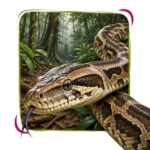
More Animal Comparisons
Pick another animal matchup and keep exploring. Compare appearances, habitats, diets, abilities, and surprising differences.




Make an Animal Story
Turn this boa vs python comparison into a twisting rainforest adventure with our free Animal Story Generator.
Source notes: References used for this comparison. See more See less
Try Another Matchup
Explore this comparison →