
Boar vs Warthog: Wild Pig Comparison
In this comparison, “boar” means the Eurasian wild boar, Sus scrofa, rather than simply any adult male pig. The common warthog, Phacochoerus africanus, is a different wild pig from African savannas. Wild boars have dense bristly coats and thrive in forests and many other habitats, while warthogs have sparse hair, high-set eyes, protective facial pads, large curved tusks, and special wrist calluses for kneeling as they graze.
About Wild Boar
- Type Mammal
- Diet Omnivore
- Group Wild Pig
- Known for Dense bristly coat, long wedge-shaped snout, rooting, tusks, forest camouflage, adaptability, strong smell, and wide range
- Special skill Rooting through soil and leaf litter, smelling hidden food, swimming strongly, moving through dense cover, and adapting to many climates
About Warthog
- Type Mammal
- Diet Omnivore
- Group African Wild Pig
- Known for Facial pads called warts, sparse bristles, upright mane, large tusks, kneeling to graze, fast running, and sheltering in burrows
- Special skill Kneeling on calloused wrists to graze, running quickly with tail raised, using burrows, and backing into shelter so the tusked head faces outward
Wild Boar vs Warthog: Quick Answer
A wild boar usually has a thick brown or black bristly coat, a long wedge-shaped snout, relatively small ears, and a forest-adapted body. A warthog has sparse gray skin, a tall mane, large facial pads called warts, high-set eyes, bigger outward-curving upper tusks, and longer legs for open African country. They are related members of Suidae but belong to different genera.
Where Do They Fit?
Follow the branches to see how Wild Boar and Warthog are classified and related.
Wild Boar vs Warthog: Quick Comparison
| Feature | Eurasian Wild Boar | Common Warthog |
|---|---|---|
| Animal type | Mammal | Mammal |
| Scientific name | Sus scrofa | Phacochoerus africanus |
| Family | Suidae | Suidae |
| Body covering | Dense coarse bristles with underfur in colder regions | Sparse bristles with a long mane along the neck and back |
| Face | Long wedge-shaped snout without warthog facial pads | Broad flat face with paired protective skin pads |
| Tusks | Upper and lower canines form tusks, especially developed in males | Large curved upper tusks plus sharp lower tusks |
| Main habitat | Forests, woodland, wetlands, scrub, and grassland | Savanna, open woodland, grassland, and floodplain |
| Native range | Europe, Asia, and parts of North Africa | Sub-Saharan Africa |
| Diet | Roots, tubers, nuts, fruit, crops, fungi, invertebrates, eggs, and other foods | Mostly grasses, roots, bulbs, fruit, and other plants, plus occasional animal food |
| Young animal | Piglet, often striped when very young | Piglet, usually plain brown rather than striped |
| Special ability | Adaptability, forest concealment, rooting, and swimming | Kneeling to graze, fast open-ground running, and defensive burrow entry |
How Are Wild Boars and Warthogs Alike?
- Both wild boars and warthogs are mammals in the pig family Suidae.
- Both have flexible snouts, cloven hooves, tusk-forming canine teeth, strong smell, and piglets.
- Both are opportunistic omnivores, although plants make up much of their diets.
- Females and young of both species commonly live in social groups called sounders.
- Both root or dig for food, wallow for comfort and cooling, and can move much faster than their heavy bodies suggest.
How Are Wild Boars and Warthogs Different?
- Wild boars are native to Eurasia and parts of North Africa, while common warthogs live in sub-Saharan Africa.
- Wild boars have dense bristly coats, while warthogs have sparse body hair and a prominent mane.
- Warthogs have obvious facial skin pads and high-set eyes, while wild boars lack those warthog features.
- Wild boars commonly use forests and thick cover, while warthogs are strongly associated with open savannas and grasslands.
- Warthogs kneel on padded wrists to crop short grass and often shelter in burrows, behaviors less characteristic of wild boars.
Boar vs Warthog Showdown
Wild-pig showdown: The wild boar wins size and overall strength because the largest populations and males can exceed common warthogs, though individual ranges overlap. The warthog wins speed in open country. Dense forest camouflage gives stealth to the wild boar, and its well-documented swimming earns the water category. Social behavior is a tie because females and young of both form sounders while adult males are often solitary. The warthog wins the weirdest-fact prize for grazing on its padded wrists and backing into burrows.
Fun Boar vs Warthog Facts
Forest Bristles vs Savanna Mane
Wild boars carry dense coarse hair that becomes especially insulating in cold climates and helps break up their outline in woodland shadows. Warthogs have much sparser body bristles but grow a conspicuous mane from the crown down the neck and back.
Warthog Warts Are Protective Pads
The bumps on a warthog’s face are not true warts caused by infection. They are thick pads of skin and connective tissue, especially prominent in adult males, that help cushion the face during ritualized contests and protect areas near the eyes and tusks.
Warthogs Kneel to Eat
Common warthogs frequently bend onto thick calloused pads on their wrists while cropping short grass or digging for roots. This feeding posture brings their low mouths close to the ground without forcing the long legs into an awkward crouch.
Their Piglets Wear Different Patterns
Very young wild boar piglets commonly have pale horizontal stripes that camouflage them among leaf litter and sunlight. Common warthog piglets are generally plain brown, matching dry earth and grass rather than wearing the wild boar’s striped pattern.
Warthogs Back into Burrows
Warthogs often use holes excavated by aardvarks or other animals, modifying them when needed. An adult may enter backward so its head and tusks face the entrance, while piglets move deeper inside; the burrow provides shade, warmth, rest, and protection.
Boar vs Warthog Quiz
- Which animal has obvious protective facial pads? Answer: The warthog.
- Which animal commonly has a dense bristly coat? Answer: The wild boar.
- On what body part does a warthog kneel while grazing? Answer: Its padded wrists.
- What is a group of female pigs and their young called? Answer: A sounder.
- Where is the common warthog native? Answer: Sub-Saharan Africa.
Boar vs Warthog FAQ
What is the main difference between a wild boar and a warthog?
A Eurasian wild boar is a densely bristled Sus pig native across much of Eurasia. A common warthog is a sparsely haired African Phacochoerus pig with facial pads, a mane, high-set eyes, and large curved tusks.
Is a warthog a type of boar?
A male warthog can be called a boar because boar is the adult-male term for pigs. However, a warthog is not the species commonly called the Eurasian wild boar.
Are warthog warts real warts?
No. They are thick protective pads of skin and tissue, not contagious skin growths.
Which is bigger, a wild boar or a warthog?
Wild boar size varies enormously across the range, but the largest males and populations can outweigh common warthogs. Many individuals overlap, so location, sex, age, and nutrition matter.
Can wild boars swim?
Yes. Wild boars are strong swimmers and can cross rivers and other stretches of water.
Animal Words to Know
- Suidae: The mammal family containing pigs, boars, warthogs, babirusas, and relatives.
- Sounder: A social group of pigs, commonly females and their young.
- Tusk: An enlarged tooth that projects beyond the mouth.
- Wallow: A muddy or wet place where an animal rolls or rests.
- Callus: A thickened area of skin that protects a body part from repeated pressure or rubbing.
Wild Boar and Warthog Habitat Activity
Wild Boar and Warthog Habitat Activity
Draw a Eurasian wild boar in a leafy forest and a common warthog on an African savanna. Give the boar dense bristles, a wedge-shaped snout, small ears, and subtle tusks. Give the warthog a sparse coat, upright mane, facial pads, large curved tusks, long legs, and raised tail. Label wild boar, warthog, forest, savanna, tusk, and piglet.
Meet Each Animal
Want the full fact file? Here are quick highlights from each animal’s own facts page.
Wild Boar Fact Highlight
From the full animal facts page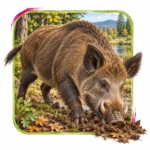
Warthog Fact Highlight
From the full animal facts page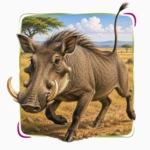
More Animal Comparisons
Pick another animal matchup and keep exploring. Compare appearances, habitats, diets, abilities, and surprising differences.




Make an Animal Story
Turn this boar vs warthog comparison into a forest-and-savanna adventure with our free Animal Story Generator.
Source notes: References used for this comparison. See more See less
Try Another Matchup
Explore this comparison →