
Budgerigar vs Cockatiel for Kids: Tiny Flock or Tall Crest?
Budgerigars and Cockatiels are native Australian parrots built for open, often dry landscapes. Both travel to find seed and water, grip with two toes forward and two backward, and nest in tree hollows. A wild Budgerigar is tiny, green, yellow, and black-barred. A wild Cockatiel is much longer, mostly because of its pointed tail, and wears a crest plus bright cheek patches.
About Budgerigar
- Type Small long-tailed parrot
- Diet Seed-eating herbivore
- Group Old World parrot family, Psittaculidae
- Known for Huge nomadic flocks, green-and-yellow wild plumage, and rapid chatter
- Special skill Tracks rain and fresh grass seed across Australia’s dry interior
About Cockatiel
- Type Small crested cockatoo
- Diet Mostly seed-eating herbivore
- Group Cockatoo family, Cacatuidae
- Known for A movable head crest, orange cheek patches, and a very long pointed tail
- Special skill Raises and flattens its crest to send clear visual mood signals
Quick Answer
Quick answer: A Budgerigar is the smaller bird at about 17 to 18 cm long, with wild green-and-yellow plumage and a habit of forming fast-moving flocks that can become immense after good rain. A Cockatiel is about 25 to 35 cm long, gray in the wild, and easy to spot by its tall movable crest, orange cheeks, white wing patches, and long pointed tail. Both mainly eat seeds, depend on freshwater, and raise chicks in tree cavities.
Budgerigar vs Cockatiel: Quick Comparison
| Feature | Budgerigar | Cockatiel |
|---|---|---|
| Scientific name | Melopsittacus undulatus | Nymphicus hollandicus |
| Bird family | Psittaculidae, Old World parrots | Cacatuidae, cockatoos |
| Adult length | About 17 to 18 cm | About 25 to 35 cm, including a long tail |
| Wild appearance | Green body, yellow face, black barring, and blue cheek spots | Gray body, movable crest, orange cheeks, white wing patch, and pointed tail |
| Native range | Most of mainland Australia | Most of mainland Australia, especially inland open country |
| Main food | Seeds of native grasses and herbs | Mostly grass, shrub, and tree seeds, especially Acacia seeds |
| Daily feeding | Often feeds on the ground in tight, alert flocks | Usually searches open ground in pairs or flocks |
| Social life | Small groups can merge into flocks of thousands when food is abundant | Pairs and flocks may contain hundreds or occasionally thousands |
| Nest and care | Bare tree hollow; female incubates and both parents help feed chicks | Tree hollow; male and female share incubation and chick care |
| Typical clutch | Often six to eight eggs | Usually four to seven eggs |
How Budgerigars and Cockatiels Are Alike
- Both are native Australian parrots that live mainly in open country.
- Both are social, travel in flocks, and move when food or water becomes scarce.
- Both mainly eat seeds and often forage on the ground.
- Both have parrot feet with two toes forward and two backward.
- Both lay white eggs inside tree hollows rather than building open cup nests.
How Budgerigars and Cockatiels Are Different
- A Budgerigar is much shorter and lighter than a Cockatiel.
- A Cockatiel belongs to the cockatoo family, while a Budgerigar belongs to a different parrot family.
- The Cockatiel has a tall movable crest and orange cheek patches; the Budgerigar has no crest and shows black barring.
- Budgerigar flocks can become extraordinarily large after rain creates a seed boom.
- The female Budgerigar does most incubation, while male and female Cockatiels take daytime and nighttime incubation shifts.
Budgerigar vs Cockatiel Adaptation Showdown
Adaptation showdown: Cockatiel wins size because it reaches about 25 to 35 cm, while a Budgerigar is about 17 to 18 cm. Speed is a Tie because comparable wild flight tests are unavailable and both are swift nomadic fliers. Cockatiel wins strength because its larger body and bill can handle bigger seeds and tougher plant material. Budgerigar wins stealth because wild green-and-yellow plumage blends with sunlit grasses and leafy shrubs. Budgerigar wins social behavior because good conditions can unite its groups into flocks numbering many thousands. Swimming is a Tie because neither parrot is an aquatic specialist. Cockatiel wins weirdest because its feather crest swings upright, slants, or flattens like a visible mood meter.
Fun Budgerigar vs Cockatiel Facts
Rain Can Build a Giant Flock
Budgerigars wander across Australia in search of fresh seed and water. After widespread rain, many small groups may join into a vast feeding and drinking flock.
Wild Budgies Are Mostly Green
Pet Budgerigars occur in many colors, but wild birds are mainly green below, yellow on the face, and patterned with black barring above.
A Crest With Several Messages
A Cockatiel can raise its crest when alert or excited, hold it at an angle when relaxed, and flatten it when alarmed or agitated.
Half the Bird Can Look Like Tail
A Cockatiel’s long pointed tail is about 15 cm and may form roughly half of the bird’s total length.
Parents Work Different Shifts
Cockatiel parents share incubation. Males commonly sit during much of the day, while females take the night shift and both feed the chicks.
Budgerigar vs Cockatiel Quiz
- Which bird is smaller? Answer: The Budgerigar.
- Which bird has a movable crest? Answer: The Cockatiel.
- What food do both birds eat most often in the wild? Answer: Seeds.
- Where do both species lay their eggs? Answer: Inside tree hollows.
- Why do wild flocks move across dry Australia? Answer: They track changing supplies of seed and freshwater.
Budgerigar vs Cockatiel FAQ
Is a Cockatiel a type of Budgerigar?
No. Both are parrots, but the Cockatiel is a small cockatoo and the Budgerigar belongs to the Old World parrot family.
Which bird is bigger?
The Cockatiel is longer and heavier, and its long pointed tail adds greatly to its length.
Do wild Budgerigars come in blue and white?
Wild birds are normally green and yellow. Blue, white, and many other color forms were developed mainly through captive breeding.
Can both birds copy sounds?
Yes. Both can learn calls and human-made sounds, although individual ability varies.
Should children approach a wild nest hollow?
No. Watch from far away so the parents can enter, feed, and protect their chicks without disturbance.
Animal Words to Know
- Crest: A group of feathers on the head that can be raised or lowered.
- Nomadic: Moving from place to place as food, water, or weather changes.
- Cere: The soft area above a parrot’s bill that contains the nostrils.
- Zygodactyl: Having two toes facing forward and two backward for gripping.
- Clutch: The group of eggs laid for one nesting attempt.
Design a Dry-Country Parrot Field Card
Design a Dry-Country Parrot Field Card
Fold a page into two field cards. Draw exactly one wild Budgerigar and exactly one wild Cockatiel at honest relative scale, making the Cockatiel clearly longer. Label the Budgerigar’s yellow face, black barring, green body, small hooked bill, and long tail. Label the Cockatiel’s crest, orange cheek, white wing patch, gray body, and very long pointed tail. Add icons for seeds, freshwater, flock travel, and a tree hollow. Observe wild parrots quietly without feeding, touching, or approaching nests.
Meet Each Animal
Want the full fact file? Here are quick highlights from each animal’s own facts page.
Budgerigar Fact Highlight
From the full animal facts page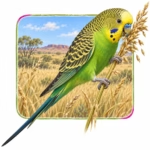
Cockatiel Fact Highlight
From the full animal facts page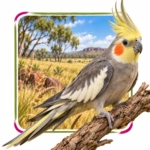
More Animal Comparisons
Pick another animal matchup and keep exploring. Compare appearances, habitats, diets, abilities, and surprising differences.

Make an Animal Story
Send two clever Australian parrots across a rain-washed grassland with our free Animal Story Generator.