
Tasmanian Devil vs Dingo for Kids: Marsupial and Wild Dog
The Tasmanian Devil and Australian Dingo are important Australian predators, but they belong to different mammal branches. The devil is a stocky pouch-bearing marsupial found naturally on Tasmania. The larger, long-legged dingo is a placental canid found across mainland Australia and may hunt cooperatively in a pack.
About Tasmanian Devil
- Type Carnivorous marsupial
- Diet Carnivore and scavenger
- Group Marsupial carnivore family, Dasyuridae
- Known for Powerful bone-crushing jaws, black fur, loud feeding sounds, and a pouch
- Special skill Crushes and consumes bone, fur, and much of a carcass with massive jaws
About Australian Dingo
- Type Wild canid
- Diet Mostly carnivore and opportunistic omnivore
- Group Dog family, Canidae
- Known for Howling, cooperative hunting, and life across nearly every mainland habitat
- Special skill Cooperates in packs to hunt prey larger than one dingo could tackle
Quick Answer
Quick answer: A Tasmanian Devil is a compact black marsupial with huge jaw muscles, a pouch, and a talent for crushing bones while scavenging. An Australian Dingo is a larger wild canid with long legs, erect ears, pack behavior, and endurance for hunting. Devils survive naturally on Tasmania, while dingoes occupy most mainland habitats and are absent from the island in the wild.
Tasmanian Devil vs Australian Dingo: Quick Comparison
| Feature | Tasmanian Devil | Australian Dingo |
|---|---|---|
| Scientific name | Sarcophilus harrisii | Canis familiaris, with Canis lupus dingo also widely used |
| Mammal branch | Marsupial in family Dasyuridae | Placental canid in family Canidae |
| Body size | About 52.5 to 80 cm total length; roughly 4 to 12 kg | Body about 86 to 123 cm; roughly 12 to 24 kg |
| Native home | Tasmania, with mainland fossils from thousands of years ago | Most of mainland Australia |
| Main habitat | Coastal heath, dry forest, mixed forest, scrub, and farmland edges | Desert, plains, grassland, woodland, forest, and mountains |
| Main food | Carrion plus mammals, birds, reptiles, amphibians, and insects | Kangaroos, wallabies, rabbits, rodents, birds, reptiles, carrion, and some fruit |
| Hunting style | Usually forages alone and often follows scent to carrion | Hunts alone, in pairs, or cooperatively in a pack |
| Social life | Mostly solitary but may gather and squabble at carcasses | Pack social system with a breeding pair and helpers |
| Young | Many tiny newborns compete for four pouch teats | Usually four to six live-born pups in a den |
| Famous sound | Screeches, growls, snarls, and jaw snaps during feeding | Long howls for contact and territory, with little barking |
How Tasmanian Devils and Dingoes Are Alike
- Both are meat-eating mammals and important predators or scavengers in Australian ecosystems.
- Both have strong jaws, keen smell, and sharp canine teeth for animal food.
- Both may hunt live prey and also take advantage of carrion.
- Both are most active from dusk through the night, although activity changes with conditions.
- Both use dens, hollow logs, caves, or sheltered ground places when raising young.
How Tasmanian Devils and Dingoes Are Different
- The Tasmanian Devil is a marsupial with a pouch, while the dingo is a placental member of the dog family.
- The devil naturally survives on Tasmania, while wild dingoes live across mainland Australia but not Tasmania.
- The dingo is taller, longer, and usually heavier than the Tasmanian Devil.
- Devils are usually solitary, while dingoes may form cooperative packs with stable social roles.
- A devil is built for crushing and scavenging at close range, while a dingo is built for running and pursuing prey.
Tasmanian Devil vs Dingo Adaptation Showdown
Adaptation showdown: Australian Dingo wins size because adults commonly weigh about 12 to 24 kg, compared with roughly 4 to 12 kg for Tasmanian Devils. Australian Dingo wins speed because its long legs and lighter running shape suit extended pursuit across open ground. Tasmanian Devil wins strength for its size because massive jaw muscles and heavy teeth crush skin, muscle, and bone. Australian Dingo wins stealth because it quietly stalks and coordinates before a chase, while devils are famously noisy at shared food. Australian Dingo wins social behavior because packs cooperate in hunting, territory defense, and pup care. Swimming is a Tie because both can swim but neither is aquatic. Tasmanian Devil wins weirdest for combining ears that redden with excitement, bone-crushing jaws, fat stored in the tail, and a backward-opening pouch.
Fun Tasmanian Devil vs Australian Dingo Facts
The Largest Living Carnivorous Marsupial
The Tasmanian Devil is the world’s largest surviving meat-eating marsupial. A large male can weigh about 12 kg, but a dingo can be roughly twice that mass.
A Skeleton on the Menu
Devils can eat skin, fur, organs, and smaller bones along with muscle. Their heavy molars and powerful jaw muscles help them use parts that many scavengers leave behind.
Red Ears and Loud Warnings
A devil’s thin ears may look bright red when blood flow increases during excitement or stress. Screeches and open-mouthed displays warn other devils without always starting a fight.
A Pack Raises the Pups
Dingoes usually breed once a year. In a stable pack, the dominant pair breeds and other members may help guard, feed, or teach four to six pups.
Howls Instead of Many Barks
Dingoes communicate over distance with long howls and use scent marks around a territory. They can bark, but do so less often than most domestic dogs.
Tasmanian Devil vs Dingo Quiz
- Which animal is a marsupial? Answer: The Tasmanian Devil.
- Which animal commonly lives in a cooperative pack? Answer: The Australian Dingo.
- What can a devil’s jaws crush? Answer: They can crush meat, tough skin, and smaller bones.
- Where do wild Tasmanian Devils naturally survive today? Answer: On the island of Tasmania.
- What is a young dingo called? Answer: A pup.
Tasmanian Devil vs Australian Dingo FAQ
Would a Tasmanian Devil fight a dingo in nature?
Wild populations do not normally meet because devils live on Tasmania and dingoes live on mainland Australia. Comparisons describe adaptations, not staged fights.
Which animal is bigger?
The Australian Dingo is taller, longer, and generally heavier.
Why are Tasmanian Devils so loud?
Growls, screeches, jaw snaps, and open-mouth displays help individuals negotiate access and distance at a shared carcass.
Do dingoes bark?
They can bark, but howling is much more important in wild dingo communication.
Are Tasmanian Devils dangerous to people?
They avoid people when possible. Like any wild carnivore, they can bite if cornered, so they should never be approached or fed.
Animal Words to Know
- Carrion: The body of a dead animal used as food by a scavenger.
- Marsupial: A mammal whose very small newborn usually continues developing while attached to a teat, often inside a pouch.
- Placental mammal: A mammal whose developing young receives nourishment through a placenta before birth.
- Apex predator: A predator near the top of a food web with few or no natural predators as an adult.
- Sclerophyll forest: A forest dominated by plants with tough, leathery leaves adapted to dry conditions.
Build Two Predator Profiles
Build Two Predator Profiles
Draw exactly one adult Tasmanian Devil and exactly one adult Australian Dingo at honest relative scale, making the dingo clearly taller and larger. Label the devil’s broad head, jaw muscles, white chest patch, pouch, short legs, and fat-storing tail. Label the dingo’s erect ears, long muzzle, running legs, white feet, pack, and pup den. Compare scavenging and pack hunting without drawing an attack. Observe wild carnivores only from a safe distance and never feed or handle them.
Meet Each Animal
Want the full fact file? Here are quick highlights from each animal’s own facts page.
Tasmanian Devil Fact Highlight
From the full animal facts page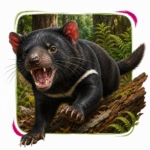
Australian Dingo Fact Highlight
From the full animal facts page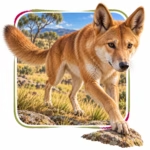
More Animal Comparisons
Pick another animal matchup and keep exploring. Compare appearances, habitats, diets, abilities, and surprising differences.

Make an Animal Story
Send a bone-crunching Tasmanian Devil and a howling Dingo through an Australian night adventure with our free Animal Story Generator.