
Carrion Crow vs Hooded Crow: Crow Species Comparison
Carrion Crows and Hooded Crows are so closely related that scientists once grouped them as one species. Their bodies, voices and habits are extremely similar. The easiest clue is color: Corvus corone is glossy black all over, while Corvus cornix has a pale ash-gray back and belly surrounded by a black head, throat, wings and tail. Their European ranges meet in narrow contact zones, where they sometimes pair and produce mixed-looking young.
About Carrion Crow
- Type Living
- Diet Omnivore; invertebrates, grain, fruit, eggs, small animals, scraps and carrion
- Group Crow family species (Corvus corone)
- Known for Entirely black plumage, strong black bill, harsh caw, territorial pairs, curiosity and adaptable scavenging
- Special skill Learns quickly, remembers useful places and changes its feeding tactics across farms, shores and towns
About Hooded Crow
- Type Living
- Diet Omnivore; invertebrates, seeds, fruit, eggs, small animals, scraps and carrion
- Group Crow family species (Corvus cornix)
- Known for Pale gray torso contrasting with a black head, bib, wings, tail and thighs, plus flexible feeding behavior
- Special skill Uses intelligence and a versatile bill to search soil, turn objects, open food and exploit changing habitats
Carrion Crow vs Hooded Crow: Quick Answer
A Carrion Crow is black from bill to tail. A Hooded Crow is the same basic size and shape, but its back, sides and belly are pale gray, creating a sharp black-and-gray pattern. Both are intelligent omnivores with heavy bills and hoarse caws. In Britain and Ireland, geography helps: Carrion Crows dominate England, Wales and eastern Scotland, while Hooded Crows dominate Ireland and north-western Scotland.
Where Do They Fit?
Follow the branches to see how Carrion Crow and Hooded Crow are classified and related.
Carrion Crow vs Hooded Crow: Quick Comparison
| Feature | Carrion Crow | Hooded Crow |
|---|---|---|
| Scientific name | Corvus corone | Corvus cornix |
| Average British mass | About 508.7 g in BTO records | About 505 g in BTO records |
| Body shape | Large crow with a square-ended tail and heavy bill | Nearly identical size, shape and bill |
| Main color | Glossy black over the whole body | Ash-gray body with black head, throat, wings, tail and thighs |
| Voice | Harsh, assertive caw | Very similar rough caw |
| British stronghold | England, Wales and south or east Scotland | North and west Scotland; also widespread in Ireland |
| Social pattern | Often solitary or paired on a territory | Often paired, but may form more visible feeding groups |
| Food | Almost anything edible, from insects and grain to scraps and carrion | A similarly varied omnivorous diet |
| Nest | Large twig nest lined with softer material | Large twig nest lined with wool, hair or other soft material |
| Where ranges meet | May pair with Hooded Crows | May pair with Carrion Crows, producing mixed plumage |
How Are Carrion and Hooded Crows Alike?
- Both are large, heavy-billed members of the intelligent crow family Corvidae.
- Both have almost the same body size, shape, flight style and hoarse caw.
- Both eat a flexible omnivorous diet that includes plants, invertebrates, small animals and carrion.
- Both form long-lasting pairs and build large stick nests in trees, crags or human structures.
- Both investigate new objects, remember food opportunities and adapt well to farms and towns.
How Are Carrion and Hooded Crows Different?
- The Carrion Crow is completely black, while the Hooded Crow has a broad pale-gray body.
- Their main European ranges occupy different regions, meeting in narrow contact zones.
- Carrion Crows dominate most of England and Wales; Hooded Crows dominate Ireland and north-west Scotland.
- Hooded Crows may gather more readily in visible feeding groups, although both species vary.
- Scientists classify them as Corvus corone and Corvus cornix despite their ability to produce hybrids.
Carrion vs Hooded Crow Adaptation Showdown
- Size – Tie: Their average masses are almost identical and their normal body measurements overlap.
- Speed – Tie: Their matching builds and flight styles provide no fair evidence for a dependable speed winner.
- Strength – Tie: Both have similarly powerful bills, feet and bodies suited to the same broad feeding tasks.
- Stealth – Carrion Crow: Uniform black plumage can disappear into deep tree shade, dark rocks and a cloudy silhouette.
- Social – Hooded Crow: It is somewhat more likely to be noticed feeding in groups, though both species may gather around abundant food.
- Swimming – Tie: Neither is a swimming specialist; both may wade or bathe in shallow water.
- Weirdest – Tie: Despite their striking color difference, they can interbreed where their ranges meet and produce fertile-looking mixed-plumage birds.
Fun Carrion Crow vs Hooded Crow Facts
A Gray Coat, Not a Hood
The Hooded Crow’s black head does resemble a hood, but most of its back, sides and belly are gray. Its wings and tail stay black.
Crow Borderlands
Across parts of Europe, the two species meet in long, fairly narrow contact zones. Mixed pairs and hybrids occur there.
What Carrion Means
Carrion is the body of a dead animal. Both crows may eat it, but neither depends on carrion alone; their menus are remarkably varied.
Nearly Matching Weights
BTO summaries give average masses of about 508.7 g for Carrion Crow and 505 g for Hooded Crow in Britain.
A Nest With a Soft Center
Both build a strong outer bowl from twigs. Inside, they add softer materials such as wool, hair, grass or bark for eggs and chicks.
Carrion Crow vs Hooded Crow Quiz
Which crow is black all over? A) Carrion Crow B) Hooded Crow C) Both Answer: A) Carrion Crow
Which crow has a pale gray back and belly? A) Carrion Crow B) Hooded Crow C) Neither Answer: B) Hooded Crow
Are the two crows very different in size? A) Yes B) No C) Only in winter Answer: B) No
What does carrion mean? A) Dead animal remains B) A tree seed C) A bird nest Answer: A) Dead animal remains
What can happen where their ranges meet? A) They may hybridize B) They turn white C) They stop calling Answer: A) They may hybridize
Carrion Crow vs Hooded Crow FAQ
Are Carrion and Hooded Crows separate species?
Most current bird lists treat them as separate species, Corvus corone and Corvus cornix, although they remain extremely close relatives.
Can they have young together?
Yes. Hybridization occurs in contact zones, and some birds show gray-and-black patterns between the typical adults.
Which crow is bigger?
Neither has a dependable size advantage. Their average masses and measurements overlap almost completely.
Do both crows eat dead animals?
Yes, but both also eat insects, grain, fruit, eggs, small animals and human food scraps.
Can location identify the crow?
Location is helpful but not perfect. Plumage is the quickest clue, especially near a contact zone where either species or a hybrid may appear.
Animal Words to Know
- Carrion: The remains of a dead animal.
- Contact zone: A region where the ranges of two related animal groups meet.
- Corvid: A bird in the crow family, including crows, ravens, rooks, jays and magpies.
- Hybrid: An offspring whose parents belong to two different species or distinct populations.
- Omnivore: An animal that eats both plant and animal foods.
Map the Two Crow Coats
Map the Two Crow Coats
Draw the same crow outline twice. Color one completely glossy black for Carrion Crow. Give the second a pale-gray back, sides and belly but keep its head, throat, wings, tail and thighs black for Hooded Crow. Add a small map key showing their British strongholds and a striped overlap zone.
Meet Each Animal
Want the full fact file? Here are quick highlights from each animal’s own facts page.
Carrion Crow Fact Highlight
From the full animal facts page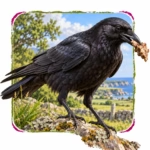
Hooded Crow Fact Highlight
From the full animal facts page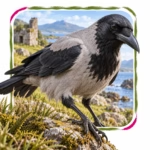
More Animal Comparisons
Pick another animal matchup and keep exploring. Compare appearances, habitats, diets, abilities, and surprising differences.





Make an Animal Story
Create a crow story about two clever neighbors discovering why their different coats do not make them so different!
Source notes: References used for this comparison. See more See less
Try Another Matchup
Explore this comparison →