
Cassowary vs Ostrich: Rainforest-Cassowary-to-Open-Savanna-Ostrich Flightless-Bird Comparison
Cassowaries and ostriches are giant flightless birds, but they are not the same kind of “ratite” built in two colors. Cassowaries are three species of compact forest birds from New Guinea, nearby islands, and northeastern Australia; ostriches are two African species shaped for open country. A southern cassowary has three toes, a tall casque, bright neck skin, bristly black feathers, and an inner dagger claw. A common ostrich is much taller and heavier, has only two toes, giant eyes, loose feathers, and the fastest running system of any living bird. Both lay large eggs, rely on powerful legs, and give fathers major chick-care jobs.
About Cassowary
- Type Bird
- Diet Mostly fruit-eating omnivore swallowing fallen fruit whole and adding fungi, flowers, seeds, snails, insects, frogs, small reptiles, carrion, or other available foods; long-distance movement between fruiting trees makes cassowaries important seed dispersers in rainforest
- Group Cassowaries, genus Casuarius in family Casuariidae, represented by three living flightless species: southern cassowary Casuarius casuarius, northern cassowary Casuarius unappendiculatus, and dwarf cassowary Casuarius bennetti; the southern cassowary is used for the page’s exact size, color, wattle, and artwork examples
- Known for A heavy rainforest bird with a low horizontal body, reduced wings, glossy hairlike black plumage, powerful three-toed legs, a long dagger-shaped inner claw, bright bare neck skin, and a keratin-covered casque; southern-cassowary females may reach about 1.7 meters and 80 kilograms and are usually larger and more colorful than males
- Special skill Strong legs sprint and jump through tangled forest, the inner-toe claw is a defensive tool, bristly feathers shed rain and resist snagging, and the casque may assist heat release, display, or low-frequency communication. Cassowaries are capable swimmers and can cross rivers or coastal water, but their first response to people should be given space and an escape route.
About Ostrich
- Type Bird
- Diet Plant-heavy omnivore eating grasses, leaves, flowers, seeds, roots, shoots, succulents, and fallen fruit plus insects, lizards, frogs, rodents, or other small animals when available; swallowed grit helps the muscular gizzard grind food because ostriches have no teeth
- Group Ostriches, genus Struthio in family Struthionidae, commonly treated as two living species: common ostrich Struthio camelus and Somali ostrich Struthio molybdophanes; the common ostrich is used for the page’s exact Smithsonian measurements, black-and-white adult-male plumage, range, and artwork
- Known for The tallest and heaviest living bird, with a long nearly bare neck, enormous eyes, bulky feathered body, powerful long legs, reduced flightless wings, and only two toes on each foot; common-ostrich adults are roughly 90–136 kilograms and can reach about 2.7 meters, with males generally larger than females
- Special skill Two-toed feet, long elastic tendons, giant leg muscles, a stride up to several meters, and wings used as balancing rudders support sustained running around 48–59 kilometers per hour and sprints near 69–70 kilometers per hour. Large eyes scan open country, wings shade chicks and aid displays, and flexible body temperature helps conserve water.
Cassowary vs Ostrich: Quick Answer
An ostrich is taller, heavier, and faster, reaching about 2.7 meters, 90–136 kilograms, and sprinting near 70 kilometers per hour. A southern cassowary is shorter and more compact, reaching about 1.7 meters and up to roughly 80 kilograms, and is built to move, hide, and swim through tropical forest. Cassowaries have three toes, a casque, colorful neck skin, and a long inner claw; ostriches have two toes, enormous eyes, long bare legs and neck, and running wings that work like rudders.
Where Do They Fit?
Follow the branches to see how Cassowary and Ostrich are classified and related.
Cassowary vs Ostrich: Quick Comparison
| Feature | Cassowary | Ostrich |
|---|---|---|
| Scientific scope | Three species in genus Casuarius; southern cassowary used for measurements | Two living species in genus Struthio; common ostrich used for measurements |
| Typical landscape | Dense tropical rainforest and adjoining wet forest edges | Open African savanna, grassland, shrubland, and semi-desert |
| Maximum example | Southern females about 1.7 m and up to roughly 80 kg | Common adults up to about 2.7 m and roughly 90–136 kg |
| Foot | Three toes; long straight claw on the inner toe | Only two toes; enlarged inner toe carries most running load |
| Head clue | Keratin-covered casque plus blue neck and species-specific wattles | Very large eyes, small flat head, long nearly bare neck, no casque |
| Top movement | Forest sprinting, jumping, maneuvering, and capable swimming | Sustained open-country running and sprints near 69–70 km/h |
| Main food | Mostly fallen rainforest fruit, plus fungi and small animals | Mostly leaves, grass, seeds, roots, and flowers, plus small animals |
| Social pattern | Usually solitary except courtship and father-led broods | Alone, in pairs, families, or organized herds and larger gatherings |
| Egg and care | Female lays green eggs; male incubates and raises striped chicks | Several hens may share a nest; main female and male incubate and guard chicks |
| Memory clue | Casque-wearing rainforest seed mover | Two-toed savanna distance runner |
How Are Cassowaries and Ostriches Alike?
- Both are warm-blooded feathered birds whose wings are too reduced for flight, so strong legs provide their main escape and defense system.
- Both belong to palaeognath birds often informally grouped as ratites, lay large hard-shelled eggs in ground nests, and hatch striped or patterned chicks able to walk soon after hatching.
- Both rely heavily on plant food but opportunistically eat insects, small vertebrates, or other animal material, making each better described as a plant-heavy omnivore than a strict leaf-only herbivore.
- Both give males major parental duties: a cassowary father incubates and raises his brood, while an ostrich male shares incubation with the main female and helps guard the chicks.
- Both can injure a person with powerful legs, so safe wildlife viewing means staying far away, never feeding, never approaching chicks, and leaving every bird a clear route to move off.
How Are Cassowaries and Ostriches Different?
- Cassowaries are three Casuarius species from New Guinea, nearby islands, and northeastern Australia; ostriches are two Struthio species native to Africa. They are separate evolutionary branches, not male and female forms.
- A common ostrich is the world’s tallest and heaviest bird and substantially exceeds even a large female southern cassowary. The ostrich’s extremely long neck and legs exaggerate the height difference.
- Cassowaries have three toes and a long dagger-like claw on the inner toe. Ostriches have only two toes, an unusual reduction that supports efficient high-speed running across firm open ground.
- Cassowaries wear a casque and colorful bare neck skin, with wattles differing by species. Ostriches lack a casque and instead have enormous eyes, a small flat head, and male-versus-female plumage differences.
- Cassowaries usually move alone through dense fruiting forest and disperse large seeds. Ostriches use open-country vision and may form pairs, families, herds, or very large gatherings.
- A male cassowary performs incubation and chick care alone after a female lays. In the common ostrich system, several hens may use one nest and the dominant pair divide incubation, usually female by day and male by night.
Cassowary vs Ostrich Adaptation Showdown
Rainforest power bird versus open-country speed bird showdown: Ostrich wins size because the common ostrich reaches about 2.7 meters and 90–136 kilograms, clearly beyond the roughly 1.7 meters and up-to-80-kilogram southern-cassowary example. Ostrich wins speed because measured or observed running ranges reach 48–59 kilometers per hour continuously and about 69–70 in a sprint, above the commonly reported short cassowary sprint. Ostrich receives the absolute-strength win from much greater typical mass and giant running musculature; this is not a fight prediction, and a cassowary’s inner claw remains a serious defensive structure. Cassowary wins stealth because dark bristly plumage and a compact horizontal body disappear into layered rainforest, while the ostrich relies more on early detection and distance. Ostrich wins social behavior for organized herds, communal nests, and shared dominant-pair care, although solitary birds occur. Cassowary wins swimming because river and coastal-water crossings are a normal documented ability, while neither bird is aquatic. Cassowary wins strangest adaptation for combining a heat-releasing casque, deep low-frequency booms, a dagger-like inner claw, and the ability to swallow and disperse large rainforest seeds. These fields compare survival adaptations, not combat.
Fun Cassowary vs Ostrich Facts
The Ostrich Is Bigger, but the Cassowary Is Still a Giant
A common ostrich can stand around 2.7 meters tall and weigh roughly 90–136 kilograms. A large female southern cassowary may reach about 1.7 meters and roughly 80 kilograms. Cassowary females are commonly larger than males, while ostrich males are generally larger than females, so comparing “an average bird” without sex and species can be misleading.
Two Toes Turn the Ostrich Foot Into Running Gear
Most birds have three or four forward-and-back toe arrangements, and cassowaries retain three forward toes. An ostrich has only two toes, with the large inner toe and hooflike nail carrying much of the load. Long legs, springy tendons, huge muscles, and balancing wings help it take multi-meter strides and turn at speed.
A Cassowary Casque Can Release Heat
The tall head structure is not a solid bone helmet. It has a keratin covering over an internal framework, and thermal imaging shows that it can act as a controllable heat-exchange surface, becoming especially useful in hot conditions. Display, age, sound, and movement through vegetation may also matter, so scientists do not reduce the casque to one simple job.
Both Birds Put Fathers on Egg Duty
A male cassowary builds the nest, incubates several dark green eggs alone, and leads the striped chicks for about nine months. Common ostriches use a different system: several hens can lay in one scrape, the dominant female usually incubates in daylight, and the dark male takes the night shift. Adults then protect and shelter the mobile chicks.
Cassowaries Plant Forests With Their Droppings
Cassowaries swallow many fruits whole and carry their seeds away from the parent tree before dropping them in a packet of natural fertilizer. Some large rainforest fruits are especially well matched to this journey, and germination can improve after gut passage. An ostrich spreads seeds too, but the cassowary is a particularly important mover of large tropical-forest seeds.
Cassowary vs Ostrich Quiz
- Which bird is taller, heavier, and faster? Answer: The ostrich.
- How many toes does each bird have on one foot? Answer: A cassowary has three; an ostrich has two.
- What is the structure on a cassowary’s head called? Answer: A casque.
- Which habitat best matches each bird? Answer: Cassowary—tropical forest; ostrich—open African savanna, grassland, or semi-desert.
- Who incubates cassowary eggs? Answer: The male cassowary.
Cassowary vs Ostrich FAQ
Which is bigger, a cassowary or ostrich?
The ostrich. A common ostrich can reach about 2.7 meters and roughly 90–136 kilograms. A southern cassowary can reach about 1.7 meters, and large females may approach 80 kilograms. Species, sex, age, and condition matter, but the overall size winner is clear.
Which is faster, a cassowary or ostrich?
The ostrich. Observations summarized by major zoos place continuous running around 48–59 kilometers per hour and short sprints around 69–70 kilometers per hour. Southern cassowaries can sprint roughly 48 kilometers per hour through forest, an impressive speed but not the ostrich maximum.
Is a cassowary more dangerous than an ostrich?
“Most dangerous” is not a useful wildlife label. Both are powerful wild birds capable of serious injury when threatened. Cassowaries have a long inner claw and ostriches are much heavier with enormous kicking legs. Stay far away, never feed either bird, do not approach nests or chicks, and follow local wildlife guidance.
Can cassowaries and ostriches fly or swim?
Neither can fly. Cassowaries are strong documented swimmers that cross rivers and sometimes coastal water. Ostriches may enter water and can move through it, but open-land running—not swimming—is their major specialty. Neither is an aquatic bird.
Do ostriches bury their heads in sand?
No. An incubating bird lowers its long neck to turn eggs, and a threatened ostrich may lie flat with its pale head and neck close to the ground. From far away this can create the illusion of a buried head, but the bird still needs to see and breathe.
Animal Words to Know
- Ratite: An informal grouping of mostly large flightless palaeognath birds such as ostriches, rheas, emus, cassowaries, and kiwis.
- Casque: The tall keratin-covered structure on a cassowary’s head.
- Wattle: A hanging area of colorful bare skin; southern cassowaries have two, while other cassowary species differ.
- Gizzard: A muscular stomach chamber that grinds food, often with help from swallowed grit.
- Seed dispersal: Moving seeds away from a parent plant, often after an animal eats fruit and later drops the seeds.
Cassowary and Ostrich Drawing Activity
Cassowary and Ostrich Drawing Activity
Draw a southern cassowary and common ostrich on the same ground line. Make the ostrich much taller, with a long bare neck, huge eyes, black-and-white adult male plumage, and two-toed feet on open savanna. Give the cassowary a stockier black body, colorful neck, helmet-like casque, and three-toed feet with a long inner claw in rainforest. Label height, neck, casque, toes, habitat, and chick.
Meet Each Animal
Want the full fact file? Here are quick highlights from each animal’s own facts page.
Cassowary Fact Highlight
From the full animal facts page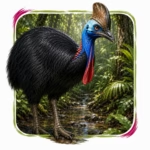
Ostrich Fact Highlight
From the full animal facts page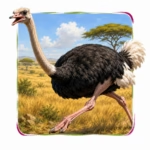
More Animal Comparisons
Pick another animal matchup and keep exploring. Compare appearances, habitats, diets, abilities, and surprising differences.





Make an Animal Story
Turn this cassowary vs ostrich comparison into a rainforest-to-savanna flightless-bird adventure with our free Animal Story Generator.
Source notes: References used for this comparison. See more See less
Try Another Matchup
Explore this comparison →