
Reticulated Python vs Burmese Python for Kids
Reticulated Pythons and Burmese Pythons are both giant, nonvenomous snakes from warm parts of Asia. The Reticulated Python, Malayopython reticulatus, wins the length contest and carries an intricate net-like pattern. The Burmese Python, Python bivittatus, is usually shorter but has an especially broad, thick body with large saddle-shaped blotches. Both wait in hiding, sense warm animals with facial pits, constrict prey and guard their eggs by wrapping around the clutch.
About Reticulated Python
- Type Living
- Diet Carnivore; ambushes mammals, birds and reptiles, then kills prey by constriction
- Group World’s longest living snake and a nonvenomous python (Malayopython reticulatus)
- Known for Exceptionally long but relatively slim body, complex net-like pattern, heat-sensing pits and great swimming
- Special skill Grows longer than any other living snake and senses warm animals using pits along its lips
About Burmese Python
- Type Living
- Diet Carnivore; ambushes mammals, birds and reptiles, then kills prey by constriction
- Group One of the world’s largest snakes and a nonvenomous python (Python bivittatus)
- Known for Very thick muscular body, broad head, dark saddle-shaped blotches, strong swimming and egg-warming coils
- Special skill Swims strongly and can warm a clutch of eggs by making tiny muscle contractions while coiled around it
Quick Answer
A Reticulated Python is usually the longer and slimmer-looking snake, with a complex pattern like a brown, gold and black net. A Burmese Python is generally shorter but extremely thick and heavy, with large dark saddle-shaped blotches. Both are powerful nonvenomous constrictors, excellent swimmers and mostly solitary ambush hunters.
Reticulated Python vs Burmese Python: Quick Comparison
| Feature | Reticulated Python | Burmese Python |
|---|---|---|
| Scientific name | Malayopython reticulatus | Python bivittatus |
| Size record | World’s longest living snake; exceptional individuals exceed 7 m | One of the largest snakes; exceptional individuals exceed 5 m |
| Build | Very long and relatively slender for a giant python | Broad, thick and heavy-bodied |
| Pattern | Intricate diamond shapes forming a net-like pattern | Large dark brown saddle-shaped blotches on a tan background |
| Head | Longer, narrower head with a bold dark line through the eye | Broad head with a dark arrow-shaped marking on top |
| Native range | South and Southeast Asia, including many islands | South and Southeast Asia on the mainland and nearby areas |
| Habitat | Rainforest, swamp, grassland and river edges | Forest, grassland, swamp, marsh and foothills |
| Food | Birds, reptiles and mammals | Birds, reptiles and mammals |
| Hunting | Ambushes, grips and constricts prey | Ambushes, grips and constricts prey |
| Egg care | Female coils around the eggs and can make warming muscle movements | Female coils around the eggs and can make warming muscle movements |
How Are Reticulated and Burmese Pythons Alike?
- Both are enormous, nonvenomous constrictor snakes native to warm parts of Asia.
- Both have rows of heat-sensing pits along the lips for detecting warm animals.
- Both are camouflage-patterned ambush hunters that usually live alone.
- Both eat birds, reptiles and mammals and swallow prey whole.
- Both lay eggs, and females wrap around the clutch and help keep it warm.
How Are Reticulated and Burmese Pythons Different?
- The Reticulated Python is the world’s longest snake, while the Burmese Python is usually shorter.
- A Reticulated Python looks relatively slim; a Burmese Python has a very thick, heavy body.
- Reticulated Pythons have a fine net-like pattern; Burmese Pythons have large saddle-shaped blotches.
- The Reticulated Python ranges across many Southeast Asian islands, while the Burmese Python is mainly a mainland Asian species.
- Burmese Pythons have formed a harmful invasive population in southern Florida; Reticulated Pythons have not established the same population there.
Reticulated Python vs Burmese Python Adaptation Showdown
- Size – Reticulated Python: It holds the living-snake length record, although a Burmese Python may look bulkier at a similar length.
- Speed – Tie: Both are ambush hunters rather than long-distance racers, and no sound matched speed test separates them.
- Strength – Tie: Each has a huge muscular body built to grip and constrict large prey; body size matters more than species name.
- Stealth – Tie: Both use brown patterned camouflage and long motionless waits to disappear into leaves and wet vegetation.
- Social – Tie: Both are mainly solitary snakes outside courtship and breeding.
- Swimming – Tie: Both are strong swimmers that often live near rivers, marshes or swamps.
- Weirdest – Reticulated Python: Its maze of diamonds and lines gives it a name meaning net-like, and it can grow longer than any other snake.
Fun Reticulated Python vs Burmese Python Facts
The Longest Snake
The Reticulated Python is the longest living snake species, with exceptional verified animals longer than 7 m.
A Living Net Pattern
The word reticulated means covered with a network. Its scales form linked diamonds, lines and patches.
Heat-Sensing Lips
Both pythons have facial pits that detect infrared heat from nearby warm-bodied animals.
Muscle-Powered Egg Heat
A mother python can shiver tiny muscles while coiled around her eggs, raising the temperature of the clutch.
A Florida Invader
Released or escaped Burmese Pythons formed a breeding population in southern Florida and now prey on native wildlife.
Reticulated Python vs Burmese Python Quiz
Which species is the world’s longest living snake? A) Reticulated Python B) Burmese Python C) Both are the same length Answer: A) Reticulated Python
Which pattern belongs to a Burmese Python? A) Large saddle blotches B) Zebra stripes C) Bright blue dots Answer: A) Large saddle blotches
Are these pythons venomous? A) Yes B) No C) Only in water Answer: B) No
What do heat pits detect? A) Warm animals B) Sound waves C) Sweet smells Answer: A) Warm animals
How can a mother python warm her eggs? A) Tiny muscle movements B) Breathing fire C) Carrying them into sunlight Answer: A) Tiny muscle movements
Reticulated Python vs Burmese Python FAQ
Which Python is longer?
The Reticulated Python. It is the longest living snake species, although most individuals are far shorter than the record holders.
Which Python is heavier?
Size varies by individual. Burmese Pythons are especially thick and heavy-bodied, while Reticulated Pythons can reach greater lengths.
Can Reticulated and Burmese Pythons swim?
Yes. Both are strong swimmers and often use habitats beside rivers, marshes or swamps.
How do these Pythons catch prey?
They strike, hold prey with backward-curving teeth and wrap muscular coils around it. They do not use venom.
Why are Burmese Pythons in Florida?
Captive snakes were released or escaped, reproduced and established an invasive population in the warm wetlands of southern Florida.
Animal Words to Know
- Ambush: A surprise attack launched after waiting in hiding.
- Constrictor: A snake that kills prey by tightening muscular coils around it.
- Infrared: Heat energy with wavelengths longer than visible red light.
- Invasive species: A non-native organism that spreads and harms its new ecosystem.
- Reticulated: Marked with a network of connected lines or shapes.
Decode Two Python Patterns
Decode Two Python Patterns
Draw two long snake outlines without touching real snakes. Fill the Reticulated Python with linked diamonds and fine black lines. Fill the Burmese Python with large dark saddle shapes. Add arrows to label relative length, body thickness, heat pits and the habitat colors each pattern can hide against.
Meet Each Animal
Want the full fact file? Here are quick highlights from each animal’s own facts page.
Reticulated Python Fact Highlight
From the full animal facts page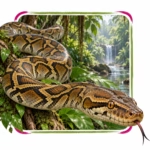
Burmese Python Fact Highlight
From the full animal facts page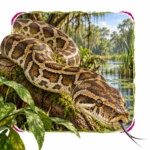
More Animal Comparisons
Pick another animal matchup and keep exploring. Compare appearances, habitats, diets, abilities, and surprising differences.


Make an Animal Story
Create a jungle story about a net-patterned Reticulated Python and a saddle-marked Burmese Python!