
Cheetah vs Jaguar: Speed Specialist-to-Power Ambush Cat Comparison
A cheetah and jaguar are spotted cats built for opposite hunting problems. The cheetah is the lighter African-and-Asian sprint specialist: solid spots, tear marks, semi-retractable claws, long legs, and a flexible spine help it chase fast prey in short bursts. The jaguar is the heavier American ambush specialist: rosettes, broad jaws, compact limbs, retractable claws, and swimming ability help it overpower varied prey near dense cover and water. They never naturally meet because their wild ranges are on different continents.
About Cheetah
- Type Mammal
- Diet Small and medium-sized hoofed mammals such as gazelles, springbok, impala, and young antelope, plus hares and ground birds; it watches and stalks by sight, accelerates into a short chase, trips or pulls prey down, and normally uses a throat hold rather than the skull-piercing bite associated with jaguars
- Group Cheetah (Acinonyx jubatus), the only living species in genus Acinonyx; most surviving native populations occur in Africa, while the critically endangered Asiatic cheetah survives in Iran, and African cheetahs have been used in India’s managed reintroduction program
- Known for A slim, deep-chested cat with a head-and-body length around 1.1–1.5 meters, a 60–80-centimeter tail, shoulder height around 67–94 centimeters, and a broad reported adult mass range of roughly 21–72 kilograms; males average larger than females, but the body remains lightweight, long-legged, narrow-waisted, and aerodynamic
- Special skill Long legs, light bones, a flexible spring-like spine, swiveling hips and shoulders, enlarged airways, lungs and heart, high-set eyes, hard paw pads, blunt semi-retractable claws that grip like cleats, a dewclaw that can help hook prey, and a long rudder-like tail for balance and rapid turns; solid spots, facial tear marks, daytime vision, and short explosive chases complete the speed toolkit
About Jaguar
- Type Mammal
- Diet A broad carnivorous diet documented from more than 85 prey species, including peccaries, deer, capybaras, tapirs, armadillos, fish, birds, turtles, and caimans; a jaguar stalks from cover, pounces at close range, and can use an unusually powerful bite to the neck or back of the skull
- Group Jaguar (Panthera onca), the largest living cat native to the Americas and the only living member of genus Panthera native to the Western Hemisphere; melanistic “black jaguars” are the same species and still carry rosettes that may be visible in suitable light
- Known for A stocky, broad-headed, muscular cat commonly measured around 1.5–1.8 meters from nose to rump with a 70–90-centimeter tail, up to roughly 75 centimeters at the shoulder, and about 68–136 kilograms in one widely used reference range; size varies greatly, with especially large animals in productive Pantanal wetlands
- Special skill Short powerful limbs, a deep chest, broad skull, massive jaw muscles, thick canines, large rounded paws, fully retractable claws, strong swimming, climbing, close-range acceleration, and rosette camouflage; jaguars can pierce hard skull regions and tackle aquatic or armored prey, while a flexible hyoid-and-larynx system allows the deep sawing roar of a Panthera cat
Cheetah vs Jaguar: Quick Answer
A cheetah is much faster, but a jaguar is usually larger, more powerfully built, and far more at home in water. Cheetahs have small solid spots, black tear marks, long legs, and semi-retractable claws for traction. Jaguars have large rosettes with inner dots, a broad head, retractable claws, and an exceptionally strong bite. The cheetah chases; the jaguar stalks and pounces.
Where Do They Fit?
Follow the branches to see how Cheetah and Jaguar are classified and related.
Cheetah vs Jaguar: Quick Comparison
| Feature | Cheetah | Jaguar |
|---|---|---|
| Scientific name | Acinonyx jubatus | Panthera onca |
| Wild region | Mainly Africa, plus a tiny native population in Iran | Americas, mainly Mexico to northern Argentina |
| Selected adult mass | Broad reported range about 21–72 kg; many adults 34–65 kg | Common reference range about 68–136 kg, with strong regional variation |
| Build | Light, tall-legged, deep-chested sprint body | Stocky, broad-headed, muscular ambush body |
| Coat marks | Small solid spots plus black facial tear lines | Large rosettes, often with one or more inner spots |
| Claws | Blunt and semi-retractable for running traction | Sharp and fully retractable for gripping and climbing |
| Hunting style | Visual stalk followed by a short high-speed chase and throat hold | Close ambush followed by a pounce and powerful neck or skull bite |
| Water | Can cross water when needed but is not water-specialized | Powerful swimmer that often uses river and wetland habitat |
| Sound | Chirps, purrs, churrs, growls, and hisses but does not roar | Roars and gives deep sawing calls; not a continuous purrer |
| Social clue | Females mostly alone; brothers may form lifelong coalitions | Mostly solitary; rare male coalitions have been documented |
How Are Cheetahs and Jaguars Alike?
- Both are warm-blooded carnivorous mammals in family Felidae, with whiskers, padded paws, sharp canine teeth, keen hearing, and excellent low-light vision.
- Both use a patterned golden-to-brown coat as camouflage, stalk before attacking, accelerate quickly over short distances, and rely on the tail for balance.
- Both normally hunt without a large permanent pack, while mothers alone protect, move, feed, and teach dependent cubs.
- Both communicate through scent marks, body posture, facial signals, and several calls, even though only the jaguar can produce a true Panthera-style roar.
- Both need large connected landscapes with prey and safe movement routes, and both face habitat fragmentation, conflict with people, and illegal killing.
How Are Cheetahs and Jaguars Different?
- Cheetahs are native mainly to Africa with a tiny remnant in Iran; jaguars are native to the Americas from Mexico to northern Argentina, so they do not meet naturally.
- A cheetah is slender, long-legged, and aerodynamic; a jaguar is normally heavier, shorter-legged, broad-headed, and built for close-range power.
- Cheetahs wear solid spots and black tear marks; jaguars wear rosettes with interior dots, and some jaguars are melanistic black while retaining faint rosettes.
- A cheetah’s blunt semi-retractable claws and hard pads add traction during a chase; a jaguar keeps sharp retractable claws for seizing, climbing, and grappling at close range.
- Cheetahs pursue visible prey in brief sprints and usually finish with a throat hold; jaguars ambush from cover and may bite through the back of a prey animal’s skull.
- Male cheetahs commonly form lasting coalitions and cheetahs cannot roar; jaguars are usually solitary, can roar, and are much more strongly adapted to swimming and wetland hunting.
Cheetah vs Jaguar Adaptation Showdown
Speed-versus-power adaptation showdown: Jaguar wins typical size because it is normally much heavier and more robust. Cheetah wins speed by an enormous margin as the fastest land mammal. Jaguar wins strength for its larger mass, compact limbs, broad skull, and exceptional bite—not because the animals should be made to fight. Jaguar narrowly wins stealth because its rosettes, secretive habits, dense cover, and close ambush depend on remaining unseen almost to pouncing distance; cheetahs are also excellent stalkers. Cheetah wins social behavior because male coalitions are a regular life strategy, whereas jaguar cooperation is unusual. Jaguar wins swimming through well-documented wetland travel and aquatic hunting. Cheetah wins weirdest adaptation for a spine-and-limb system that lengthens each stride, semi-retractable traction claws, and a tail that counters high-speed turns. These fields compare adaptations, not combat.
Fun Cheetah vs Jaguar Facts
One Cat Is a Sprinter and the Other Is a Power Ambusher
A cheetah spends body mass on long limbs, large airways, a flexible spine, traction claws, and a balancing tail. This produces spectacular acceleration but leaves less room for the thick skull, large teeth, and heavy muscles of a jaguar. A jaguar gives up long-distance chase speed for close-range force, broad paws, and a bite suited to varied prey. Evolution cannot maximize every feature at once.
Solid Spots and Rosettes Are Different Patterns
Most cheetahs carry separate round or oval black spots and dark lines running from the eyes toward the mouth. Jaguars usually have larger broken rings called rosettes, often with a small dot inside. Both patterns disrupt the body’s outline, but a jaguar’s rosettes fit dappled forest and riverside shade while cheetah spots blend with grass, scrub, and broken open-country shadow.
Their Claws Solve Opposite Problems
Most cat claws withdraw into protective sheaths, but a cheetah’s main claws are only partly retractable and become blunt through ground contact. Along with hard pads, they grip the soil during acceleration and turning. A jaguar fully retracts sharper claws between uses, then extends them to hold prey, climb, or scramble along muddy banks.
Only the Jaguar Can Roar
Jaguars belong to genus Panthera and produce deep roars or repeated sawing calls. Cheetahs belong to Acinonyx and cannot roar, but their quieter vocabulary is surprisingly rich: purrs, chirps, churrs, growls, hisses, and contact calls help mothers, cubs, and coalition partners locate or reassure one another. A cheetah may sound more like a giant chirping house cat than a movie lion.
The Cheetah Is More Closely Related to the Cougar
Looks can mislead family trees. Jaguars sit on the Panthera branch with lions, tigers, leopards, and snow leopards. Genetic studies place the cheetah on a different feline branch with the cougar and jaguarundi. That means a cheetah is more closely related to an American cougar than to the jaguar it resembles in a simple spotted-cat picture.
Cheetah vs Jaguar Quiz
- Which cat is the fastest land mammal? Answer: The cheetah.
- Which cat has rosettes that often contain inner dots? Answer: The jaguar.
- Why are a cheetah’s claws less retractable than a jaguar’s? Answer: Their exposed, blunter claws help grip the ground during fast running.
- Which cat regularly uses rivers and wetlands and is a powerful swimmer? Answer: The jaguar.
- Would wild cheetahs and jaguars normally meet? Answer: No. Their native ranges are on different continents.
Cheetah vs Jaguar FAQ
Who is faster, a cheetah or jaguar?
The cheetah is far faster. It is specialized for a brief high-speed chase, with long legs, a flexible spine, traction claws, and a rudder-like tail. Jaguars can accelerate and pounce quickly, but their heavier bodies are built for power rather than a long sprint.
Who is stronger, a cheetah or jaguar?
The jaguar has the stronger power toolkit: greater typical mass, thicker limbs, broader jaws, and an exceptionally forceful bite. This is an anatomical comparison, not a prediction of a fight. The cats never meet naturally and should never be placed together.
How can I tell a cheetah from a jaguar?
Look for solid spots, black tear marks, a small head, long legs, and a slim waist on the cheetah. A jaguar is stockier, has a broad square-looking head, and wears large rosettes that usually contain inner spots.
Can cheetahs or jaguars be black?
Melanistic black jaguars are well documented, and their rosettes remain faintly visible. Cheetahs are not known to become fully melanistic. A rare king cheetah has enlarged blotches and long stripes, but it is not black and is still the same species.
Are cheetahs and jaguars close relatives?
They are both cats, but they occupy different major feline branches. Jaguars belong to Panthera. Cheetahs are genetically closer to cougars and jaguarundis than to jaguars, despite both comparison animals having patterned coats.
Animal Words to Know
- Rosette: A ring-like coat marking; jaguar rosettes often contain one or more small inner spots.
- Semi-retractable: Able to withdraw only partly, as with most cheetah claws.
- Cursorial: Adapted for running efficiently over the ground.
- Ambush predator: A hunter that approaches unseen and attacks suddenly from close range.
- Coalition: A lasting alliance of male cheetahs, often brothers, that travels and defends space together.
Cheetah and Jaguar Body-Design Activity
Cheetah and Jaguar Body-Design Activity
Draw a cheetah and jaguar on the same ground line. Make the cheetah slim and long-legged, with solid spots, black tear marks, and a long balancing tail on open African grassland. Make the jaguar stocky and powerful, with a broad head, shorter-looking tail, and rosettes containing small inner spots beside an American rainforest river. Label body shape, spots, rosettes, speed, swimming, and continent.
Meet Each Animal
Want the full fact file? Here are quick highlights from each animal’s own facts page.
Cheetah Fact Highlight
From the full animal facts page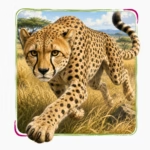
Jaguar Fact Highlight
From the full animal facts page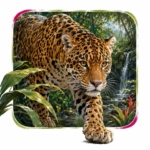
More Animal Comparisons
Pick another animal matchup and keep exploring. Compare appearances, habitats, diets, abilities, and surprising differences.



Make an Animal Story
Turn this cheetah vs jaguar comparison into a lightning-fast grassland chase and riverside rosette mystery with our free Animal Story Generator.
Source notes: References used for this comparison. See more See less
Try Another Matchup
Explore this comparison →