
Chickadee vs Nuthatch for Kids
Black-Capped Chickadees and White-Breasted Nuthatches often appear in the same winter flock, yet they are not close members of one bird family. The chickadee belongs to Paridae and works among leaves and small branches with a short bill and long tail. The nuthatch belongs to Sittidae and has a longer pointed bill, very short tail, and strong feet for creeping over trunks. Both eat insects and seeds, cache food, use tree cavities, and visit feeders. Their sizes, markings, calls, nest work, and ways of exploring a tree make them easy to compare.
About Black-Capped Chickadee
- Type Bird
- Diet Omnivore; mostly insects in warm seasons
- Group Chickadee; family Paridae
- Known for A black cap and bib, white cheeks, curious behavior, complex alarm calls, and winter flocks
- Special skill Remembering thousands of food caches and sharing coded alarm information with a mixed flock
About White-Breasted Nuthatch
- Type Bird
- Diet Omnivore; mainly insects plus seeds and nuts
- Group Nuthatch; family Sittidae
- Known for A white face and breast, long pointed bill, nasal calls, bark probing, and headfirst tree travel
- Special skill Walking down trunks headfirst while probing bark from angles that upward-moving birds may miss
Quick Answer
Quick answer: The White-Breasted Nuthatch is heavier and usually broader-winged, with a long pointed bill, short tail, and a habit of moving headfirst down tree trunks. The Black-Capped Chickadee is lighter, rounder-headed, and marked with a black cap and bib plus white cheeks. Both eat insects and seeds, cache food, visit feeders, use cavity nests, and join winter mixed-species flocks. Chickadees often lead those flocks and can excavate rotten wood; nuthatches usually enlarge or reuse existing holes and live as territorial pairs.
Black-Capped Chickadee vs White-Breasted Nuthatch: Quick Comparison
| Feature | Black-Capped Chickadee | White-Breasted Nuthatch |
|---|---|---|
| Scientific identity | Poecile atricapillus | Sitta carolinensis |
| Bird family | Paridae | Sittidae |
| Published adult length | About 12-15 cm | About 13-14 cm |
| Published adult mass | About 9-14 g | About 18-30 g |
| Published wingspan | About 16-21 cm | About 20-27 cm |
| Adult appearance | Black cap and bib, white cheeks, gray back, buffy sides, and long tail | Black or gray cap, white face and breast, blue-gray back, long bill, and very short tail |
| Main foraging zone | Leaves, twigs, small branches, feeders, and sometimes the ground | Trunks, bark furrows, and large branches, often moving headfirst downward |
| Main foods | Insects and spiders, plus seeds, berries, and feeder foods | Insects and spiders, plus seeds, nuts, acorns, and feeder foods |
| Nest hole | Often excavates rotten wood or uses a natural hole, old woodpecker hole, or box | Usually uses a natural cavity or old woodpecker hole, sometimes enlarging or reusing it |
| Winter social life | Forms flocks that lead mixed groups of woodland birds | Year-round pair may join chickadee- or titmouse-led mixed flocks |
How Are Black-Capped Chickadees and White-Breasted Nuthatches Alike?
- Both are small North American woodland songbirds that also visit parks, wooded neighborhoods, yards, and feeders.
- Both eat insects and spiders as well as seeds and nuts, and both save individual food items in caches.
- Both move acrobatically on trees and can turn sideways or upside down while searching for food.
- Both nest inside tree cavities or nest boxes and raise naked, helpless chicks in a soft inner cup.
- Both join winter mixed-species flocks, where extra eyes can help the group find food and notice predators.
How Are Black-Capped Chickadees and White-Breasted Nuthatches Different?
- The chickadee belongs to family Paridae, while the White-Breasted Nuthatch belongs to family Sittidae.
- The nuthatch is much heavier at about 18-30 grams, while the chickadee weighs about 9-14 grams, even though their lengths overlap.
- The chickadee has a short bill and long tail, while the nuthatch has a long pointed bill and a very short tail.
- Chickadees work among leaves and small twigs, while nuthatches probe bark on trunks and often travel down headfirst.
- Chickadees form winter flocks that lead mixed groups and can excavate rotten wood, while nuthatches keep year-round pairs and usually use existing holes.
Black-Capped Chickadee vs White-Breasted Nuthatch Showdown
Adaptation showdown: White-Breasted Nuthatch wins size because it is much heavier and reaches a broader wingspan, although the length ranges overlap. Speed is a Tie because the sources do not provide a fair same-condition race. White-Breasted Nuthatch wins whole-body strength as the heavier bird with a long seed-hammering bill and powerful clinging feet; this is not a fight prediction. Stealth is a Tie because both are active tree foragers without a matched concealment test. Black-Capped Chickadee wins social behavior because its winter flocks act as a nucleus for many other species. Swimming is a Tie because neither is a specialized swimmer. White-Breasted Nuthatch wins weirdest for routinely walking down trunks headfirst without using its tail as a prop.
Fun Black-Capped Chickadee vs White-Breasted Nuthatch Facts
Chickadees Lead a Winter Team
A Black-Capped Chickadee flock often becomes the nucleus of a mixed group. Nuthatches, woodpeckers, kinglets, creepers, warblers, and vireos may travel nearby. Many of those birds understand chickadee alarm calls even though they make different calls themselves.
More Dee Notes Mean More Danger
The chick-a-dee call carries identity, contact, and warning information. When a chickadee adds more dee notes, it can signal a higher threat level. Listening birds do not need a human translation to respond.
Headfirst Is a New Point of View
White-Breasted Nuthatches travel up, sideways, and down tree trunks. They often begin high and creep downward headfirst, pausing to look around and probe bark. They do not brace against stiff tail feathers the way woodpeckers do.
Nuthatch Means Nut Opener
A White-Breasted Nuthatch jams a large nut or seed into a bark crevice and hammers it with its pointed bill. The old idea of hatching or opening the nut helped give nuthatches their name.
A Cache Gets a Camouflage Blanket
White-Breasted Nuthatches hide seeds and insects one at a time under loose bark. They may cover each cache with bark, lichen, moss, or snow. Chickadees also store food one item per hiding place and can remember thousands of locations.
Black-Capped Chickadee vs White-Breasted Nuthatch Quiz
- Which bird often moves down a trunk headfirst? Answer: The White-Breasted Nuthatch.
- Which bird helps organize winter mixed-species flocks? Answer: The Black-Capped Chickadee.
- Which bird is much heavier? Answer: The White-Breasted Nuthatch.
- What can more dee notes signal? Answer: A higher threat level.
- How may a nuthatch hide a food cache? Answer: By covering it with bark, lichen, moss, or snow.
Black-Capped Chickadee vs White-Breasted Nuthatch FAQ
Is a nuthatch a kind of chickadee?
No. Black-Capped Chickadees belong to family Paridae, while White-Breasted Nuthatches belong to family Sittidae.
Which is bigger, a chickadee or a nuthatch?
The White-Breasted Nuthatch is much heavier at about 18-30 grams, compared with about 9-14 grams for the chickadee. Their length ranges overlap.
Why do nuthatches go down trees headfirst?
That movement lets them inspect bark from different angles while probing for insects and seeds. Their strong feet support them without a woodpecker-style tail brace.
Do chickadees and nuthatches travel together?
Yes, especially in winter. Nuthatch pairs often join mixed flocks led by chickadees or titmice, which can help with food finding and predator awareness.
Why is speed a tie?
The birds use different tree zones and movements, and the cited sources do not provide a matched speed test. A tie is fairer than comparing unrelated observations.
Animal Words to Know
- Sittidae: The songbird family that contains nuthatches.
- Bark forager: A bird that searches tree bark for insects, seeds, or other food.
- Cache: A hidden food item or store saved for later.
- Nucleus flock: A central flock that other species join while moving and feeding.
- Territorial pair: Two mated birds that stay together and defend an area.
Trace Two Tree-Explorer Routes
Trace Two Tree-Explorer Routes
Draw one adult Black-Capped Chickadee and one adult White-Breasted Nuthatch at honest relative scale on the same large tree. Map the chickadee among leaf clusters and small twigs, then map the nuthatch up, sideways, and headfirst down the trunk. Add cards for cap and bib, white breast, short bill, long bill, flock leader, year-round pair, soft-wood cavity, old woodpecker hole, seed cache, and bark cover. Sort each clue under Chickadee, Nuthatch, or Both.
Meet Each Animal
Want the full fact file? Here are quick highlights from each animal’s own facts page.
Black-Capped Chickadee Fact Highlight
From the full animal facts page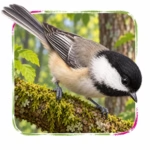
White-Breasted Nuthatch Fact Highlight
From the full animal facts page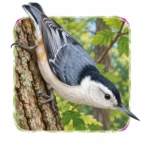
More Animal Comparisons
Pick another animal matchup and keep exploring. Compare appearances, habitats, diets, abilities, and surprising differences.




Make an Animal Story
Send a flock-leading chickadee and a headfirst nuthatch into a tree-top puzzle with our free Animal Story Generator.