
Cockatoo vs Parrot: Crested Australasian Parrot-Family-to-Whole-Parrot-Order Comparison
A cockatoo is not separate from parrots: every cockatoo is a parrot in the family Cacatuidae. “Parrot” names the whole order Psittaciformes, so it also includes macaws, African greys, Amazons, budgerigars, lorikeets, lovebirds, kea, kākāpō, and many other birds. Cockatoos stand out through an erectile crest, an Australasian range, abundant powder down, and mostly white, black, gray, or pink plumage. This page therefore compares the cockatoo family with the wider parrot order and uses named non-cockatoo examples whenever the broad group is too varied for one answer.
About Cockatoo
- Type Bird
- Diet Mostly plant-eating omnivore that cracks seeds, nuts, cones, fruit, berries, buds, roots, tubers, flowers, and grain, with insects or wood-boring larvae important to some species; strong bills and foot-to-beak handling help open hard plant structures, while ground-feeding flocks may visit crops
- Group Cockatoo means the distinct parrot family Cacatuidae, an ancient Australasian branch within order Psittaciformes containing about 21–22 living species depending on the checklist; it includes white cockatoos, corellas, black cockatoos, the palm cockatoo, galah, gang-gang cockatoo, and the small cockatiel
- Known for A movable head crest, heavy curved bill, zygodactyl feet, abundant powder-down feathers, loud contact calls, and often white, black, gray, or pink plumage; size ranges from the cockatiel and smaller corellas to black cockatoos around 60–65 centimeters, while a palm cockatoo can approach about 1 kilogram
- Special skill The erectile crest changes outline during alertness, excitement, display, or rest, while specialized powder-down feathers continually break into a fine conditioning dust. Cockatoos also show striking technical behavior: wild male palm cockatoos manufacture sticks or seed-pod tools and drum regular individual rhythms, and Goffin’s cockatoos can make, select, and transport multi-tool sets in experiments.
About Parrot
- Type Bird
- Diet Species-dependent herbivore or omnivore eating combinations of fruit, seeds, nuts, flowers, nectar, pollen, buds, leaves, bark, roots, fungi, insects, larvae, snails, carrion, or other foods; lorikeets have brush-tipped tongues for nectar and pollen, while kea, kākāpō, macaws, cockatoos, and pygmy-parrots each use very different menus
- Group Parrot means the whole order Psittaciformes, a diverse evolutionary group of roughly 400 living species; exact totals and family boundaries vary among modern checklists, but the order includes New Zealand parrots, cockatoos, and the large radiation of true parrots such as macaws, Amazons, African greys, lorikeets, budgerigars, and lovebirds
- Known for A stout curved bill with a mobile upper mandible, two-forward and two-backward zygodactyl toes, grasping feet often used to bring food to the bill, strong vocal communication, extended learning and parental care, and extraordinary variation from pygmy-parrots around 8–10 centimeters and 10 grams to the roughly 100-centimeter hyacinth macaw and flightless kākāpō that can approach 3 kilograms
- Special skill The hooked bill acts as both food processor and climbing aid, while zygodactyl feet grip branches and manipulate objects. Different lineages add human-sound mimicry, learned contact-call labels, brush-tipped tongues, tool use, snow-country problem solving, ground living, flightlessness, lek booming, seed dispersal, or powerful nut cracking, but no single generic parrot has every adaptation.
Cockatoo vs Parrot: Quick Answer
All cockatoos are parrots, but most parrots are not cockatoos. Cockatoos belong to family Cacatuidae, live naturally only in Australasia, and usually have a crest they can raise or lower plus abundant powder-down feathers. The wider parrot order includes hundreds of species on several continents, with far more variation in size, color, tail shape, diet, and habitat. Both share a hooked bill, zygodactyl feet, intelligence, social calls, and helpless chicks raised in nests.
Where Do They Fit?
Follow the branches to see how Cockatoo and Parrot are classified and related.
Cockatoo vs Parrot: Quick Comparison
| Feature | Cockatoo | Parrot |
|---|---|---|
| Scientific identity | Family Cacatuidae inside order Psittaciformes | The entire order Psittaciformes, including cockatoos |
| Head clue | Distinct movable crest in every species, although shape varies | Most non-cockatoo parrots lack the classic cockatoo crest |
| Typical colors | Often white, black, gray, or pink with colored crest, cheek, or tail patches | Green, blue, red, yellow, gray, black, brown, and many combinations |
| Native range | Australasia from the Philippines and Indonesia to New Guinea, islands, and Australia | Americas, Africa, Asia, Australasia, New Zealand, and many tropical islands |
| Size range | Small cockatiel to black cockatoos around 60–65 cm and palm cockatoo near 1 kg | About 8–10 cm pygmy-parrots to 100 cm hyacinth macaw and kākāpō near 3 kg |
| Feather-care clue | Especially abundant powder down creates a fine feather-conditioning dust | Powder down varies; most other parrots do not produce the same heavy cockatoo dust |
| Feet and bill | Hooked bill and two-forward, two-backward toes | The same basic parrot plan, modified for many foods and lifestyles |
| Typical nest | Usually an old tree hollow, with some species highly dependent on ancient cavity trees | Tree holes are common, but some use cliffs, banks, termite mounds, cacti, ground cavities, or rock shelters |
| Sound | Often very loud contact calls; crest adds a visible signal | Calls, songs, squawks, mimicry, and learned vocal labels vary by species |
| Memory clue | Crested Australasian branch of the parrot tree | The whole tree includes the cockatoo branch |
How Are Cockatoos and Parrots Alike?
- Every cockatoo is a parrot, so both belong to order Psittaciformes and share the characteristic stout hooked bill, mobile upper mandible, strong tongue, and zygodactyl feet with two toes forward and two backward.
- Both can grip food with one foot, bring it to the bill, climb with feet and bill together, crack hard plant material, manipulate objects, and learn flexible solutions to new problems.
- Both use loud contact calls, body posture, feathers, eye and head movements, preening, food sharing, and close physical contact to communicate and maintain social bonds.
- Both commonly form pairs or flocks, lay white eggs in sheltered cavities, hatch helpless chicks with closed eyes, and provide long parental care while young birds learn food, routes, calls, and social rules.
- Both include threatened species harmed by habitat loss, removal of nesting trees, illegal wildlife trade, disease, and conflict around farms or cities, and neither should be captured, fed, or approached in the wild.
How Are Cockatoos and Parrots Different?
- Cockatoo is one parrot family, Cacatuidae. Parrot is the entire order Psittaciformes, so a cockatoo-versus-parrot comparison is a branch-versus-whole-tree comparison rather than two unrelated bird groups.
- Every cockatoo has an erectile crest that can be raised, partly opened, or flattened. Most other parrots do not have the classic movable cockatoo crest, although some can fluff crown feathers.
- Wild cockatoos are restricted to Australasia. Other parrots also live naturally across the tropical Americas, Africa, mainland and island Asia, New Zealand, and many oceanic islands.
- Cockatoos are often white, black, gray, or pink because their feather structure produces fewer of the brilliant structural colors common in many other parrots; galahs and pink cockatoos show that the family is not colorless.
- Cockatoos produce especially conspicuous powder down from specialized feathers. Other parrots preen and may have some powder-producing feathers, but they generally do not create the same heavy dust associated with cockatoos.
- The wider parrot order covers far greater extremes: tiny pygmy-parrots, long-tailed macaws, nectar-feeding lorikeets, alpine kea, and the heavy flightless kākāpō. No one non-cockatoo species represents all that diversity.
Cockatoo vs Parrot Adaptation Showdown
Crested Australasian branch versus whole parrot order showdown: Parrot wins maximum size only at broad-category level because non-cockatoo examples include the roughly 100-centimeter hyacinth macaw and kākāpō approaching 3 kilograms, beyond the largest cockatoo references; cockatoos themselves still belong inside that winning order. Speed is a tie because species, wind, route, and flight style vary and no standardized family-wide race exists. Strength is a tie: large cockatoos and large macaws both have formidable bills, but reliable same-method bite-force comparisons are lacking. Stealth is a tie because white, black, gray, green, and rainbow plumage can each work in the correct light and habitat. Social behavior is a tie because both show pair bonds, flock learning, communication, and extended chick care with major species differences. Swimming is a tie because parrots may bathe, wade, or cross water but neither side is an aquatic specialist. Cockatoo wins strangest adaptation for the family’s heavy powder down plus wild palm-cockatoo tool manufacture and regular drumming rhythms, with Goffin’s cockatoo tool sets adding another remarkable example. These fields compare adaptations and representative extremes, not combat.
Fun Cockatoo vs Parrot Facts
Every Cockatoo Is Already a Parrot
DNA and anatomy place cockatoos as the distinct family Cacatuidae within order Psittaciformes. They split early from the lineage leading to most other living parrots, but that deep branch is still part of the parrot family tree. Saying “cockatoos and parrots” can be useful conversationally, yet scientifically it means cockatoos and other parrots.
A Cockatiel Is a Tiny Cockatoo
The familiar cockatiel, Nymphicus hollandicus, belongs to family Cacatuidae. Its slim body and modest size can make it look more like a small parakeet, but its movable crest, powder down, skull traits, and ancestry place it on the cockatoo branch. Not every cockatoo is a huge white bird.
The Crest Works Like a Feather Signal Flag
A cockatoo can flatten, partly lift, or fully spread its crest during rest, alertness, excitement, courtship, conflict, or surprise. The exact message depends on the species, posture, calls, and situation, so a raised crest does not always mean anger. Most other parrots signal with body feathers but lack this specialized folding head fan.
Powder Down Turns Feathers Into Fine Dust
Special powder-down feathers keep growing and their tips crumble into tiny keratin particles that spread through the plumage during preening. Cockatoos produce especially noticeable amounts, helping condition feathers but also creating airborne dust. The powder is a feather product, not smoke, dandruff from dirty skin, or magic chalk.
Palm Cockatoos Make Their Own Drumsticks
Wild male palm cockatoos cut and shape sticks or seed pods, grip one in a foot, and beat it against a hollow tree during displays. Recorded sequences have regular nonrandom rhythms and individual styles. Goffin’s cockatoos show a different technical talent by making and carrying several tools for sequential tasks; these abilities belong to named species, not automatically to every cockatoo.
Cockatoo vs Parrot Quiz
- Is a cockatoo a parrot? Answer: Yes. Cockatoos are the parrot family Cacatuidae.
- What head feature can every cockatoo raise or flatten? Answer: An erectile crest.
- Where do cockatoos live naturally? Answer: In Australasia, from parts of the Philippines and Indonesia through New Guinea and islands to Australia.
- What does zygodactyl mean? Answer: Two toes point forward and two point backward.
- Which cockatoo makes drumming tools in the wild? Answer: The palm cockatoo.
Cockatoo vs Parrot FAQ
What is the main difference between a cockatoo and a parrot?
A cockatoo is one specialized kind of parrot in family Cacatuidae. “Parrot” is the larger order Psittaciformes and includes cockatoos plus macaws, African greys, Amazons, lorikeets, budgerigars, kea, kākāpō, and many others. Cockatoos are especially recognized by a movable crest, abundant powder down, and an Australasian native range.
Are all white parrots cockatoos?
No. Color alone is unreliable. Many cockatoos are white, but others are black, gray, or pink, and non-cockatoo parrots can also have pale feathers. Scientists check the crest, bill, skull, feather structure, range, behavior, and ancestry rather than using one color.
Which is bigger, a cockatoo or a parrot?
“Parrot” is too broad for one size. Cockatoos range from the small cockatiel to black cockatoos around 60–65 centimeters and palm cockatoos near 1 kilogram. The wider order also includes tiny pygmy-parrots, the approximately 100-centimeter hyacinth macaw, and the heavier flightless kākāpō.
Can cockatoos talk better than other parrots?
No universal ranking exists. Cockatoos can imitate sounds and some human words, but performance varies by species and individual. African grey parrots and some Amazons are famous mimics, while wild parrot vocal skill is mainly used for natural contact calls, pair communication, alarm, and social learning.
Do cockatoos make good pets?
This page does not recommend obtaining one. Cockatoos are long-lived, extremely loud, dusty, destructive chewers with complex social, flight, veterinary, diet, and enrichment needs. Wild-caught trade harms birds and ecosystems. Families should admire wild birds responsibly and, if considering any companion parrot, consult qualified avian veterinarians and established rescue organizations first.
Animal Words to Know
- Psittaciformes: The bird order containing every living parrot, including cockatoos and macaws.
- Cacatuidae: The scientific family containing cockatoos, corellas, black cockatoos, the galah, palm cockatoo, and cockatiel.
- Erectile crest: A group of head feathers that a bird can deliberately raise, fan, or flatten.
- Zygodactyl: A foot arrangement with two toes pointing forward and two pointing backward.
- Powder down: Specialized feathers whose tips break into fine particles used during feather care.
Cockatoo and Parrot Family Activity
Cockatoo and Parrot Family Activity
Draw a sulphur-crested cockatoo beside an African grey parrot and a macaw. Give the cockatoo a raised head crest and mostly pale plumage. Give the other parrots their own body shapes, colors, and tails. Add a large bracket around all three birds labeled “parrots” and write: all cockatoos are parrots, but not all parrots are cockatoos. Label crest, hooked bill, climbing feet, tail, flock, and chick.
Meet Each Animal
Want the full fact file? Here are quick highlights from each animal’s own facts page.
Cockatoo Fact Highlight
From the full animal facts page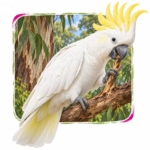
Parrot Fact Highlight
From the full animal facts page
More Animal Comparisons
Pick another animal matchup and keep exploring. Compare appearances, habitats, diets, abilities, and surprising differences.


Make an Animal Story
Turn this cockatoo vs parrot comparison into a crested Australasian branch-of-the-parrot-tree mystery with our free Animal Story Generator.
Source notes: References used for this comparison. See more See less
Try Another Matchup
Explore this comparison →