
West Indian Ocean Coelacanth vs West African Lungfish: Lobe-Finned Fish Species Comparison
Coelacanths and lungfish are both lobe-finned fishes, meaning their evolutionary branch is different from the ray-finned fishes seen most often today. This page compares the West Indian Ocean Coelacanth, Latimeria chalumnae, with the West African Lungfish, Protopterus annectens. The coelacanth is a giant, blue, deep-sea fish with sturdy fleshy fins. The lungfish is a smaller, eel-shaped freshwater fish with thin paired fins and true lungs. Neither is a direct ancestor of modern land animals, but lungfish are their closest living fish relatives.
About West Indian Ocean Coelacanth
- Type Living
- Diet Carnivore; drifts and slowly swims after deep-water fish and squid-like cephalopods
- Group Ancient-looking marine lobe-finned fish and one of two living coelacanth species (Latimeria chalumnae)
- Known for Massive blue body, white spot pattern, fleshy paired fins, three-lobed tail, hinged skull and rediscovery alive in 1938
- Special skill Moves its four fleshy paired fins in a coordinated alternating pattern and senses weak electrical signals with a rostral organ
About West African Lungfish
- Type Living
- Diet Omnivore and predator; eats mollusks, crustaceans, insects, worms, fish, amphibians and some roots or seeds
- Group Freshwater African lobe-finned fish with paired lungs and threadlike paired fins (Protopterus annectens)
- Known for Long eel-like body, whip-thin paired fins, air breathing and drought survival in a mucus-lined mud cocoon
- Special skill Must gulp air into two true lungs and can wait through drought by slowing its metabolism inside a dried mucus cocoon
West Indian Ocean Coelacanth vs West African Lungfish: Quick Answer
A West Indian Ocean Coelacanth is a huge deep-marine fish that shelters in rocky caves and breathes with gills. Its old lung-like organ is filled with fat, not air. A West African Lungfish lives in freshwater and must surface to fill two true lungs. When its wetland dries, it burrows into mud and forms a protective mucus cocoon. Both have fleshy paired fins, but they use them in very different worlds.
West Indian Ocean Coelacanth vs West African Lungfish: Quick Comparison
| Feature | West Indian Ocean Coelacanth | West African Lungfish |
|---|---|---|
| Scientific name | Latimeria chalumnae | Protopterus annectens |
| Fish group | Coelacanth lobe-finned fish | Lungfish lobe-finned fish |
| Adult size | Up to about 2 m and 95-100 kg | Up to a little over 1 m and around 4 kg |
| Body shape | Thick blue body, large scales, eight fins and a three-lobed tail | Long brown-olive eel-like body with continuous fins around the tail |
| Paired fins | Four fleshy lobed fins with internal bones | Four long, thin, threadlike fins |
| Breathing | Gills; the old lung remnant is fat-filled | Gills plus two true lungs; must gulp air |
| Habitat | Deep saltwater rocky slopes and caves | Shallow freshwater rivers, swamps and floodplains |
| Dry-season survival | Cannot survive a drying habitat | Aestivates inside a mucus-lined mud cocoon |
| Young | Gives birth to live young after an estimated five-year gestation | Lays eggs in a guarded nest; larvae have external gills |
| Conservation | Critically Endangered and very slow to mature and reproduce | Least Concern globally, though local populations can face fishing and habitat pressure |
How Are Coelacanths and Lungfish Alike?
- Both belong to the lobe-finned fish branch called Sarcopterygii.
- Both have paired fins containing internal bones rather than only thin fin rays.
- Both come from evolutionary lineages known through fossils hundreds of millions of years old.
- Both are predators that can crush or swallow many kinds of animal prey.
- Both have slow, careful movement styles rather than being built as high-speed open-water chasers.
How Are Coelacanths and Lungfish Different?
- The West Indian Ocean Coelacanth lives in deep saltwater, while the West African Lungfish lives in shallow freshwater.
- The coelacanth grows far larger and heavier than the lungfish.
- Coelacanth paired fins are thick and lobed; lungfish paired fins are extremely long and threadlike.
- The coelacanth breathes with gills, while the lungfish must regularly gulp air into two true lungs.
- The coelacanth gives birth to live young, while the lungfish lays eggs and a male guards the nest.
Coelacanth vs Lungfish Adaptation Showdown
- Size – West Indian Ocean Coelacanth: A large female can reach about 2 m and near 100 kg, many times the lungfish’s mass.
- Speed – Tie: Both save energy with slow movement, and no fair matched speed trial is available.
- Strength – West Indian Ocean Coelacanth: Its thick, heavily scaled body and enormous mass give it much greater overall power.
- Stealth – West Indian Ocean Coelacanth: Its blue body and unique white pattern blend with dim rocky depths where it drifts toward prey.
- Social – West African Lungfish: A breeding male digs a nest and guards eggs and young, a longer social duty than the coelacanth’s loose cave gatherings.
- Swimming – West Indian Ocean Coelacanth: Its eight fins and coordinated lobed-fin movements give precise control in deep rocky water.
- Weirdest – West African Lungfish: It is a fish that can drown without air, then spend a dry season wrapped in a self-made living cocoon under mud.
Fun West Indian Ocean Coelacanth vs West African Lungfish Facts
Found Alive in 1938
Scientists knew coelacanths mainly from fossils until Marjorie Courtenay-Latimer recognized an extraordinary living fish from a South African catch.
Fins with a Walking Rhythm
A coelacanth alternates its paired fins in a pattern that resembles the limb rhythm of a four-legged animal.
A Five-Year Pregnancy
Scale and embryo studies suggest a West Indian Ocean Coelacanth carries developing young for about five years.
A Fish That Must Breathe Air
The West African Lungfish has two true lungs and must reach the surface for air even while living underwater.
A Living Cocoon
During drought, outer skin layers and mucus form a protective cocoon around an aestivating lungfish in its mud chamber.
Coelacanth vs Lungfish Quiz
Which fish lives in deep saltwater caves? A) West Indian Ocean Coelacanth B) West African Lungfish C) Both Answer: A) West Indian Ocean Coelacanth
Which fish must gulp air? A) West Indian Ocean Coelacanth B) West African Lungfish C) Neither Answer: B) West African Lungfish
What kind of fins do both fish have? A) Lobe-based paired fins B) Feathered wings C) Flippers with nails Answer: A) Lobe-based paired fins
How does a lungfish survive a dry season? A) It aestivates in a mud cocoon B) It flies away C) It turns into an egg Answer: A) It aestivates in a mud cocoon
Which fish grows larger? A) West Indian Ocean Coelacanth B) West African Lungfish C) They are equal Answer: A) West Indian Ocean Coelacanth
West Indian Ocean Coelacanth vs West African Lungfish FAQ
Are Coelacanths and Lungfish Closely Related?
They share the lobe-finned fish branch, but their lineages separated deep in evolutionary time and now have very different bodies and lives.
Do Coelacanths Have Lungs?
Living coelacanths have a fat-filled organ left from an ancestral lung. It does not work as an air-breathing lung, so they use gills.
Can a West African Lungfish Live Out of Water?
It can survive a long drought inside moist mud and a protective mucus cocoon, but it is not an ordinary land animal.
Is the Coelacanth a Living Fossil?
The nickname describes its ancient lineage and resemblance to fossils, but living coelacanths have continued evolving like every other species.
Did Lungfish Become the First Land Animals?
No living lungfish is the ancestor of a land animal. Lungfish and tetrapods are surviving branches that share an older common ancestor.
Animal Words to Know
- Aestivation: A low-energy resting state used to survive hot or dry conditions.
- Cephalopod: A sea animal such as a squid or octopus.
- Gestation: The period when young develop inside a parent’s body before birth.
- Lobe-finned: Having paired fins with a fleshy base and internal bones.
- Rostral organ: The electricity-sensing structure in the front of a coelacanth’s head.
Build a Sea-to-Swamp Adaptation Map
Build a Sea-to-Swamp Adaptation Map
Draw a deep rocky ocean cave on the left and a drying freshwater floodplain on the right. Add one large blue spotted coelacanth and one smaller brown eel-shaped lungfish at believable scale. Use arrows to connect five body features to their jobs: lobed fins, gills, true lungs, rostral organ and mud cocoon.
Meet Each Animal
Want the full fact file? Here are quick highlights from each animal’s own facts page.
West Indian Ocean Coelacanth Fact Highlight
From the full animal facts page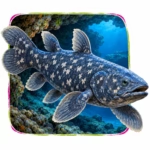
West African Lungfish Fact Highlight
From the full animal facts page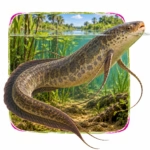
More Animal Comparisons
Pick another animal matchup and keep exploring. Compare appearances, habitats, diets, abilities, and surprising differences.



Make an Animal Story
Create an ancient-fish adventure about a deep-sea Coelacanth and an air-breathing Lungfish!
Source notes: References used for this comparison. See more See less
Try Another Matchup
Explore this comparison →