
Deinosuchus vs Crocodile: Extinct vs Living Crocodyliform Comparison
Deinosuchus means terror crocodile, but it was not a species of modern crocodile. This comparison uses the saltwater crocodile as the largest living true-crocodile benchmark. Deinosuchus lived roughly 82–75 million years ago around North America’s Western Interior Seaway. A 2025 phylogenetic study placed it on the stem leading toward modern crocodylians rather than inside the true-crocodile or alligator branches, and it revised some famous body-size estimates downward.
About Deinosuchus
- Type Extinct Reptile
- Diet Carnivore and opportunistic predator; turtles, fish, other aquatic animals, and dinosaurs or dinosaur carcasses supported by tooth form and bite-mark evidence
- Group Deinosuchus (species including D. riograndensis and D. schwimmeri; stem-crocodylian in a 2025 analysis)
- Known for Gigantic semiaquatic body, very broad elongated skull, inflated snout tip, two mysterious openings in front of the nostrils, thick crushing teeth, powerful jaws, upward-facing sensory organs, heavy pitted osteoderms, muscular tail, and inferred saltwater tolerance
- Special skill Using giant size, armor, a broad skull, and robust teeth to ambush and process large animals in highly productive Cretaceous wetlands
About Crocodile
- Type Reptile
- Diet Carnivore; fish, crustaceans, turtles, snakes, birds, wild pigs, deer, livestock, and other animals depending on age, size, and opportunity
- Group Saltwater Crocodile (Crocodylus porosus; Family Crocodylidae)
- Known for Large streamlined semiaquatic body, broad head, 64–68 interlocking teeth, powerful measured bite, high-set eyes ears and nostrils, pressure-sensitive facial organs, transparent third eyelid, armored osteoderms, muscular tail, salt glands, excellent swimming, nest guarding, and hatchling care
- Special skill Hiding with only sensory organs exposed, launching a powerful ambush, swimming across salt water, and replacing lost teeth throughout life
Deinosuchus vs Crocodile: Quick Answer
Deinosuchus was generally larger and more massively built than a saltwater crocodile, with thick crushing teeth and bite marks preserved on turtle shells and dinosaur bones. However, its exact maximum length and bite force remain model estimates. A saltwater crocodile is the largest living reptile, usually reaches up to about 6 metres, has a directly measured bite of 16,414 newtons in one 4.59-metre individual, and has observed swimming, hunting, nesting, and parental behavior.
Where Do They Fit?
Follow the branches to see how Deinosuchus and Crocodile are classified and related.
Deinosuchus vs Crocodile: Quick Comparison
| Feature | Deinosuchus | Saltwater Crocodile |
|---|---|---|
| Compared group | Extinct genus with multiple named species | Crocodylus porosus, one living true-crocodile species |
| Status | Extinct before the end-Cretaceous mass extinction | Living and protected or managed across much of its range |
| Relationship | Recovered as a stem-crocodylian outside modern alligators and true crocodiles in a 2025 analysis | True crocodile in Crocodylidae |
| Length | Very large specimens exceeded 7 m; older estimates reached about 8–10 m or more, but methods disagree | Large males can reach about 6 m; exceptional historic records near 6.7 m are rare |
| 2025 estimate | One well-studied D. riograndensis specimen had a preferred upper estimate near 7.66 m; larger fossils imply a larger maximum | Living individuals can be measured directly |
| Teeth and snout | Very broad inflated snout and thick robust crushing teeth | Broad snout with interlocking conical teeth for gripping and tearing |
| Bite | Enormous but model-based; no living animal could be tested | Maximum measured value of 16,414 N in a 4.59 m specimen |
| Habitat | Cretaceous coastal wetlands around an inland sea | Modern fresh, brackish, coastal, and marine waters |
| Parental care | Unknown | Females guard mound nests and assist hatchlings |
| Main evidence | Skulls, jaws, teeth, vertebrae, osteoderms, limb bones, and bite marks | Living observation, measurements, tracking, anatomy, genetics, and experiments |
How Were Deinosuchus and Crocodiles Alike?
- Both were large semiaquatic crocodyliform reptiles with long bodies, muscular tails, short legs, and armored skin.
- Both had high-set eyes and nostrils that allowed most of the head and body to remain hidden underwater.
- Both continually replaced teeth and used powerful jaws during ambush feeding.
- Both occupied warm productive wetlands and could eat aquatic animals as well as large land animals near the water.
- Both probably regulated body heat by moving between water, shade, and sun, although Deinosuchus behavior is inferred.
How Were Deinosuchus and Crocodiles Different?
- Deinosuchus was an extinct stem-crocodylian, while the saltwater crocodile belongs to the living true-crocodile family Crocodylidae.
- Deinosuchus reached gigantic sizes beyond 7 metres; saltwater crocodiles usually remain under 6 metres even though exceptional animals can be larger.
- Deinosuchus had an unusually inflated snout tip, two mysterious openings before the nostrils, and especially thick crushing teeth.
- Deinosuchus behavior, growth, bite force, reproduction, and salt tolerance are reconstructed, while these traits can be observed or measured in living crocodiles.
- Deinosuchus shared coastal North America with dinosaurs, while saltwater crocodiles live across today’s tropical Asia-Pacific region.
Deinosuchus vs Crocodile Showdown
Crocodylian showdown: Deinosuchus wins size and robust whole-body strength because even conservative evidence places large individuals above the normal saltwater-crocodile range. The living crocodile wins speed, stealth, swimming, and social evidence because those performances and maternal behaviors are observed, while equivalent Deinosuchus traits are inferred. Deinosuchus wins the weirdest-fact prize for two large skull openings positioned in front of its nostrils whose function remains unknown. These are adaptation and evidence categories, not a prediction of combat.
Fun Deinosuchus vs Crocodile Facts
Deinosuchus Was Neither a True Crocodile nor an Alligator
Older family trees often placed Deinosuchus near alligators, even though its name means terror crocodile. A larger 2025 analysis instead recovered it outside the crown group containing all living crocodiles, alligators, caimans, and gharials. Scientists may test this placement again as characters and fossils are added.
Its Famous Size Has Been Recalculated
Older reconstructions often produced lengths around 8–10 metres and occasional higher claims. A 2025 skull-width method gave 7.66 metres as a realistic upper estimate for one fairly complete D. riograndensis specimen, while acknowledging that the larger holotype probably exceeded it. No single number describes every species and individual.
Bite Marks Connect It to Dinosaurs
Tooth-shaped punctures and scores attributed to Deinosuchus occur on turtle shells and several dinosaur bones. They show that its jaws contacted those animals, but an isolated mark may record hunting, scavenging, or feeding after death. The evidence supports dinosaur feeding without turning every encounter into a movie battle.
Two Snout Holes Remain a Mystery
Deinosuchus had an inflated area at the front of its broad snout and a pair of large openings in front of the nostrils. No living or extinct crocodylian has an identical arrangement, and the openings’ function is unknown. They may eventually reveal something about soft tissue or sensing.
A Living Crocodile Supplies Measured Evidence
Researchers measured 16,414 newtons of bite force from a 4.59-metre saltwater crocodile, the highest directly recorded animal bite in that study. Field observations also document long sea crossings, submerged ambushes, nest guarding, hatchling calls, and tooth replacement—behaviors fossils alone rarely preserve.
Deinosuchus vs Crocodile Quiz
- Was Deinosuchus a true modern crocodile? Answer: No; a 2025 study placed it as a stem-crocodylian outside the living crown group.
- Which living species is used in this comparison? Answer: The saltwater crocodile.
- What evidence shows Deinosuchus fed on some dinosaurs? Answer: Matching bite marks on dinosaur bones.
- Can scientists directly measure a Deinosuchus bite? Answer: No; its bite force must be modeled from fossils and living comparisons.
- What strange feature appeared near the end of its snout? Answer: Two large openings in front of the nostrils.
Deinosuchus vs Crocodile FAQ
Was Deinosuchus bigger than a saltwater crocodile?
Large Deinosuchus individuals exceeded 7 metres and probably surpassed the usual maximum of living saltwater crocodiles. Exact fossil estimates vary with the bones and scaling method used.
Was Deinosuchus a crocodile or alligator?
It was a crocodyliform relative. A 2025 analysis placed it on the stem leading toward modern crocodylians, outside both true crocodiles and alligators.
Did Deinosuchus eat dinosaurs?
Yes, at least sometimes. Bite marks attributed to Deinosuchus occur on dinosaur bones, although individual marks cannot always distinguish predation from scavenging.
Did Deinosuchus meet Tyrannosaurus rex?
Probably not. Deinosuchus disappeared before Tyrannosaurus rex lived, and their best-known times and regions did not overlap.
Which had the stronger bite?
Deinosuchus probably generated the larger absolute force because of its size, but every figure is modeled. The saltwater crocodile has the stronger evidence because its bite has been measured directly.
Animal Words to Know
- Crocodyliform: A member of the wider evolutionary group containing modern crocodilians and many extinct relatives.
- Stem-crocodylian: An extinct relative closer to the lineage leading to living crocodilians than to more distant crocodyliforms, but outside their living crown group.
- Osteoderm: A bony plate embedded in the skin that contributes to crocodilian armor.
- Western Interior Seaway: A shallow Cretaceous sea that divided much of North America into eastern and western landmasses.
- Biomechanical model: A calculation using anatomy and physics to estimate performance such as bite force.
Deinosuchus and Crocodile Evidence Activity
Deinosuchus and Crocodile Evidence Activity
Draw a dotted reconstruction of Deinosuchus beside a measured saltwater crocodile at a cautious relative scale. Give both armored backs, strong tails, and large jaws, but label Deinosuchus as an extinct alligatoroid rather than a true crocodile. Add fossil evidence cards showing a skull, tooth, armored plate, and bitten shell, then modern evidence cards showing a photograph, nest, and measured crocodile. Label reconstruction, alligatoroid, crocodile, fossil, extinct, and living.
Meet Each Animal
Want the full fact file? Here are quick highlights from each animal’s own facts page.
Deinosuchus Fact Highlight
From the full animal facts page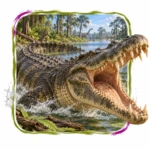
Crocodile Fact Highlight
From the full animal facts page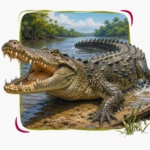
More Animal Comparisons
Pick another animal matchup and keep exploring. Compare appearances, habitats, diets, abilities, and surprising differences.

Make an Animal Story
Turn this Deinosuchus vs crocodile comparison into a fossil-evidence Cretaceous wetland adventure with our free Animal Story Generator.
Source notes: References used for this comparison. See more See less
Try Another Matchup
Explore this comparison →