
Dingo vs Coyote: Wild Canid Comparison
Dingoes and coyotes are medium-sized wild canids from different parts of the world. Dingoes belong to an ancient dog lineage established in Australia, while coyotes are the distinct species Canis latrans from North and Central America. Both are adaptable omnivores with pointed ears, long muzzles, bushy tails, strong pair bonds, and flexible social lives. They evolved their present ecological roles separately and do not naturally meet in the wild.
About Dingo
- Type Mammal
- Diet Omnivore
- Group Ancient Dog Lineage
- Known for Ginger coat in many individuals, erect ears, bushy tail, endurance, howling, Australian ecology, and wild survival
- Special skill Wild hunting, endurance travel, surviving extreme Australian habitats, flexible diet, and ecological predator role
About Coyote
- Type Mammal
- Diet Omnivore
- Group Canid
- Known for Yips and howls, narrow muzzle, gray-brown coat, black-tipped tail, adaptability, and success near cities
- Special skill Adapting to human-altered habitats, endurance running, flexible hunting, and complex yips and howls
Dingo vs Coyote: Quick Answer
A dingo is an ancient dog-line canid living mainly in Australia, while a coyote is a separate wild-canid species from North and Central America. Their sizes overlap, but dingoes often look more dog-like with a ginger coat and white points, while coyotes usually have grizzled gray-brown fur, a narrower muzzle, and a black-tipped tail. Both are clever, adaptable survivors.
Where Do They Fit?
Follow the branches to see how Dingo and Coyote are classified and related.
Dingo vs Coyote: Quick Comparison
| Feature | Dingo | Coyote |
|---|---|---|
| Animal type | Mammal and canid | Mammal and canid |
| Scientific treatment | Often Canis familiaris dingo or Canis lupus dingo; classification varies | Canis latrans |
| Ancestry | Ancient dog lineage | Distinct North American canid species |
| Natural range | Mainly Australia | North America through Central America |
| Typical build | Medium-sized, lean, sturdy, and dog-like | Medium-sized, slender, long-legged, and narrow-muzzled |
| Common coat | Ginger or tan, black and tan, or creamy white, often with white points | Grizzled gray-brown with reddish areas and a black-tipped tail |
| Diet | Wild prey, carrion, insects, fruit, and other available foods | Animals, carrion, insects, fruit, seeds, and human-related foods |
| Social life | Alone, in pairs, or in packs | Alone, in pairs, or in family groups and small packs |
| Famous calls | Howls and other vocalizations; less frequent barking | Yips, howls, barks, whines, and group choruses |
| Baby name | Pup | Pup |
| Special skill | Survival across varied Australian environments | Rapid adaptation to changing and urban landscapes |
How Are Dingoes and Coyotes Alike?
- Both dingoes and coyotes are mammals in the dog family Canidae.
- Both have pointed ears, long muzzles, bushy tails, strong senses, and non-retractable claws.
- Both are flexible omnivores that hunt, scavenge, and eat some plant foods.
- Both may live alone, in bonded pairs, or in larger family groups depending on local conditions.
- Both communicate using howls, scents, posture, facial expressions, and other social signals.
How Are Dingoes and Coyotes Different?
- Dingoes descend from an ancient dog lineage, while coyotes form a distinct wild species, Canis latrans.
- Dingoes live mainly in Australia, while coyotes live across North and Central America.
- Dingoes often have ginger coats with white points, while coyotes usually have grizzled gray-brown coats and black-tipped tails.
- Coyotes frequently use rapid yips and elaborate choruses, while dingoes are particularly associated with sustained howling and bark less often than many canids.
- Dingoes are major predators in Australian ecosystems, while coyotes fill a widespread mid-to-large predator role in American ecosystems.
Dingo vs Coyote Showdown
Wild-canid showdown: Size and strength are ties because dingo and coyote measurements overlap and vary geographically. The coyote takes the speed category by a modest edge in commonly reported maximum estimates, though both have excellent stamina. Stealth, social behavior, and swimming are ties because each varies with habitat and individual. The dingo wins our weirdest-fact prize as an ancient dog lineage that became a major wild predator after reaching Australia thousands of years ago.
Fun Dingo vs Coyote Facts
Ancient Dog Lineage vs Separate Species
Dingoes trace their ancestry to ancient domestic dogs from Asia, though their modern scientific rank is debated. Coyotes are classified consistently as the distinct species Canis latrans and evolved in North America.
Australia vs the Americas
Dingoes occupy Australian deserts, forests, grasslands, tropical areas, and coastal landscapes. Coyotes live from Alaska and Canada through the United States and Mexico into Central America, using wilderness, farms, suburbs, and cities.
Ginger Coat vs Grizzled Coat
Many dingoes have short ginger fur with white feet, chest, and tail tip, though cream and black-and-tan animals also occur. Coyotes typically have mixed gray, brown, black, white, and reddish hairs with a dark tail tip.
Howl vs Yipping Chorus
Dingoes howl to maintain social contact and advertise their presence. Coyotes howl too, but are especially famous for high-pitched yips and rapidly changing group choruses that can make a few animals sound like a crowd.
Neither Is Just a Scavenger
Dingoes actively hunt prey such as kangaroos, wallabies, rabbits, rodents, birds, and reptiles. Coyotes hunt rodents, rabbits, deer in some circumstances, birds, reptiles, and other animals. Both also scavenge and eat plant foods when useful.
Dingo vs Coyote Quiz
- Where do dingoes mainly live? Answer: Australia.
- Where do coyotes naturally live? Answer: North and Central America.
- Which animal is the species Canis latrans? Answer: The coyote.
- Are dingoes and coyotes both canids? Answer: Yes.
- What are baby dingoes and coyotes called? Answer: Pups.
Dingo vs Coyote FAQ
What is the main difference between a dingo and a coyote?
A dingo belongs to an ancient dog lineage established mainly in Australia. A coyote is the distinct wild species Canis latrans from North and Central America.
Are dingoes and coyotes related?
Yes. Both belong to Canidae and the broader Canis group, but they have different evolutionary histories and are not the same species.
Which is bigger, a dingo or a coyote?
Their typical sizes overlap. Some coyotes are larger than some dingoes and vice versa, depending on sex, age, individual, ancestry, food, and geographic population.
Do dingoes and coyotes live together?
No, not naturally. Dingoes live mainly in Australia, while coyotes are native to North and Central America.
Which is faster, a dingo or a coyote?
Both are fast endurance runners. Commonly reported maximum estimates give the coyote a small edge, but reliable speed varies and depends on terrain, motivation, measurement, and individual condition.
Animal Words to Know
- Canid: A member of the dog family Canidae.
- Lineage: A line of descent linking a population to its ancestors.
- Omnivore: An animal that eats both animal and plant foods.
- Scavenge: To feed on animal remains or other food not freshly captured.
- Endurance: The ability to continue an activity such as running for an extended time.
Dingo and Coyote Map Activity
Dingo and Coyote Map Activity
Draw a ginger dingo beside a gray-brown coyote at a similar scale. Give the dingo a wedge-shaped head, upright ears, pale feet, and a bushy tail. Give the coyote a narrower muzzle, grizzled coat, reddish legs, and a dark tail tip. Add small maps showing Australia for the dingo and North and Central America for the coyote. Label canid, range, coat, pup, howl, and yip.
Meet Each Animal
Want the full fact file? Here are quick highlights from each animal’s own facts page.
Dingo Fact Highlight
From the full animal facts page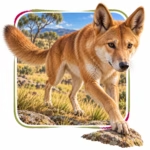
Coyote Fact Highlight
From the full animal facts page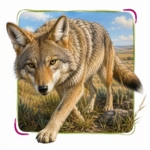
More Animal Comparisons
Pick another animal matchup and keep exploring. Compare appearances, habitats, diets, abilities, and surprising differences.

Make an Animal Story
Turn this dingo vs coyote comparison into a cross-continent wild-canid adventure with our free Animal Story Generator.
Source notes: References used for this comparison. See more See less
Try Another Matchup
Explore this comparison →