
Dragonfly vs Mosquito: Flying Insect Comparison
Dragonflies and mosquitoes are both flying insects whose young develop in water, but their bodies and life cycles are very different. An adult dragonfly is a large visual hunter with four broad wings, huge eyes, short antennae, and chewing mouthparts. An adult mosquito is a much smaller true fly with one functional wing pair, two balancing halteres, long antennae and legs, and a narrow proboscis for drinking liquids. A dragonfly grows from aquatic nymph to adult without a pupa, while a mosquito passes through aquatic larval and pupal stages.
About Dragonfly
- Type Insect
- Diet Carnivore; adults catch flying insects and nymphs hunt aquatic animals
- Group Dragonfly (Order Odonata; Suborder Anisoptera)
- Known for Four net-veined wings, enormous compound eyes, short antennae, forward-pointing prey-catching legs, chewing mouthparts, agile flight, aquatic predatory nymphs, and incomplete metamorphosis without a pupa
- Special skill Controlling four wings in agile flight and using a hinged extendable lower lip to seize prey underwater as a nymph
About Mosquito
- Type Insect
- Diet Adults drink nectar and plant sugars; females of many species also take blood meals for egg development
- Group True Fly (Family Culicidae)
- Known for One functional wing pair, balancing halteres, narrow scaled wings, long legs, an elongated proboscis, sensitive odor detection, aquatic larvae and pupae, and complete metamorphosis
- Special skill Detecting carbon dioxide and body odors and completing both larval and pupal development in water
Dragonfly vs Mosquito: Quick Answer
A dragonfly is a predatory insect in Odonata with four net-veined wings, enormous eyes, chewing mouthparts, and an aquatic nymph stage but no pupa. A mosquito is a true fly in Culicidae with two wings, two halteres, a proboscis, an aquatic larva, and an aquatic pupa. Dragonflies can eat mosquitoes, but they also hunt many other small insects.
Where Do They Fit?
Follow the branches to see how Dragonfly and Mosquito are classified and related.
Dragonfly vs Mosquito: Quick Comparison
| Feature | Dragonfly | Mosquito |
|---|---|---|
| Scientific group | Order Odonata, suborder Anisoptera | Order Diptera, family Culicidae |
| Typical adult size | Medium to large for a flying insect | Small and slender |
| Functional wings | Four net-veined wings | Two narrow scaled wings |
| Balancing organs | Controls two full wing pairs | Has two halteres formed from the reduced hindwings |
| Eyes and antennae | Huge compound eyes and very short antennae | Smaller compound eyes and long sensitive antennae |
| Adult mouthparts | Chewing mandibles for insect prey | Elongated proboscis for drinking liquids |
| Young stage | Aquatic predatory nymph or naiad with six legs | Aquatic legless larva or wiggler that mostly filters or gathers tiny food |
| Pupal stage | None | Aquatic active pupa or tumbler |
| Metamorphosis | Incomplete: egg, nymph, adult | Complete: egg, larva, pupa, adult |
| Adult food | Flying insects | Nectar and plant sugars; many females also take blood |
How Are Dragonflies and Mosquitoes Alike?
- Both are insects with six legs, antennae, compound eyes, three main body regions, and an exoskeleton.
- Both have flying adults and aquatic immature stages.
- Both lay eggs in water, on wet surfaces, or near water depending on species.
- Both are important prey for fish, amphibians, birds, bats, spiders, and other invertebrates.
- Both molt as they grow and become winged only as adults.
How Are Dragonflies and Mosquitoes Different?
- Dragonflies belong to Odonata, while mosquitoes are true flies in Diptera.
- Dragonflies fly with four functional wings, while mosquitoes use one wing pair and balance with halteres.
- Dragonflies have huge eyes, tiny antennae, and chewing jaws, while mosquitoes have longer antennae and a liquid-drinking proboscis.
- A dragonfly nymph has legs and hunts aquatic prey, while a mosquito larva is legless and usually eats microorganisms or organic particles.
- Dragonflies have no pupal stage, while mosquitoes become active aquatic pupae before emerging as adults.
Dragonfly vs Mosquito Showdown
Wetland-flight showdown: The dragonfly wins size, speed, and strength as a large aerial predator, and it takes swimming because many nymphs can blast water from an internal gill chamber for jetlike movement. The mosquito wins stealth through its tiny, light body and sensitive host-detecting senses. Social behavior is a tie because neither forms cooperative colonies, even though both can gather. The dragonfly wins our weirdest-fact prize for spending its youth underwater with a hinged prey-catching mouthpart, then skipping the pupal stage and emerging as a four-winged adult.
Fun Dragonfly vs Mosquito Facts
Four Wings Face Two Wings and Two Halteres
A dragonfly has two full pairs of membranous wings crossed by a network of veins. A mosquito, like every typical true fly, uses only its front pair as wings. Its reduced hindwings are small club-shaped halteres that vibrate and detect turns, helping the mosquito balance in flight.
One Life Cycle Skips the Pupa
Dragonflies undergo incomplete metamorphosis: egg, aquatic nymph, and adult. Wing pads enlarge outside the nymph’s body until its final molt above water. Mosquitoes undergo complete metamorphosis: egg, aquatic larva, aquatic pupa, and adult. The pupa does not feed but can tumble through water.
Dragonfly Nymphs Carry a Folding Grabber
A dragonfly nymph’s lower lip, or labium, is hinged and can shoot forward to seize insect larvae, crustaceans, tadpoles, or small fish depending on the nymph’s size. Water moved through internal rectal gills supplies oxygen and can also be expelled quickly for escape.
Mosquito Mouths Differ by Sex and Species
Adult male mosquitoes drink nectar and other plant sugars and do not take blood meals. Females also use sugar for energy; females of many species take blood to gain nutrients for egg production, while some mosquito species can reproduce without doing so. The proboscis contains specialized mouthparts inside an outer sheath.
Dragonflies Eat More Than Mosquitoes
Adult dragonflies catch mosquitoes, midges, flies, moths, and other airborne insects, while nymphs may capture mosquito larvae and many other aquatic animals. They are general predators rather than mosquito-only hunters, so a dragonfly sighting does not guarantee that local mosquitoes will disappear.
Dragonfly vs Mosquito Quiz
- How many functional wings does an adult dragonfly have? Answer: Four.
- What balancing organs replace a mosquito’s hindwings? Answer: Halteres.
- Which insect has no pupal stage? Answer: The dragonfly.
- Where do the young stages of both insects live? Answer: In water or aquatic habitats.
- Do male mosquitoes take blood meals? Answer: No; they drink plant sugars such as nectar.
Dragonfly vs Mosquito FAQ
What is the main difference between a dragonfly and a mosquito?
A dragonfly is a large four-winged predator with huge eyes and chewing mouthparts. A mosquito is a small two-winged true fly with halteres and a liquid-drinking proboscis.
Do dragonflies eat mosquitoes?
Yes. Adults can catch adult mosquitoes, and nymphs can capture mosquito larvae. However, dragonflies eat many kinds of prey and do not specialize only in mosquitoes.
Are dragonflies dangerous to people?
No. Dragonflies do not sting or seek people for food. They can use their jaws if roughly handled, so watching without grabbing is safest for the insect and observer.
Do all mosquitoes bite people?
No. Males do not take blood meals, some females feed on animals other than people, and females of some species do not require blood for egg production.
Why do dragonflies have no pupa?
Dragonflies use incomplete metamorphosis. Their aquatic nymphs gradually develop external wing pads and become adults during a final molt rather than reorganizing inside a pupa.
Animal Words to Know
- Odonata: The insect order containing dragonflies and damselflies.
- Culicidae: The true-fly family containing all mosquitoes.
- Nymph: An immature insect stage in incomplete metamorphosis; an aquatic nymph may also be called a naiad.
- Halter: One small balancing organ formed from a true fly’s reduced hindwing.
- Labium: The lower lip; a dragonfly nymph has a hinged extendable labium for catching prey.
Dragonfly and Mosquito Pond Activity
Dragonfly and Mosquito Pond Activity
Draw a dragonfly and a mosquito above a pond, using a magnified inset for the much smaller mosquito. Give the dragonfly four net-veined wings and huge eyes. Give the mosquito one narrow wing pair, long legs, and a proboscis. Underwater, draw a six-legged dragonfly nymph beside a legless mosquito larva and pupa. Label dragonfly, mosquito, nymph, larva, pupa, and pond.
Meet Each Animal
Want the full fact file? Here are quick highlights from each animal’s own facts page.
Dragonfly Fact Highlight
From the full animal facts page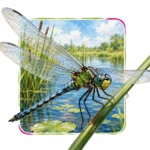
Mosquito Fact Highlight
From the full animal facts page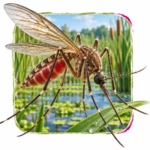
More Animal Comparisons
Pick another animal matchup and keep exploring. Compare appearances, habitats, diets, abilities, and surprising differences.





Make an Animal Story
Turn this dragonfly vs mosquito comparison into a lively pond-patrol adventure with our free Animal Story Generator.
Source notes: References used for this comparison. See more See less
Try Another Matchup
Explore this comparison →