
European Robin vs American Robin: Robin Name Comparison
European and American robins share an orange breast and a familiar name, but they are not close robin twins. The European Robin, Erithacus rubecula, is a tiny member of the Old World flycatcher family. The American Robin, Turdus migratorius, is a much larger true thrush. European robins often guard small territories alone, while American robins may gather in large flocks outside the nesting season.
About European Robin
- Type Living
- Diet Omnivore; mainly small invertebrates, berries, fruit and some seeds
- Group Old World flycatcher family species (Erithacus rubecula)
- Known for Tiny round body, orange face and breast, fine bill, bold song and fierce defense of a small territory
- Special skill Darts from low cover to catch tiny ground animals and can hold a territory with a surprisingly strong song
About American Robin
- Type Living
- Diet Omnivore; earthworms and insects in warmer months, with more fruit and berries in colder months
- Group True thrush family species (Turdus migratorius)
- Known for Large thrush body, rusty-orange breast, yellow bill, lawn hunting, blue eggs and cheerful spring song
- Special skill Runs across lawns, stops upright and quickly grabs earthworms or insects before flying to a cup-shaped nest
European Robin vs American Robin: Quick Answer
The European Robin is a small, round bird with an orange face and breast, brown back and thin dark bill. The American Robin is much larger, with a rusty-orange belly, gray-brown back, darker head and yellow bill. They belong to different bird families. The American bird received its name because European settlers thought its orange breast looked familiar.
Where Do They Fit?
Follow the branches to see how European Robin and American Robin are classified and related.
European Robin vs American Robin: Quick Comparison
| Feature | European Robin | American Robin |
|---|---|---|
| Scientific name | Erithacus rubecula | Turdus migratorius |
| Bird family | Muscicapidae, the Old World flycatchers | Turdidae, the true thrushes |
| Length | About 12.5-14 cm | About 20-28 cm |
| Mass | Usually about 14-22 g | Usually about 77-85 g |
| Orange color | Covers the face, throat and upper breast | Covers much of the breast and belly but not the face |
| Bill | Short, thin and dark | Longer and mostly yellow |
| Young bird | Mottled brown and lacks the adult orange face | Spotted below, with a paler version of the adult shape |
| Nest and eggs | Low cup nest; pale eggs with reddish-brown speckles | Mud-lined cup nest; famously smooth blue eggs |
| Social pattern | Often solitary and strongly territorial | Territorial while nesting but often forms winter flocks |
| Native range | Europe, western Asia and North Africa | North America from Alaska and Canada south into Mexico |
How Are European and American Robins Alike?
- Both are songbirds with a warm orange or reddish breast.
- Both search on or near the ground for worms, insects and other small invertebrates.
- Both switch toward berries and other fruit when those foods become plentiful.
- Both build cup-shaped nests and feed helpless chicks in the nest.
- Both include populations that migrate and populations that stay in one region year-round.
How Are European and American Robins Different?
- The American Robin is roughly twice as long and usually several times heavier.
- The European Robin is an Old World flycatcher; the American Robin is a true thrush.
- Orange reaches a European Robin’s face, while an American Robin has a darker head and yellow bill.
- European robins are often solitary and territorial; American robins commonly gather in winter flocks.
- American robins lay bright blue eggs, while European Robin eggs are pale and speckled.
European vs American Robin Adaptation Showdown
- Size – American Robin: It is about twice as long and normally four or more times heavier than a European Robin.
- Speed – Tie: Both make quick flights and ground dashes, but no fair shared-course measurement proves a winner.
- Strength – American Robin: Its much larger body gives it more total power for flight and pulling large earthworms; this is not a fight prediction.
- Stealth – European Robin: Its tiny brown-backed body can disappear into dense, shadowy undergrowth even when its orange breast is nearby.
- Social – American Robin: Outside the nesting season, American robins can travel and feed in flocks far larger than the European bird’s usual groups.
- Swimming – Tie: Neither species is a swimming specialist, and the available evidence gives neither a meaningful advantage.
- Weirdest – American Robin: Its eggs contain blue-green pigment, producing the color so famous that people call a whole shade robin’s-egg blue.
Fun European Robin vs American Robin Facts
Robins in Name Only
The European Robin belongs to the Old World flycatcher family, while the American Robin is a thrush. Their similar orange breasts inspired the shared name.
A Blue Egg Bowl
An American Robin builds a sturdy grass cup reinforced with mud. The female usually lays several smooth blue eggs inside it.
A Spotty Childhood
Young European robins do not yet have orange faces, and young American robins have dark spots on the breast. The patterns help hide inexperienced birds.
Winter Changes the Menu
Both species take many insects and worms, but fruit becomes especially important when cold weather makes tiny animals harder to find.
A Tiny Territory Guard
A European Robin may look gentle near a garden path, yet it sings and displays boldly to keep other robins out of its feeding area.
European Robin vs American Robin Quiz
Which robin is much larger? A) European Robin B) American Robin C) They are equal Answer: B) American Robin
Which robin belongs to the true thrush family? A) European Robin B) American Robin C) Neither Answer: B) American Robin
Which robin has orange on its face? A) European Robin B) American Robin C) Both always do Answer: A) European Robin
What color are American Robin eggs? A) Bright blue B) Black C) Green with stripes Answer: A) Bright blue
Which robin often forms large winter flocks? A) European Robin B) American Robin C) Neither Answer: B) American Robin
European Robin vs American Robin FAQ
Are European and American robins closely related?
No. They are both songbirds, but the European Robin is an Old World flycatcher and the American Robin is a true thrush.
Why are both called robins?
European settlers in North America gave the American bird a familiar name because its orange-red breast reminded them of the European Robin.
Which robin is bigger?
The American Robin is much bigger, usually several times heavier and roughly twice as long.
Do both robins migrate?
Some populations do. Migration distance varies with location, weather and food, and some birds remain in the same broad area all year.
Can I identify them by location alone?
Usually, because their native ranges are on different continents, but escaped or rare wandering birds make plumage, size and bill shape useful too.
Animal Words to Know
- Flycatcher: A bird in one of several families whose members often catch insects.
- Flock: A group of birds traveling, resting or feeding together.
- Migrate: To move seasonally between different regions.
- Territory: An area an animal claims and defends from others of its species.
- Thrush: A songbird in the family Turdidae, often with strong legs and a varied song.
Build a Robin Name Detective Card
Build a Robin Name Detective Card
Fold a page in half. Draw a tiny European Robin with an orange face, thin dark bill and brown back on one side. Draw a much larger American Robin with a dark head, yellow bill and blue egg on the other. Add family, size, egg and social clues, then cover the names and identify each bird.
Meet Each Animal
Want the full fact file? Here are quick highlights from each animal’s own facts page.
European Robin Fact Highlight
From the full animal facts page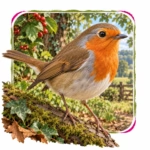
American Robin Fact Highlight
From the full animal facts page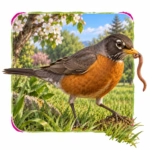
More Animal Comparisons
Pick another animal matchup and keep exploring. Compare appearances, habitats, diets, abilities, and surprising differences.






Make an Animal Story
Create a robin story about a tiny garden singer meeting a much larger traveler from across the ocean!
Source notes: References used for this comparison. See more See less
Try Another Matchup
Explore this comparison →