
Gazelle vs Antelope: Living Bovid Subgroup-to-Umbrella Comparison
Gazelle and antelope are not two equal scientific groups. Every true gazelle is a kind of antelope, but most antelopes are not gazelles. Gazelles are a recognizable set of slender bovids in genera such as Gazella, Eudorcas, and Nanger. Antelope is a much broader informal name covering many other bovid lineages, including impalas, eland, kudu, oryx, dik-diks, duikers, wildebeest, saiga, lechwe, and more. The word does not describe one species, one genus, or one neat evolutionary branch.
About Gazelle
- Type Mammal
- Diet Ruminant herbivores that graze grasses and browse leaves, shoots, herbs, flowers, seedpods, and shrubs, often obtaining substantial water from vegetation
- Group Gazelles (several genera including Gazella, Eudorcas, and Nanger; Tribe Antilopini; Family Bovidae)
- Known for Generally small-to-medium, slender antelopes with light frames, long narrow legs, fine faces, large eyes, short tails, tan or reddish coats, white undersides and rumps, dark side or face markings in many species, permanent ringed horns in males and often females, and bodies specialized for swift open-country movement
- Special skill Combining lightweight legs, efficient lungs and circulation, wide vision, camouflage, warning signals, rapid turns, fast running, and stiff-legged stotting leaps in many species
About Antelope
- Type Mammal
- Diet Mostly ruminant herbivores that graze grasses, browse leaves and shoots, or switch between them; a few small duikers sometimes add fallen fruit, insects, eggs, or tiny animals
- Group Antelopes (informal name for many horned lineages in Family Bovidae; this field means non-gazelle antelopes for contrast)
- Known for Extremely varied bovid body plans ranging from rabbit-size royal antelope and tiny dik-diks to giant eland and wildebeest, with cloven hooves, permanent keratin-sheathed horns in at least males, ruminant digestion, and forms specialized for running, hiding, climbing rocks, browsing forests, crossing deserts, or wading through wetlands
- Special skill Diversifying one bovid blueprint into desert oryx, rock-hopping klipspringers, swamp-running lechwe, long-necked gerenuk, forest duikers, giant eland, wide-ranging herds, and many other specialists
Gazelle vs Antelope: Quick Answer
A gazelle is a particular kind of small-to-medium, slender, swift antelope. “Antelope” is the larger umbrella name for many horned hoofed mammals in the cattle family Bovidae. Therefore, every gazelle is an antelope, but an eland, kudu, oryx, wildebeest, duiker, and many other antelopes are not gazelles. Pronghorn are often nicknamed American antelope but belong to Antilocapridae, not Bovidae.
Where Do They Fit?
Follow the branches to see how Gazelle and Antelope are classified and related.
Gazelle vs Antelope: Quick Comparison
| Feature | Gazelles | Antelopes as a Wider Group |
|---|---|---|
| Relationship | A named subgroup of antelopes | The broad umbrella that contains gazelles and many others |
| Taxonomy | Several genera, especially Gazella, Eudorcas, and Nanger | Many separate bovid branches; not one strict taxonomic clade |
| Examples | Thomson’s, dorcas, dama, Grant’s, and goitered gazelles | Eland, kudu, oryx, impala, wildebeest, duiker, saiga, lechwe, and gazelles |
| Typical build | Usually slender, light, long-legged, and open-country adapted | Anything from tiny forest hider to giant muscular grazer |
| Size | Small to medium; Thomson’s gazelle about 15–35 kg | From about 3 kg royal antelope to several hundred kilograms |
| Horns | Permanent ringed horns; sex pattern differs by species | Permanent bovid horns in at least males; shape varies enormously |
| Movement | Fast running, turning, and stotting in many species | Running, hiding, swimming, wading, rock-hopping, or migrating |
| Habitat | Mainly dry open country, though species differ | Desert, grassland, forest, mountain, scrub, and wetland |
| Food | Grass, herbs, leaves, shoots, and shrubs | Mostly grazing, browsing, or mixed herbivory |
| Young | Calf | Calf |
How Are Gazelles and Other Antelopes Alike?
- Gazelles and other true antelopes are mammals in Bovidae and even-toed hoofed order Artiodactyla.
- They have cloven hooves, horizontal pupils, keen senses, plant diets, cud-chewing digestion, and permanent horns rather than deer antlers.
- Most rely on camouflage, alert posture, alarm signals, speed, hiding, group vigilance, or horns to survive.
- Females give birth to calves that can stand and move soon after birth, though some hide before joining a herd.
- Many face habitat loss, barriers, competition with livestock, hunting, drought, and disrupted migration routes.
How Are Gazelles and Other Antelopes Different?
- Gazelle names apply to a limited set of related antelope genera; antelope is a broad common category spanning many bovid branches.
- Gazelles are usually light, narrow-bodied open-country runners, while other antelopes include heavy eland, shaggy wildebeest, tiny forest duikers, and wetland lechwe.
- Most gazelles live in dry grassland, steppe, scrub, or desert; the wider group also occupies rainforest, marsh, reedbed, high mountain, and rocky cliff.
- Gazelles often stot and sprint, whereas other antelopes may hide motionless, wade, swim, rock-hop, climb, or travel in giant migrations.
- Gazelle horns are commonly slender and ringed; wider antelope horns may be straight, spiral, curved, lyre-shaped, ridged, short, or extremely long.
- There is no single conservation status for either category: each species must be assessed separately.
Gazelle vs Wider Antelope Group Adaptation Showdown
Group-within-a-group adaptation showdown: The wider antelope group wins maximum size, strength, habitat stealth, swimming, and weirdest specialization because it includes giant eland, forest duikers, wetland lechwe, rock-hopping klipspringers, long-necked gerenuk, and big-nosed saiga. Gazelles take the representative open-country speed and agility category, though speed varies and some other antelopes are also extremely fast. Social skill is a tie because both include solitary, paired, territorial, herd-living, and migratory strategies. These categories compare adaptations, not combat.
Fun Gazelle vs Antelope Facts
Every Gazelle Is an Antelope
Gazelles sit inside the broader antelope umbrella, much as robins sit inside the broader bird category. The reverse does not work: an eland, kudu, oryx, wildebeest, impala, duiker, or lechwe is an antelope but not a gazelle.
Gazelle Is More Than One Genus
Familiar gazelles do not all belong to Gazella. Thomson’s gazelle is placed in Eudorcas, Grant’s and dama gazelles in Nanger, and dorcas and mountain gazelles in Gazella. Scientific classification changes as anatomy, fossils, and genetic evidence are compared.
Horns Are Not Antlers
True antelope horns have a bony core wrapped in keratin and normally remain attached throughout life. Deer antlers are solid bone and are shed and regrown. Horn presence and shape vary by antelope species and sex, so a hornless-looking female may still belong to Bovidae.
A Gazelle’s Bounce Is Called Stotting
Many gazelles spring upward with relatively stiff legs so all four hooves leave the ground. Stotting may alert companions, show that an animal is difficult to catch, or help monitor danger. Springbok and some other antelopes also perform spectacular bounding displays.
An “American Antelope” Is Not a True Antelope
The North American pronghorn is often called an antelope, but it belongs to Antilocapridae rather than Bovidae. Its forked keratin horn sheaths are shed, unlike the permanent sheaths of true bovid horns. Common names can mislead, which is why family names matter.
Gazelle vs Antelope Quiz
- Is every gazelle an antelope? Answer: Yes.
- Is every antelope a gazelle? Answer: No.
- Name three gazelle genera. Answer: Gazella, Eudorcas, and Nanger.
- What is a gazelle’s stiff-legged leap called? Answer: Stotting.
- Is the North American pronghorn a true antelope? Answer: No; it belongs to Antilocapridae.
Gazelle vs Antelope FAQ
What is the main difference between a gazelle and an antelope?
Gazelle is a narrower name for certain slender antelopes. Antelope is the broader informal category containing gazelles and many other bovids.
Is an impala a gazelle?
No. An impala is an antelope in its own genus, Aepyceros, but it is not a gazelle.
Are gazelles the fastest antelopes?
Gazelles are very fast and agile, but speed differs among species and testing methods. Springbok, wildebeest, topi, and other antelopes are also rapid runners.
Do all antelopes live in Africa?
No. Most occur in Africa, but true antelopes also live across the Middle East and Asia. Gazelles themselves range across all three regions.
Do all antelopes have horns?
True antelopes have permanent bovid horns in at least males, but females may have large horns, small horns, or none depending on species.
Animal Words to Know
- Antelope: An informal name for many horned hoofed mammals in Bovidae, excluding cattle, sheep, and goats in ordinary usage.
- Bovid: A member of Bovidae, the family containing antelopes, cattle, sheep, goats, and relatives.
- Ruminant: A hoofed herbivore that ferments plants in a chambered stomach and rechews cud.
- Stotting: A stiff-legged leap in which all four hooves leave the ground.
- Keratin: The tough protein forming hair, nails, and the outer sheath of a true horn.
Gazelle and Antelope Sorting Activity
Gazelle and Antelope Sorting Activity
Draw a large circle labeled antelopes and place several gazelles inside it, such as Thomson’s, dorcas, and Grant’s gazelles. Add non-gazelle antelopes, such as an impala, kudu, oryx, and wildebeest, inside the same larger circle. Put the pronghorn outside because it belongs to a different family. Label gazelle, antelope, horns, Bovidae, grassland, and desert.
Meet Each Animal
Want the full fact file? Here are quick highlights from each animal’s own facts page.
Gazelle Fact Highlight
From the full animal facts page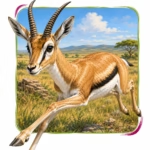
Antelope Fact Highlight
From the full animal facts page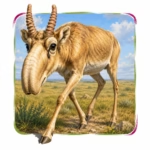
More Animal Comparisons
Pick another animal matchup and keep exploring. Compare appearances, habitats, diets, abilities, and surprising differences.



Make an Animal Story
Turn this gazelle vs antelope comparison into a hoofed-animal sorting adventure with our free Animal Story Generator.
Source notes: References used for this comparison. See more See less
Try Another Matchup
Explore this comparison →