
Gharial vs Mugger Crocodile
Gharials and Mugger Crocodiles are Asian crocodilians, but their heads reveal very different jobs. The Gharial, Gavialis gangeticus, is longer and slimmer, with an extremely narrow snout for sweeping after fish in deep rivers. An adult male grows a rounded knob called a ghara on his snout. The Mugger Crocodile, Crocodylus palustris, is shorter and much heavier-bodied. Its broad jaws handle many kinds of prey, and its stronger legs carry it between rivers, lakes and ponds.
About Gharial
- Type Living
- Diet Carnivore and fish specialist; young also eat insects, frogs and other small aquatic animals
- Group Highly aquatic, fish-eating crocodilian in family Gavialidae (Gavialis gangeticus)
- Known for Extremely long narrow snout, many needle-like teeth, large swimming tail and the adult male’s round ghara nose knob
- Special skill Sweeps its narrow snout sideways through water and snaps long jaws around slippery fish with little drag
About Mugger Crocodile
- Type Living
- Diet Carnivore and generalist; eats fish, reptiles, birds and mammals, while hatchlings take insects and crabs
- Group Broad-snouted true crocodile also called the marsh crocodile (Crocodylus palustris)
- Known for Very broad snout, heavy armored body, powerful jaws, strong swimming, capable land travel and cooling burrows
- Special skill Walks overland to find water and digs a burrow that shelters it from extreme heat, cold or drought
Quick Answer
A Gharial is the longer, slimmer river specialist. Its needle-toothed narrow snout catches fish, its tail powers excellent swimming and an adult male grows a round ghara on his nose. A Mugger Crocodile is shorter but bulkier, with a broad snout for varied prey. It swims well, walks more capably on land and can shelter in a burrow.
Gharial vs Mugger Crocodile: Quick Comparison
| Feature | Gharial | Mugger Crocodile |
|---|---|---|
| Scientific name | Gavialis gangeticus | Crocodylus palustris |
| Adult length | Females about 3.5-4.5 m; large males about 5-6 m | Most adults about 3-4 m; exceptional males may grow larger |
| Build | Very long and slim with a powerful flattened tail | Shorter-looking, broad and heavily built |
| Snout | Extremely long and narrow | Very broad and rounded |
| Teeth | Many slim, sharp, interlocking teeth for fish | Strong conical teeth for gripping many kinds of prey |
| Male feature | Adult male grows a round ghara at the snout tip | No ghara |
| Habitat | Large deep rivers with sandbanks | Rivers, lakes, marshes, ponds, reservoirs and canals |
| Main food | Mostly fish | Fish, reptiles, birds and mammals |
| Movement | Superb swimmer but can only belly-slide on land | Strong swimmer that can belly-walk or high-walk over land |
| Conservation | Critically Endangered | Vulnerable |
How Are Gharials and Mugger Crocodiles Alike?
- Both are large Asian crocodilians with armored skin, powerful tails and eyes high on the head.
- Both are cold-blooded reptiles that bask in sunshine to warm themselves.
- Both are carnivores that catch fish and other aquatic prey.
- Both lay eggs in nests on land and protect their nesting areas.
- Both need healthy freshwater habitat and safe banks for resting or nesting.
How Are Gharials and Mugger Crocodiles Different?
- A Gharial has an extremely narrow snout; a Mugger Crocodile has a broad rounded snout.
- The Gharial mainly catches fish, while the Mugger Crocodile eats many kinds of vertebrate prey.
- A Gharial may grow longer, but a Mugger Crocodile has a much heavier, stronger-looking body.
- Gharials are highly specialized for deep rivers and move poorly on land; Muggers use many wetlands and walk overland.
- Only the adult male Gharial grows a ghara knob at the tip of the snout.
Gharial vs Mugger Crocodile Adaptation Showdown
- Size – Gharial: Large adult males can reach about 5-6 m, giving this species the greater length.
- Speed – Tie: The Gharial is better shaped for water and the Mugger for land, so one fair all-surface winner is not supported.
- Strength – Mugger Crocodile: Its broad skull, robust jaws and heavy body suit tackling a wider range of large prey.
- Stealth – Mugger Crocodile: Its broad olive-brown body can wait almost fully submerged in many shallow, plant-filled wetlands.
- Social – Tie: Both may share basking sites and guard breeding areas, but neither forms a cooperative permanent team.
- Swimming – Gharial: A streamlined body, narrow snout and large flattened tail make it the stronger river specialist.
- Weirdest – Gharial: An adult male grows a hollow-looking round ghara that changes his calls and makes bubbles at the water surface.
Fun Gharial vs Mugger Crocodile Facts
A Pot on the Nose
The male Gharial’s ghara is named after an Indian clay pot with a similar rounded shape.
Built for Fish
A Gharial’s narrow jaws move through water with less resistance, and many sharp teeth snag slippery fish.
A Crocodilian That Slides
A Gharial’s legs are weak for lifting its body, so on land it usually pushes forward on its belly.
The Marsh Crocodile
Mugger Crocodiles use natural wetlands and human-made ponds, reservoirs and irrigation canals.
A Cool Underground Room
A Mugger Crocodile may dig a burrow where temperatures stay steadier during harsh heat, cold or drought.
Gharial vs Mugger Crocodile Quiz
Which animal has the narrowest snout? A) Gharial B) Mugger Crocodile C) Both Answer: A) Gharial
What is a ghara? A) A nose knob on an adult male Gharial B) A crocodile nest C) A kind of fish Answer: A) A nose knob on an adult male Gharial
Which animal eats the wider variety of prey? A) Gharial B) Mugger Crocodile C) Neither eats animals Answer: B) Mugger Crocodile
Which animal walks better on land? A) Gharial B) Mugger Crocodile C) They have no legs Answer: B) Mugger Crocodile
Which animal is Critically Endangered? A) Gharial B) Mugger Crocodile C) Both are extinct Answer: A) Gharial
Gharial vs Mugger Crocodile FAQ
Is a Gharial a Crocodile?
It is a crocodilian and close relative of true crocodiles, but it belongs to the separate gharial family Gavialidae.
Why is a Gharial’s snout so thin?
The narrow shape creates less drag in water, helping the jaws sweep sideways and snap around fish.
What does a Mugger Crocodile eat?
Adults eat fish, turtles, snakes, birds and mammals. Youngsters begin with smaller prey such as insects and crabs.
Can Gharials walk on land?
They can push themselves forward, but their legs do not lift the body well. They usually belly-slide rather than high-walk.
Do Gharials and Muggers live together?
Their ranges overlap in some South Asian rivers, but Gharials favor deeper flowing water while Muggers often use slower and shallower places.
Animal Words to Know
- Bask: To rest in sunlight and absorb heat.
- Crocodilian: A member of the reptile group containing crocodiles, alligators, caimans and gharials.
- Ghara: The rounded growth on the tip of an adult male Gharial’s snout.
- Generalist: An animal able to use many foods or habitats.
- Specialist: An animal strongly adapted to a narrow kind of food or habitat.
Design Two Crocodilian Snouts
Design Two Crocodilian Snouts
Cut two long paper strips. Shape one into a very narrow Gharial snout and draw many slim teeth; add a ghara circle for an adult male. Shape the other into a broad rounded Mugger snout and draw sturdy conical teeth. Place paper fish under the first and a mixed prey list under the second, then explain how each shape fits its menu.
Meet Each Animal
Want the full fact file? Here are quick highlights from each animal’s own facts page.
Gharial Fact Highlight
From the full animal facts page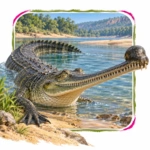
Mugger Crocodile Fact Highlight
From the full animal facts page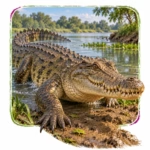
More Animal Comparisons
Pick another animal matchup and keep exploring. Compare appearances, habitats, diets, abilities, and surprising differences.


Make an Animal Story
Create a river story about a fish-catching Gharial and a broad-snouted Mugger Crocodile!
Source notes: References used for this comparison. See more See less
Try Another Matchup
Explore this comparison →