
Giant Squid vs Colossal Squid: Deep-Sea Cephalopod Species Comparison
Giant squid and colossal squid are different deep-sea species, not two names for the same animal. Giant squid are found across several oceans and usually win total length because their thin feeding tentacles can make up much of the measurement. Colossal squid live around Antarctica and are shorter overall but have a much larger, heavier mantle, bigger beak, and swivelling tentacle hooks. Both have eight arms, two feeding tentacles, enormous eyes, three hearts, blue blood, and many mysteries because scientists have seen so little of their natural behavior.
About Giant Squid
- Type Mollusk
- Diet Deep-water fishes and other squids captured by shooting out the two feeding tentacles, drawing prey to the eight arms, and cutting it with the beak; cannibalism has also been detected in some stomach studies
- Group Giant squid (Architeuthis dux), a deep-ocean cephalopod currently treated as one widely distributed species; females grow considerably larger than males
- Known for A long, relatively slender squid with a reddish-brown mantle, small triangular rear fins, enormous eyes, eight muscular arms, and two exceptionally long feeding tentacles whose widened clubs carry hundreds of suckers edged with toothed chitin rings; it also has a sharp beak, funnel, and internal pen
- Special skill Ten flexible appendages, exceptionally extensible feeding tentacles, toothed sucker rings, a powerful beak and radula, dinner-plate-sized light-gathering eyes, reddish skin with chromatophores, a muscular mantle and funnel for jet propulsion, fins for controlled swimming, gills, three hearts, copper-based blue blood, and ammonium-rich tissues that help with buoyancy
About Colossal Squid
- Type Mollusk
- Diet Large fishes, especially Antarctic and Patagonian toothfish, plus other deep-water prey; diet and hunting style are reconstructed from stomach contents, beaks, hooks, stable isotopes, and scars because an adult has never been watched feeding in the wild
- Group Colossal squid (Mesonychoteuthis hamiltoni), the only species in its genus and a cold-water member of the glass-squid family Cranchiidae
- Known for A shorter but far thicker and heavier squid with a broad muscular mantle, large terminal fins, huge forward-facing eyes, eight relatively short arms bearing hooks and suckers, and two feeding tentacles whose clubs carry suckers plus two rows of swivelling hooks; juveniles can look glassy and transparent, while larger animals become opaque reddish-purple
- Special skill A huge thick mantle, very large fins, the largest squid beak yet measured, powerful arms with fixed hooks and suckers, tentacle clubs with swivelling hooks, enormous eyes with light-producing organs called photophores, cold-water physiology, ammonium-based buoyancy, a funnel for jet propulsion, and red-purple chromatophores that can darken the body
Giant Squid vs Colossal Squid: Quick Answer
The giant squid is the longer animal, reaching about 13 meters in the best documented whole specimens because of two extremely long feeding tentacles. The colossal squid is the heavier and more thickly built animal: Te Papa’s famous specimen weighed about 490 kilograms, compared with about 275 kilograms for the largest giant squid figures used by the museum. Giant squid clubs grip with toothed suckers; colossal squid clubs add sharp swivelling hooks.
Where Do They Fit?
Follow the branches to see how Giant Squid and Colossal Squid are classified and related.
Giant Squid vs Colossal Squid: Quick Comparison
| Feature | Giant Squid | Colossal Squid |
|---|---|---|
| Scientific name | Architeuthis dux | Mesonychoteuthis hamiltoni |
| Cephalopod family | Architeuthidae | Cranchiidae, the glass-squid family |
| Main range | Temperate and subtropical deep water in several oceans | Cold circumpolar Southern Ocean around Antarctica |
| Best size clue | Longer overall, with a recorded total length near 13 m | Shorter overall, estimated to about 7 m, but much thicker and heavier |
| Documented weight clue | Up to about 275 kg in Te Papa’s comparison | Te Papa specimen about 490 kg |
| Body proportions | Relatively narrow mantle, small fins, and extremely long thin tentacles | Broad heavy mantle, large fins, shorter arms, and shorter stouter tentacles |
| Tentacle clubs | Many suckers edged by toothed chitin rings, without rotating hooks | Suckers plus two rows of sharp swivelling hooks |
| Arm equipment | Suckers with toothed rings | Both hooks and suckers |
| Live deep-sea milestone | First filmed in its natural habitat in 2012 after earlier live surface footage | A 30 cm juvenile was first confirmed on video in its habitat in 2025 |
| Major predator clue | Sperm-whale stomachs and sucker scars reveal many encounters | Sperm whales eat adults; beaks also occur in Antarctic predator diets |
How Are Giant Squid and Colossal Squid Alike?
- Both are enormous deep-sea cephalopod mollusks with a mantle, head, two fins, eight arms, two specialized feeding tentacles, a hard beak, and a radula.
- Both use gills, three hearts, copper-rich blue blood, a funnel for jet propulsion, and fins for slower steering and balance.
- Both have gigantic light-gathering eyes, skin cells that can alter color, and tissues that help them remain buoyant without a gas-filled swim bladder.
- Both eat fish and squid, and both can become prey for sperm whales despite their impressive grasping equipment.
- Both remain scientifically mysterious because intact adults are rarely found and normal feeding, mating, spawning, and development have scarcely been observed in the wild.
How Are Giant Squid and Colossal Squid Different?
- Giant squid range through several temperate and subtropical oceans; colossal squid are Southern Ocean specialists associated with Antarctic and subantarctic waters.
- Giant squid are longer overall because their feeding tentacles are extraordinarily stretched; colossal squid are shorter but have a much broader, heavier mantle and greater body mass.
- A giant squid tentacle club grips with many suckers lined by toothed rings; a colossal squid club combines suckers with two rows of swivelling hooks.
- Giant squid arms mainly bear suckers, while colossal squid arms carry both hooks and suckers and lead to a larger, more robust beak.
- Giant squid have comparatively small rear fins and a torpedo-like body; colossal squid have large fins and a compact, barrel-shaped mantle.
- Scientists filmed an adult-sized giant squid in deep water in 2012, whereas the first confirmed in-habitat colossal-squid footage in 2025 showed a transparent juvenile only 30 centimeters long, not the unknown adult giant.
Giant Squid vs Colossal Squid Adaptation Showdown
Deep-sea adaptation showdown: Colossal squid wins typical size when size means body mass and mantle bulk; giant squid wins total length, so both measurements must be named. Speed is a tie because no dependable adult maximum has been measured for either species. Colossal squid wins strength as a cautious anatomical inference from its heavier mantle, larger beak, stout arms, and hooks—not from a filmed contest. Stealth, teamwork, and swimming are ties because natural observations are too scarce for a fair ranking, and neither is known to hunt cooperatively. Colossal squid wins weirdest adaptation for tentacle hooks that swivel within fleshy sockets. These categories compare anatomy, not a fight.
Fun Giant Squid vs Colossal Squid Facts
The Longest Squid Is Not the Heaviest Squid
A well-documented giant squid can approach 13 meters from fin to tentacle tip, but much of that length consists of two narrow, elastic feeding tentacles. The colossal squid reaches a shorter estimated total length, around 7 meters, yet its mantle is so wide and muscular that a measured specimen weighed about 490 kilograms. Measuring only total length hides the difference between a ribbon-like reach and a massive body.
Sucker Rings and Swivelling Hooks Leave Different Clues
Each giant-squid sucker has a hard chitin ring with tiny teeth that help it hold slippery prey. Colossal-squid arms carry fixed hooks and suckers, while the enlarged tentacle clubs include hooks able to rotate in their fleshy sockets. Circular scars on sperm whales and hooks or beaks recovered from stomachs let researchers identify encounters even when no person saw them happen.
Their Giant Eyes Solve a Darkness Problem
Both squid possess enormous eyes that gather scarce light in the deep sea. A colossal-squid eye examined at Te Papa measured about the size of a dinner plate and included photophores that can produce light. Researchers think such eyes may help detect the glow of disturbed plankton around a moving sperm whale at a useful distance, but many details of vision and behavior remain hypotheses rather than direct observations.
Whales Became Unplanned Deep-Sea Research Vessels
Sperm whales dive deep enough to hunt both species. Scientists examine hard squid beaks in whale stomachs and compare sucker scars on whale skin to learn which squid live below. The first colossal-squid material described by science came from remains recovered from a sperm-whale stomach, while giant-squid beaks have also been especially valuable for estimating size and distribution.
A Transparent Baby Ended a Hundred-Year Camera Wait
On March 9, 2025, an underwater robot filmed a 30-centimeter juvenile colossal squid at 600 meters near the South Sandwich Islands. It was the first confirmed video of the species alive in its natural habitat, one hundred years after its formal naming. The baby looked glassy and delicate, very different from the opaque red-purple adult usually reconstructed from preserved specimens.
Giant Squid vs Colossal Squid Quiz
- Which squid is usually longer from fin to tentacle tip? Answer: The giant squid.
- Which squid has the heavier, broader mantle? Answer: The colossal squid.
- What special structures sit on a colossal squid’s tentacle clubs? Answer: Suckers and two rows of swivelling hooks.
- Where does the colossal squid live? Answer: In cold Southern Ocean waters around Antarctica and subantarctic islands.
- What was special about the colossal squid filmed in 2025? Answer: It was the first confirmed live individual filmed in its natural habitat, and it was a 30 cm juvenile.
Giant Squid vs Colossal Squid FAQ
Which is bigger, a giant squid or a colossal squid?
It depends on the measurement. Giant squid are longer overall, reaching about 13 meters in the best documented records. Colossal squid are shorter but much bulkier and heavier, with Te Papa’s specimen weighing about 490 kilograms. Calling one simply “bigger” hides this length-versus-mass difference.
Are giant squid and colossal squid the same species?
No. The giant squid is Architeuthis dux in family Architeuthidae. The colossal squid is Mesonychoteuthis hamiltoni in the glass-squid family Cranchiidae. They have different ranges, proportions, hooks, suckers, and evolutionary histories.
Do colossal squid have longer tentacles than giant squid?
No. Giant squid have the spectacularly long feeding tentacles that create their greater total length. Colossal-squid tentacles are shorter and stouter, but their clubs carry rotating hooks as well as suckers.
Has anyone seen a living colossal squid?
Yes. Fishers had previously brought up living or dying individuals, but the first confirmed video in the animal’s natural habitat was recorded in March 2025. It showed a 30-centimeter juvenile at 600 meters depth. No healthy adult has yet been filmed living freely in its deep habitat.
Would a colossal squid fight a giant squid?
There is no good evidence of natural meetings or battles. Their core ranges differ, with colossal squid centered in Antarctic waters and giant squid more broadly distributed in lower-latitude oceans. This page compares adaptations and measurements, not an imagined fight.
Animal Words to Know
- Mantle: The muscular main body of a squid that encloses most organs and pumps water for jet propulsion.
- Tentacle club: The widened end of a squid’s feeding tentacle where specialized suckers or hooks grip prey.
- Chitin: A tough biological material forming structures such as a squid’s toothed sucker rings and an insect’s outer skeleton.
- Photophore: A light-producing organ found in many deep-sea animals, including around the eyes of the colossal squid.
- Paralarva: A young free-swimming cephalopod that resembles a tiny adult but has different proportions and habits.
Giant Squid and Colossal Squid Body Activity
Giant Squid and Colossal Squid Body Activity
Draw a giant squid and colossal squid on the same scale. Give both eight arms and two feeding tentacles. Make the giant squid longer and slimmer, with especially long tentacles and sucker-lined clubs. Make the colossal squid broader and heavier-looking, with shorter tentacles and swiveling hooks on the clubs. Label mantle, arm, tentacle, sucker, hook, and deep ocean.
Meet Each Animal
Want the full fact file? Here are quick highlights from each animal’s own facts page.
Giant Squid Fact Highlight
From the full animal facts page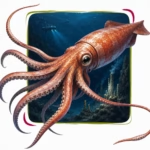
Colossal Squid Fact Highlight
From the full animal facts page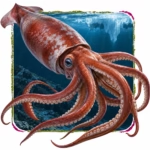
More Animal Comparisons
Pick another animal matchup and keep exploring. Compare appearances, habitats, diets, abilities, and surprising differences.






Make an Animal Story
Turn this giant squid vs colossal squid comparison into a deep-sea tentacle-and-hook mystery with our free Animal Story Generator.
Source notes: References used for this comparison. See more See less
Try Another Matchup
Explore this comparison →