
White-handed Gibbon vs Rhesus Macaque: Primate Group Comparison
Gibbons and macaques are both Asian primates, but one is an ape and the other is a monkey. This page uses the White-handed Gibbon, Hylobates lar, and the Rhesus Macaque, Macaca mulatta. The gibbon has no tail and swings beneath branches with extremely long arms. The macaque has a tail, runs and climbs on all fours, carries food in cheek pouches and lives in much larger troops across a wider range of habitats.
About White-handed Gibbon
- Type Living
- Diet Omnivore but mainly a fruit eater; also eats leaves, flowers, shoots and insects
- Group Small ape in the gibbon family Hylobatidae (Hylobates lar)
- Known for Extremely long arms, no tail, white hands and feet, pale face ring, hook-like grip, swinging travel and loud duets
- Special skill Brachiates hand over hand through the canopy, covering about 3 m in one swing and making much longer leaps
About Rhesus Macaque
- Type Living
- Diet Omnivore; eats fruit, seeds, roots, leaves, herbs, crops, insects, eggs and small animals
- Group Adaptable Old World monkey in genus Macaca (Macaca mulatta)
- Known for Brown-gray coat, bare pink face, medium tail, cheek pouches, clever hands, noisy troops and comfort around water
- Special skill Adapts to many climates and human-shaped places, stores food in cheek pouches and swims strongly
White-handed Gibbon vs Rhesus Macaque: Quick Answer
A White-handed Gibbon is a small tailless ape with arms much longer than its legs. It lives high in Southeast Asian forests, swings below branches and sings duets with its family. A Rhesus Macaque is a sturdier monkey with a pink face and medium tail. It walks on all fours, eats many foods, swims well and can live in forests, mountains, farms and cities.
Where Do They Fit?
Follow the branches to see how White-handed Gibbon and Rhesus Macaque are classified and related.
White-handed Gibbon vs Rhesus Macaque: Quick Comparison
| Feature | White-handed Gibbon | Rhesus Macaque |
|---|---|---|
| Scientific name | Hylobates lar | Macaca mulatta |
| Primate type | Small ape | Old World monkey |
| Adult mass | About 4.4-7.6 kg | Females average about 5.3 kg; males about 7.7 kg |
| Arms and body | Very long arms, slim body and hook-like hands | More balanced arms and legs with a sturdier body |
| Tail | No tail | Medium-length tail |
| Coat and face | Dark or pale coat, white hands and feet, and pale face ring | Brown-gray coat with a mostly bare pink face |
| Habitat | High rainforest canopy in Southeast Asia | Many Asian habitats from forest to mountains and cities |
| Food | Mostly ripe fruit, plus leaves, flowers and insects | Fruit, seeds, roots, leaves, insects, eggs and small animals |
| Social life | Small family group of about 2-6 | Large ranked troop, sometimes reaching about 200 |
| Special movement | Arm-over-arm brachiation and long canopy leaps | Four-limbed walking, running, climbing and strong swimming |
How Are White-handed Gibbons and Rhesus Macaques Alike?
- Both are intelligent Asian primates with grasping hands and forward-facing eyes.
- Both are active during the day and can climb trees.
- Both eat fruit, leaves, flowers and insects, although their menus differ.
- Both use calls, faces, touch and grooming to communicate.
- Both care for a single infant for a long period while it learns social and survival skills.
How Are White-handed Gibbons and Rhesus Macaques Different?
- A White-handed Gibbon is an ape with no tail; a Rhesus Macaque is a monkey with a tail.
- Gibbon arms are extremely long for swinging, while macaque limbs suit running and climbing on all fours.
- Gibbons stay mainly in high forest canopy, while macaques use the ground and trees in many habitats.
- Gibbons usually live in small family groups, while macaques form much larger ranked troops.
- Rhesus Macaques have cheek pouches and swim strongly; White-handed Gibbons have neither cheek pouches nor a swimming specialization.
White-handed Gibbon vs Rhesus Macaque Adaptation Showdown
- Size – Rhesus Macaque: Adult males average about 7.7 kg, slightly above the White-handed Gibbon’s published upper mass near 7.6 kg.
- Speed – White-handed Gibbon: Its specialized arms and hands carry it rapidly through open canopy gaps in swings of about 3 m.
- Strength – Rhesus Macaque: Its sturdier body and slightly higher average male mass give it a cautious all-round strength edge.
- Stealth – White-handed Gibbon: It moves mostly above the forest floor and can retreat quietly to high sleeping trees when predators are active.
- Social – Rhesus Macaque: A ranked troop may contain scores of monkeys and can sometimes reach about 200 members.
- Swimming – Rhesus Macaque: It willingly enters water and has been observed swimming across stretches as wide as 1 km.
- Weirdest – White-handed Gibbon: This tailless ape flies between branches with hook-like hands, then sings a long duet to announce its territory.
Fun White-handed Gibbon vs Rhesus Macaque Facts
An Ape, Not a Monkey
Gibbons belong to the ape family Hylobatidae. Like all apes, a White-handed Gibbon has no tail.
Three-Metre Swings
A White-handed Gibbon may cover about 3 m in one arm swing and leap much farther across an open canopy gap.
A Forest Duet
Bonded gibbons combine loud calls into patterned songs that announce their family and forest range.
Cheek-Pouch Shopping
A Rhesus Macaque stuffs food into stretchy cheek pouches so it can leave quickly and chew somewhere safer.
Swimming From Infancy
Rhesus Macaques are skilled swimmers, and even very young infants can move through water.
White-handed Gibbon vs Rhesus Macaque Quiz
Which primate is an ape? A) White-handed Gibbon B) Rhesus Macaque C) Both are monkeys Answer: A) White-handed Gibbon
Which primate has a tail? A) White-handed Gibbon B) Rhesus Macaque C) Neither Answer: B) Rhesus Macaque
What is brachiation? A) Arm-over-arm swinging B) Swimming underwater C) Digging a burrow Answer: A) Arm-over-arm swinging
Which primate lives in much larger troops? A) White-handed Gibbon B) Rhesus Macaque C) Both always live alone Answer: B) Rhesus Macaque
Which animal stores food in cheek pouches? A) White-handed Gibbon B) Rhesus Macaque C) Both Answer: B) Rhesus Macaque
White-handed Gibbon vs Rhesus Macaque FAQ
Is a Gibbon a Monkey?
No. A gibbon is a small ape. It has no tail and has the long arms and flexible shoulders of an ape.
Which Gibbon and Macaque does this page compare?
It uses the White-handed Gibbon and Rhesus Macaque. Other species can look and behave differently.
Why are a Gibbon’s arms so long?
Long arms and hook-like hands let it brachiate, swinging quickly beneath branches without stepping onto them.
Can Rhesus Macaques swim?
Yes. They are strong swimmers and have been observed crossing water up to about 1 km wide.
Do White-handed Gibbons always have pale fur?
No. Adults can have pale cream-brown or dark brown-black coats, but both color forms have white hands and a pale face ring.
Animal Words to Know
- Ape: A tailless primate group containing gibbons, orangutans, gorillas, chimpanzees, bonobos and humans.
- Brachiation: Travel by swinging arm over arm beneath branches.
- Canopy: The upper leafy layer formed by forest trees.
- Cheek pouch: An expandable space inside the cheek used to hold food temporarily.
- Troop: A social group of monkeys such as Rhesus Macaques.
Test Two Primate Travel Plans
Test Two Primate Travel Plans
Tape paper branches across the top half of a page and draw a tailless White-handed Gibbon swinging beneath them with both long arms. On the lower half, draw a pink-faced Rhesus Macaque walking on all fours with its tail behind it. Trace each route and label which body features make it work.
Meet Each Animal
Want the full fact file? Here are quick highlights from each animal’s own facts page.
White-handed Gibbon Fact Highlight
From the full animal facts page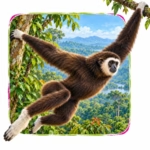
Rhesus Macaque Fact Highlight
From the full animal facts page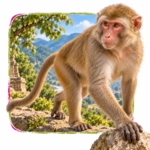
More Animal Comparisons
Pick another animal matchup and keep exploring. Compare appearances, habitats, diets, abilities, and surprising differences.

Make an Animal Story
Create a jungle story about a singing White-handed Gibbon and a swimming Rhesus Macaque!
Source notes: References used for this comparison. See more See less
Try Another Matchup
Explore this comparison →