
Goldfinch vs Canary for Kids
European Goldfinches and Atlantic Canaries are close finch relatives, but wild adults wear very different patterns. The goldfinch flashes a red face and bold yellow wing bars across Europe and western Asia. The Atlantic Canary is a smaller-looking, yellow-green, brown-streaked island bird. Domestic canaries descend from this wild species, but wild birds are not usually solid bright yellow.
About European Goldfinch
- Type Bird
- Diet Mostly herbivore; small seeds, especially thistle and teasel, plus some invertebrates
- Group Finch; family Fringillidae
- Known for A red face, black-and-white head, golden-yellow wing bars, tinkling calls, and acrobatic feeding
- Special skill Clings to swaying seed heads and uses a fine pointed bill to pull out tiny seeds
About Atlantic Canary
- Type Bird
- Diet Mostly herbivore; seeds, buds, fruit, and some small invertebrates
- Group Finch; family Fringillidae
- Known for Wild yellow-green plumage with brown streaks, a lively song, island life, and domestic descendants
- Special skill Produces complex musical phrases and thrives across varied habitats on volcanic islands
Quick Answer
Quick answer: Both are tiny, social, seed-eating finches. A European Goldfinch averages about 15.8 grams in BTO records and has a red face, black-and-white head, and brilliant yellow wing stripe. A wild Atlantic Canary is about 10 to 12 centimeters long, yellow-green with brown streaks, native to Atlantic islands, and is the ancestor of familiar domestic canaries.
European Goldfinch vs Atlantic Canary: Quick Comparison
| Feature | European Goldfinch | Atlantic Canary |
|---|---|---|
| Scientific identity | Carduelis carduelis | Serinus canaria |
| Bird family | Fringillidae | Fringillidae |
| Typical mass clue | Average adult about 15.8 g in BTO records | Reported range about 8.4-24.3 g |
| Head and body colors | Red face, black-and-white head, warm buff body | Yellow-green face and breast with brown or gray-brown streaks |
| Wing clue | Broad bright yellow bar on black wings | Duller yellow-green wings with darker streaking |
| Native range | Europe, western and central Asia, and North Africa | Canary Islands, Madeira, and Azores |
| Main food | Fine seeds, especially thistle and teasel | Seeds, buds, fruit, and some tiny invertebrates |
| Bill tool | Fine pointed cone for extracting small seeds | Short cone-shaped seed-cracking bill |
| Social life | Charms or flocks outside breeding | Flocks outside breeding; pairs may nest near one another |
| Famous sound | Light liquid twittering and tinkling calls | Musical warbling song with many phrases |
How Are Goldfinches and Canaries Alike?
- Both are small songbirds in the finch family, Fringillidae.
- Both have cone-shaped bills that help them handle many small seeds.
- Both include yellow in their plumage and communicate with musical calls or songs.
- Both build small cup nests in trees, shrubs, or other vegetation.
- Both may gather into flocks outside the breeding season.
How Are Goldfinches and Canaries Different?
- The goldfinch has a red face and bold black-white-yellow pattern; the wild canary is yellow-green and brown-streaked.
- The goldfinch is widespread across Europe, western Asia, and North Africa; the Atlantic Canary is native to three eastern Atlantic island groups.
- Goldfinches specialize in picking tiny seeds from plants such as thistles and teasels; canaries use a stouter seed bill across a varied plant diet.
- A goldfinch’s yellow wing bar flashes strongly in flight; a wild canary looks more softly streaked overall.
- Domestic canaries descend from Atlantic Canaries, while European Goldfinches were not the starting species for domestic canary breeds.
Goldfinch vs Canary Showdown
Adaptation showdown: Size is a Tie because both are tiny finches with overlapping body masses. Speed is a Tie because the sources provide no fair matched flight-speed test. Strength is a Tie because both use lightweight finch bodies and seed-handling bills rather than power. Atlantic Canary wins stealth because a wild bird’s yellow-green and brown-streaked feathers blend with island scrub better than a goldfinch’s bold red face and yellow wing bars. Social behavior is a Tie because both flock outside breeding and form pairs for nesting. Swimming is a Tie because neither is a water specialist. Atlantic Canary wins weirdest because one wild island species became the ancestor of the many colors and songs of domestic canaries.
Fun European Goldfinch vs Atlantic Canary Facts
Wild Canaries Are Streaked
Wild Atlantic Canaries are yellow-green with brown or gray-brown streaks. The smooth bright-yellow pet canary is a domestic form shaped by centuries of breeding.
A Flashing Gold Wing
European Goldfinches have a broad yellow bar across otherwise dark wings. The stripe can flash even when a fast flock twists through the air.
Built for Tiny Seeds
The European Goldfinch’s fine pointed bill reaches seeds inside thistles, teasels, and other plants. Its nimble feet help it cling at unusual angles.
Three Island Homes
The Atlantic Canary is native to the Canary Islands, Madeira, and the Azores. These volcanic island groups sit in the eastern Atlantic Ocean.
Both Belong to the Finch Family
Despite different colors and ranges, both species are members of Fringillidae. Their compact bodies, perching feet, and seed-adapted bills reveal the family resemblance.
Goldfinch vs Canary Quiz
- Which bird has a red face? Answer: The European Goldfinch.
- What does a wild Atlantic Canary usually look like? Answer: Yellow-green with brown or gray-brown streaks.
- Where is the Atlantic Canary native? Answer: The Canary Islands, Madeira, and the Azores.
- Which plant foods are especially linked with goldfinches? Answer: Tiny seeds from plants such as thistles and teasels.
- Are both birds finches? Answer: Yes. Both belong to the family Fringillidae.
European Goldfinch vs Atlantic Canary FAQ
Is a goldfinch a canary?
No. They are different species in the same finch family.
Are wild canaries bright yellow?
Wild Atlantic Canaries are usually yellow-green and streaked, unlike many bright domestic varieties.
Which bird has the red face?
An adult European Goldfinch has the bold red face.
Do both birds eat seeds?
Yes. Seeds are important to both, though each also eats other small foods.
Can both birds sing?
Yes. Both are songbirds, and the canary is especially famous for complex musical singing.
Animal Words to Know
- Finch: A small songbird in a family whose members often have bills adapted for seeds.
- Wing bar: A stripe across a bird’s folded or flying wing.
- Native range: The places where a species occurs naturally.
- Streaked: Marked with many narrow lines of color.
- Domestication: The long process by which people breed animals for life with humans and selected traits.
Design Two Finch Field Cards
Design Two Finch Field Cards
Draw exactly one adult European Goldfinch and exactly one adult wild Atlantic Canary at honest relative scale on two field cards. Label the goldfinch’s red face, black-and-white head, fine bill, and yellow wing bar. Label the canary’s yellow-green feathers, brown streaks, and short cone bill. Add maps for their native ranges and a seed menu. Observe any wild birds quietly without people handling them.
Meet Each Animal
Want the full fact file? Here are quick highlights from each animal’s own facts page.
European Goldfinch Fact Highlight
From the full animal facts page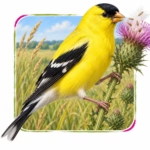
Atlantic Canary Fact Highlight
From the full animal facts page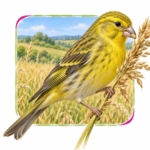
More Animal Comparisons
Pick another animal matchup and keep exploring. Compare appearances, habitats, diets, abilities, and surprising differences.



Make an Animal Story
Send a flashing Goldfinch and a musical wild Canary into an island seed mystery with our free Animal Story Generator.