
Greater Glider vs Flying Squirrel for Kids: Two Forest Gliders
The Southern Greater Glider and Northern Flying Squirrel live on opposite sides of the world and are not close relatives. One is an Australian marsupial possum, and the other is a North American placental rodent. Both independently evolved a skin sail, large night eyes, a steering tail, and a tree-cavity lifestyle.
About Southern Greater Glider
- Type Large gliding possum
- Diet Specialist herbivore
- Group Ringtail possum family, Pseudocheiridae
- Known for Being Australia’s largest gliding possum and eating eucalyptus leaves
- Special skill Glides on a membrane stretching between each elbow and knee
About Northern Flying Squirrel
- Type Small gliding rodent
- Diet Omnivore with a strong taste for fungi
- Group Squirrel family, Sciuridae
- Known for Silent night glides and a broad flattened steering tail
- Special skill Glides on a wrist-to-ankle membrane and spreads fungal spores through forests
Quick Answer
Quick answer: A Southern Greater Glider is a large Australian marsupial that eats mainly eucalyptus leaves and carries one joey in a pouch. A Northern Flying Squirrel is a much smaller North American placental rodent that eats fungi, lichens, nuts, and other foods and gives birth to several pups. Both glide rather than truly fly, but their similar bodies evolved independently.
Southern Greater Glider vs Northern Flying Squirrel: Quick Comparison
| Feature | Southern Greater Glider | Northern Flying Squirrel |
|---|---|---|
| Scientific name | Petauroides volans | Glaucomys sabrinus |
| Mammal branch | Marsupial possum in family Pseudocheiridae | Placental rodent in family Sciuridae |
| Native home | Eastern mainland Australia | Canada, Alaska, and northern or mountain regions of the United States |
| Body size | Body about 30 to 48 cm; usually about 1 to 1.5 kg | Total length about 27.5 to 34.2 cm; mass about 75 to 140 g |
| Gliding membrane | Stretches mainly from elbow to knee | Stretches from wrist to ankle |
| Main food | Almost entirely eucalyptus leaves and buds | Fungi, lichens, nuts, seeds, fruit, buds, sap, and occasional animal food |
| Young | Usually one joey that develops in a pouch and later rides on the back | Usually two to four pups that develop before birth in the uterus |
| Main shelter | Several hollows in old eucalypt trees | Tree cavities, old woodpecker holes, or leafy nests |
| Social life | Usually solitary and territorial | May share nests and huddle in groups during cold weather |
| Tail | Very long, bushy, and used as a rudder but not for gripping | Broad, flattened, and used for balance, braking, and steering |
How Greater Gliders and Flying Squirrels Are Alike
- Both are nocturnal tree-dwelling mammals with large dark eyes.
- Both glide on a patagium instead of using powered flight like a bat or bird.
- Both steer, brake, and balance with a long furry tail.
- Both shelter in tree cavities and depend on forests with mature trees.
- Both evolved similar gliding body shapes even though they are distant relatives.
How Greater Gliders and Flying Squirrels Are Different
- The Southern Greater Glider is a marsupial possum, while the Northern Flying Squirrel is a placental rodent.
- The Greater Glider lives in Australian eucalypt forest, while the flying squirrel lives in North American conifer and mixed forest.
- The Greater Glider is roughly eight to fifteen times as heavy as the Northern Flying Squirrel.
- The Greater Glider specializes on eucalyptus leaves, while the flying squirrel eats fungi, lichens, seeds, nuts, and other foods.
- A Greater Glider raises one pouch joey and is usually solitary, while a flying squirrel bears several pups and may huddle in shared nests.
Greater Glider vs Flying Squirrel Adaptation Showdown
Adaptation showdown: Southern Greater Glider wins size because it commonly weighs about 1 to 1.5 kg, many times the Northern Flying Squirrel’s 75 to 140 g. Speed is a Tie because both glide rather than truly fly and fair matched airspeed data are unavailable. Southern Greater Glider wins strength because its much larger body and climbing limbs handle thick branches and tough foliage. Stealth is a Tie because both are quiet, camouflaged, and active in darkness. Northern Flying Squirrel wins social behavior because several may share a winter nest, while the Greater Glider is usually solitary. Swimming is a Tie because neither species is a water specialist. Southern Greater Glider wins weirdest for being a giant leaf-eating marsupial whose elbow-to-knee sail resembles the flying squirrel’s separately evolved wrist-to-ankle sail.
Fun Southern Greater Glider vs Northern Flying Squirrel Facts
Look-alikes, Not Close Cousins
Greater Gliders are marsupial possums and flying squirrels are placental rodents. Their shared gliding shape evolved separately in a process called convergent evolution.
A Marsupial Giant
The Southern Greater Glider is Australia’s largest gliding possum. An adult may weigh more than ten Northern Flying Squirrels, although individual sizes vary.
Different Corners of the Sail
A Greater Glider spreads a membrane mainly between elbow and knee. A Northern Flying Squirrel spreads its membrane from wrist to ankle.
Fungi on the Move
Northern Flying Squirrels eat many underground fungi and carry fungal spores to new places in their droppings. Those fungi can form useful partnerships with tree roots.
Winter Roommates
Northern Flying Squirrels may share nests and huddle when temperatures fall. Groups can conserve heat inside a protected tree cavity.
Greater Glider vs Flying Squirrel Quiz
- Which animal is a marsupial? Answer: The Southern Greater Glider.
- Which animal is a rodent? Answer: The Northern Flying Squirrel.
- Do these mammals truly fly? Answer: No. They glide by trading height for forward movement.
- Which animal may share a nest in winter? Answer: The Northern Flying Squirrel.
- What is convergent evolution? Answer: It is the separate evolution of similar features in distantly related organisms facing similar challenges.
Southern Greater Glider vs Northern Flying Squirrel FAQ
Is a Greater Glider a flying squirrel?
No. It is an Australian marsupial possum, while flying squirrels are placental rodents.
Which animal is bigger?
The Southern Greater Glider is dramatically heavier and usually has a longer body.
Can either animal flap its membrane?
No. The membrane is a fixed skin sail used for gliding, steering, and braking, not powered flapping.
Why do Northern Flying Squirrels eat fungi?
Fungi are nutritious forest food, especially when other foods are scarce, and the squirrels spread fungal spores afterward.
Do Greater Gliders live in North America?
No. Southern Greater Gliders are native to eastern Australia; Northern Flying Squirrels are native to North America.
Animal Words to Know
- Placental mammal: A mammal whose young develops before birth with nourishment supplied through a placenta.
- Rodent: A mammal in the order Rodentia, with a pair of continuously growing incisors in each jaw.
- Patagium: A sheet of skin between the limbs that supports a gliding animal in the air.
- Convergent evolution: The separate evolution of similar features in organisms that are not close relatives.
- Mycorrhizal fungus: A fungus that forms a partnership with plant roots and helps exchange water and nutrients.
Map Two Forest Gliding Routes
Map Two Forest Gliding Routes
Draw exactly one adult Southern Greater Glider and exactly one adult Northern Flying Squirrel at honest relative scale, making the Greater Glider dramatically larger. Place them in separate but connected Australian eucalypt and North American conifer forest panels. Trace each membrane from its correct limb points and add safe launch, steering, and landing arrows. Label mammal branch, forest, food, nest, tail, and young. Never climb to nests or handle wild gliders.
Meet Each Animal
Want the full fact file? Here are quick highlights from each animal’s own facts page.
Southern Greater Glider Fact Highlight
From the full animal facts page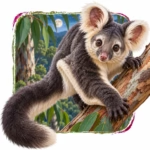
Northern Flying Squirrel Fact Highlight
From the full animal facts page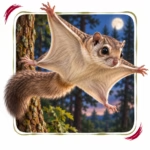
More Animal Comparisons
Pick another animal matchup and keep exploring. Compare appearances, habitats, diets, abilities, and surprising differences.
Make an Animal Story
Send an Australian Greater Glider and a North American Flying Squirrel across two moonlit forests with our free Animal Story Generator.