
Jaguar vs Cougar: Overlapping American Apex Cat Comparison
Jaguars and cougars are the two largest native cats across much of the Americas, and their ranges overlap from Mexico through Central America and large parts of South America. The jaguar is usually the heavier, stockier, rosetted water-associated Panthera cat with a skull-piercing bite and a roar. The cougar is the longer-tailed, plain-coated, extremely widespread Puma cat built for leaping, rough terrain, and habitat flexibility; cougar, puma, and mountain lion are different names for that one species.
About Jaguar
- Type Mammal
- Diet More than 85 documented prey species, including peccaries, deer, capybaras, tapirs, armadillos, turtles, caimans, fish, and birds; the jaguar stalks from cover, attacks at close range, and may use its broad jaws and thick canines to bite the neck or pierce the back of the skull
- Group Jaguar (Panthera onca), the largest living cat native to the Americas and the only living Panthera species native to the Western Hemisphere; black jaguars are melanistic individuals of this same species, not a separate “black panther” species
- Known for A stocky, broad-headed cat commonly measured around 1.5–1.8 meters from nose to rump with a 70–90-centimeter tail, up to roughly 75 centimeters at the shoulder, and about 68–136 kilograms in one widely used reference range; males are larger than females and regional body size varies sharply with habitat and prey
- Special skill Broad skull and powerful jaw muscles, thick canines, short muscular limbs, deep chest, large rounded paws, fully retractable claws, close-range acceleration, climbing, strong swimming, a relatively short tail, rosette camouflage, and a Panthera voice box capable of roaring; these traits support ambushes on land and in wet habitats
About Cougar
- Type Mammal
- Diet Mainly medium and large hoofed mammals such as deer, elk, guanacos, vicuñas, and peccaries, plus beavers, porcupines, rabbits, raccoons, birds, and other available prey; a cougar stalks silently, springs from close range, bites the neck, drags a large meal into cover, and often caches it under leaves or debris for later feeding
- Group Cougar (Puma concolor), one widespread American cat species also called puma, mountain lion, catamount, and—in some regions—panther; the Florida panther is a regional cougar population, not a separate cat species, and the many common names do not indicate different animals
- Known for A long, relatively slender cat with males around 1.02–1.54 meters from nose to rump plus a 68–96-centimeter tail and roughly 36–120 kilograms in a broad reference range, while females are around 0.86–1.31 meters plus a 63–79-centimeter tail and roughly 29–64 kilograms; most animals are well below exceptional upper masses
- Special skill Long muscular hind limbs for pouncing and leaping, a very long cylindrical tail for balance, flexible spine, broad paws, retractable claws, acute hearing and night vision, tan camouflage, terrain versatility, climbing and swimming ability, a short powerful skull, kill-caching behavior, vast travel ranges, and a voice that purrs, whistles, yowls, and screams but cannot produce a Panthera roar
Jaguar vs Cougar: Quick Answer
A jaguar is usually heavier and stockier, with a broad head, short tail, rosettes, a powerful bite, and strong swimming habits. A cougar is usually slimmer and longer-tailed, with a plain tan adult coat, powerful hind legs, and the widest native land-mammal range in the Western Hemisphere. Jaguars can roar; cougars purr, whistle, yowl, and scream but cannot roar.
Where Do They Fit?
Follow the branches to see how Jaguar and Cougar are classified and related.
Jaguar vs Cougar: Quick Comparison
| Feature | Jaguar | Cougar |
|---|---|---|
| Scientific name | Panthera onca | Puma concolor |
| Other names | Black jaguar when melanistic; sometimes loosely called black panther | Puma, mountain lion, catamount, and regional panther |
| Typical build | Heavier, stockier, broader head, shorter legs and tail | Slenderer, longer tail, powerful hindquarters, lighter head |
| Adult coat | Golden to reddish with rosettes; sometimes melanistic black | Mostly plain tawny, gray-brown, or reddish; no confirmed melanistic black form |
| Broad mass clue | Often cited around 68–136 kg, varying strongly by region and sex | Females about 29–64 kg and males about 36–120 kg in a broad reference range |
| Range | Resident populations mainly Mexico to northern Argentina in 18 countries | Southern Alaska to southern Chile across 23 countries |
| Water clue | Powerful swimmer strongly associated with rivers and wetlands in many regions | Can swim but is better known for land travel, climbing, and leaping |
| Hunting clue | Close ambush with exceptionally powerful neck or skull bite | Close stalk and pounce, neck bite, then often caches the meal |
| Voice | Roars and gives deep sawing calls | Purrs, whistles, yowls, and screams but cannot roar |
| Young pattern | Cubs are born rosetted or dark patterned like adults | Cubs are spotted, but the spots fade into a mostly plain adult coat |
How Are Jaguars and Cougars Alike?
- Both are native American cats in family Felidae, and their wild ranges overlap from Mexico through Central America and much of South America.
- Both are muscular carnivores that stalk quietly, pounce from close range, use retractable claws and a neck bite, and usually hunt without a permanent group.
- Both use forest, scrub, grassland, and other covered habitats, climb when useful, can swim, scent-mark routes, and require large connected landscapes.
- Both mothers raise spotted cubs alone, carry or hide them when young, provide food, and allow a long period for learning stalking and hunting skills.
- Both are top predators that influence prey and scavenger communities, yet both face habitat fragmentation, road deaths, prey loss, and retaliation around livestock.
How Are Jaguars and Cougars Different?
- Jaguars belong to genus Panthera and are the largest native American cats by typical mass; cougars belong to genus Puma and are usually lighter and more slender.
- Adult jaguars have rosettes with inner spots and may be melanistic black; adult cougars are mostly plain tan or gray-brown, although cougar cubs begin life with spots.
- A jaguar has a broad head, thick neck, compact limbs, rounded paws, and a relatively short tail; a cougar has powerful long hind limbs and a tail roughly one-third of its total length.
- Jaguars occupy a more restricted Latin American range and often depend on wet habitats; cougars span from southern Alaska to southern Chile across forests, mountains, deserts, grasslands, and steppe.
- Jaguars are specialized for an exceptionally powerful bite and may attack armored or aquatic reptiles; cougars often focus on hoofed mammals and commonly hide a kill under leaves or debris.
- Jaguars can roar but do not continuously purr like smaller cats; cougars cannot roar but can purr and are famous for whistles, yowls, and startling scream-like calls.
Jaguar vs Cougar Adaptation Showdown
American-cat adaptation showdown: Jaguar wins typical size because it is normally heavier and more compactly muscular, although cougar and jaguar size ranges overlap and exceptional males complicate simple numbers. Cougar receives a cautious speed win because its longer-legged, lighter build is more specialized for rapid land travel, leaping, and short pursuit, while jaguar anatomy emphasizes power; no standardized wild head-to-head speed trial exists, so popular maximum figures should not be treated as exact records. Jaguar wins strength for skull, bite, limb, and body-mass adaptations, not as a fight prediction. Stealth is a tie: rosettes hide jaguars in broken shade, while a cougar’s plain coat and silent travel work across many terrains. Social behavior is a tie because both are mainly solitary yet show flexible relationships, maternal families, and occasional adult tolerance. Jaguar wins swimming through routine wetland travel and aquatic hunting. Jaguar wins weirdest adaptation for a bite capable of piercing the back of a prey animal’s skull and tackling hard-shelled or crocodilian prey. These fields compare adaptations, not combat.
Fun Jaguar vs Cougar Facts
Cougar, Puma, and Mountain Lion Mean One Species
People across two continents gave Puma concolor many names. “Cougar” is common in much of North America, “mountain lion” is familiar in the United States, and “puma” is widely used in Latin America and by scientists. Catamount and panther appear regionally. A Florida panther is a cougar population; it is not a jaguar, a separate black-cat species, or a different genus.
Adult Coat Patterns Reverse the Cub Clue
A jaguar cub is born with the patterned coat it will keep: rosettes enlarge and sharpen as the body grows. A cougar cub is born with dark spots and a ringed tail, useful camouflage around a den, but most markings fade during its first year until the adult becomes nearly plain tawny or gray-brown. An old cub photograph can therefore make a cougar look surprisingly jaguar-like.
One Roars and the Other Purrs
The jaguar is a Panthera cat with throat structures that support a deep roar and repeated sawing calls. The cougar sits on a different feline branch and cannot roar, despite being one of the world’s largest cats. It purrs, hisses, growls, whistles, chirps, yowls, and can produce a far-carrying scream, showing that body size alone does not decide a cat’s voice.
They Share Continents but Usually Divide the Menu
Jaguars and cougars overlap through tropical America, sometimes walking the same forests, ranchlands, or dry-country corridors. Studies often find differences in prey size, habitat, and activity that reduce direct competition: larger jaguars tend to take heavier prey where available, while cougars use a broad prey menu and may shift space or time around jaguars. The pattern varies by ecosystem, so coexistence is flexible rather than a fixed rule.
A Jaguar Is Closer to a Lion Than to a Cougar
Both comparison animals are felids, but the jaguar belongs to the roaring-cat genus Panthera with lions, tigers, leopards, and snow leopards. The cougar belongs to genus Puma and shares a closer evolutionary branch with the jaguarundi and cheetah. Similar size and overlapping American homes therefore do not mean the jaguar and cougar are one another’s closest relatives.
Jaguar vs Cougar Quiz
- What three common names can all mean Puma concolor? Answer: Cougar, puma, and mountain lion.
- Which adult cat has rosettes with inner spots? Answer: The jaguar.
- Which cat has the wider range, reaching from southern Alaska to southern Chile? Answer: The cougar.
- Which cat can roar? Answer: The jaguar; the cougar cannot roar.
- What happens to a cougar cub’s spots as it grows? Answer: They fade, leaving the adult mostly plain-coated.
Jaguar vs Cougar FAQ
Is a cougar the same as a mountain lion or puma?
Yes. Cougar, mountain lion, and puma are common names for Puma concolor. Catamount and panther are also used in some regions. These names describe one species, not several look-alike cats.
Is a jaguar bigger than a cougar?
Usually yes by typical body mass and build. Jaguars are the largest native cats in the Americas and are stockier, with broader heads and heavier muscles. Large male cougars overlap smaller jaguars in mass, so every individual does not follow a neat size line.
Who is faster, a jaguar or cougar?
A cougar’s lighter, longer-legged body is generally treated as the more speed-and-leap-oriented design, while the jaguar is built for power and close ambush. Exact top-speed claims come from mixed methods rather than a controlled comparison, so this page gives the cougar only a cautious adaptation win.
Can jaguars and cougars live in the same place?
Yes. Their ranges overlap from Mexico through much of South America. They usually remain difficult to see and may divide prey sizes, habitats, routes, or active hours. Overlap does not mean they form groups or regularly confront one another.
Is a black panther a jaguar or cougar?
A black panther is not a species. In the Americas it most often means a melanistic jaguar, whose rosettes remain visible in good light. Cougars are sometimes called panthers regionally, especially Florida panthers, but confirmed all-black cougars are not known.
Animal Words to Know
- Melanism: A genetic increase in dark pigment that can make a jaguar appear black while its rosettes remain present.
- Cache: A stored food supply; cougars often cover a large kill and return to feed later.
- Rosette: A broken ring-like coat marking, often containing small inner spots on a jaguar.
- Sympatric: Living in the same geographic area, as jaguars and cougars do across parts of tropical America.
- Habitat partitioning: Reducing competition by using different places, resources, or times within an overlapping landscape.
Jaguar and Cougar Map Activity
Jaguar and Cougar Map Activity
Draw a jaguar and cougar at the same scale, then add a simple map of the Americas. Make the jaguar stockier, with a broad head and rosettes containing inner spots; place its main range from Mexico through much of South America. Make the cougar slimmer, with a plain tawny coat and long tail; show its much wider range from Canada to southern South America. Label rosettes, plain coat, tail, range, forest, and mountain.
Meet Each Animal
Want the full fact file? Here are quick highlights from each animal’s own facts page.
Jaguar Fact Highlight
From the full animal facts page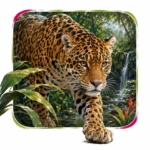
Cougar Fact Highlight
From the full animal facts page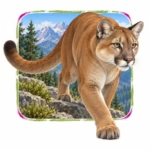
More Animal Comparisons
Pick another animal matchup and keep exploring. Compare appearances, habitats, diets, abilities, and surprising differences.






Make an Animal Story
Turn this jaguar vs cougar comparison into a rosetted-river and mountain-shadow mystery with our free Animal Story Generator.
Source notes: References used for this comparison. See more See less
Try Another Matchup
Explore this comparison →