
Jaguarundi vs Ocelot: Neotropical Wild Cat Comparison
Jaguarundis and Ocelots are wild cats of the Americas, but they are easy to separate once you know the clues. The Jaguarundi, Puma yagouaroundi, is smaller, long-bodied and low to the ground. Its coat is one plain color and may be gray, brown or rusty red. The Ocelot, Leopardus pardalis, is heavier and covered with bold spots, rosettes and stripes. Jaguarundis are often active by day, while Ocelots usually travel and hunt around twilight and at night.
About Jaguarundi
- Type Living
- Diet Carnivore; hunts rodents, birds, reptiles, frogs and other small animals, mostly on the ground
- Group Small American wild cat in family Felidae (Puma yagouaroundi)
- Known for A long low body, short legs, small flattened head, long tail and plain gray, brown or reddish coat
- Special skill Uses an unusually broad set of whistles, chirps, chatters and other calls and is often active in daylight
About Ocelot
- Type Living
- Diet Carnivore; hunts rodents, opossums, rabbits, armadillos, reptiles, birds and other mostly small prey
- Group Medium-sized American spotted cat in family Felidae (Leopardus pardalis)
- Known for A golden or gray coat covered in black spots, rosettes, chains and stripes, with bold face marks and white ear spots
- Special skill Moves quietly through thick vegetation at night and can climb, leap and swim when needed
Jaguarundi vs Ocelot: Quick Answer
A Jaguarundi looks a little like an otter-shaped cat: it has short legs, a long body, a small head and a plain coat. It usually weighs about 4.5–9 kg. An Ocelot is a more powerful cat of about 8.5–16 kg, with a shorter-looking body and a patterned coat. Both use dense cover, but the Jaguarundi is more often seen by day and the Ocelot is mainly active after dark.
Where Do They Fit?
Follow the branches to see how Jaguarundi and Ocelot are classified and related.
Jaguarundi vs Ocelot: Quick Comparison
| Feature | Jaguarundi | Ocelot |
|---|---|---|
| Scientific name | Puma yagouaroundi | Leopardus pardalis |
| Adult size | About 50–77 cm from head to rump, plus a 33–60 cm tail; roughly 4.5–9 kg | About 65–97 cm from head to rump, plus a 25–41 cm tail; roughly 8.5–16 kg |
| Body shape | Long, low and slender, with short legs, a tiny flattened head and a very long tail | Taller, deeper-bodied and more muscular, with a rounded head and a proportionally shorter tail |
| Coat | Nearly uniform gray, dark brown, chestnut or rusty red, with no adult rosettes | Cream, gold, reddish gray or gray with black spots, open rosettes, chains and stripes |
| Usual activity | Often hunts from morning through late afternoon, although activity changes by place | Usually active at twilight and at night and rests in sheltered cover during the day |
| Main hunting level | Searches mostly on the ground and may spring upward for birds | Hunts mainly on the ground but climbs well and may rest in trees |
| Food | Mostly small mammals and ground birds, plus reptiles, frogs, insects and occasional fish | Mostly small mammals, reptiles and birds, with larger prey such as armadillos in some areas |
| Shared habitat | Uses forest, scrub, savanna, wetland edges and disturbed vegetation with thick cover | Strongly favors dense forest, mangrove or brush that hides it from prey and people |
| Voice and signs | Has an unusually varied voice and leaves catlike tracks and scent marks | Communicates with scent marks, calls and shared scat sites called latrines |
| Conservation | Widespread globally but declining in parts of its range; several listed forms have vanished from the United States | Least Concern globally, but the small United States population is federally endangered |
How Are Jaguarundis and Ocelots Alike?
- Both are wild cats native to warm parts of the Americas.
- Both are meat-eaters that catch small mammals, birds and reptiles.
- Both use dense plants as cover and often live close to streams, swamps or other water.
- Both are mostly solitary and mark home areas with scent.
- Both can climb and swim, although most hunting happens on the ground.
How Are Jaguarundis and Ocelots Different?
- A Jaguarundi has a plain coat; an Ocelot has black spots, rosettes and stripes.
- The Jaguarundi is smaller and much lower-slung than the heavier Ocelot.
- Jaguarundis are often active by day, while Ocelots usually hunt after dusk.
- A Jaguarundi has a tiny flattened head and very long tail; an Ocelot has a rounder head and deeper body.
- Jaguarundis are close relatives of cougars, while Ocelots belong to the Leopardus branch of small spotted cats.
Jaguarundi vs Ocelot Showdown
- Size – Ocelot: Adults are usually much heavier and more strongly built than Jaguarundis.
- Speed – Tie: Both are quick wild cats, but there is no fair same-course race showing one universal winner.
- Strength – Ocelot: Its larger body, deeper chest and heavier muscles can handle a wider range of prey.
- Stealth – Ocelot: Its broken pattern, night activity and patient movement make it hard to see in shadowy forest.
- Social – Tie: Both spend most adult life alone except during breeding or while a mother raises kittens.
- Swimming – Tie: Both can cross water, but neither is a specialized aquatic cat and no matched test exists.
- Weirdest – Jaguarundi: Its otter-like outline, two plain color forms and chirping voice make it one unusual feline.
Fun Jaguarundi vs Ocelot Facts
An Otter-Shaped Cat
Short legs, a long body, a tiny head and a strong tail give the Jaguarundi an outline unlike most cats.
One Species, Two Color Plans
Jaguarundis occur in a dark gray-brown form and a reddish or chestnut form, sometimes in the same family.
Every Ocelot Has a Pattern
An Ocelot’s spots and rosettes form an individual design that researchers can use to recognize it.
Different Work Shifts
Jaguarundis often move in daylight, while Ocelots in the same region are more active after sunset.
A Chatty Little Hunter
Researchers have recorded whistles, chirps, purrs, chatters and other sounds in the Jaguarundi’s broad call set.
Jaguarundi vs Ocelot Quiz
Which cat has a plain coat? A) Jaguarundi B) Ocelot C) Both always have rosettes Answer: A) Jaguarundi
Which cat is usually larger? A) Jaguarundi B) Ocelot C) They are always equal Answer: B) Ocelot
Which cat is more often active by day? A) Jaguarundi B) Ocelot C) Neither ever moves by day Answer: A) Jaguarundi
What covers an Ocelot’s coat? A) Black rosettes and stripes B) Feathers C) Scales Answer: A) Black rosettes and stripes
What do both cats eat? A) Only grass B) Small animals C) Only fruit Answer: B) Small animals
Jaguarundi vs Ocelot FAQ
Is a Jaguarundi a Kind of Ocelot?
No. Both are American wild cats, but a Jaguarundi belongs to the Puma branch and an Ocelot belongs to the Leopardus branch.
Which Cat Is Bigger?
The Ocelot. Its usual adult weight begins near the upper end of the Jaguarundi’s range and can reach about 16 kg.
Why Does a Jaguarundi Look Like an Otter?
Its long body, short legs, small flattened head and long tail create a mustelid-like outline. It is still a true cat, not an otter.
Do Jaguarundis and Ocelots Hunt at the Same Time?
Sometimes, but their busiest hours often differ. Jaguarundis tend to be more active in daylight, while Ocelots usually move at twilight and night.
Can Either Cat Be a Pet?
No. Both are wild predators with complex space, diet and behavior needs. They should be protected and observed only from a safe distance.
Animal Words to Know
- Diurnal: Mainly active during daylight hours.
- Felid: A member of the cat family, Felidae.
- Latrine: A repeated place where an animal leaves droppings and scent information.
- Nocturnal: Mainly active during the night.
- Rosette: A ring-shaped or flower-like marking on an animal’s coat.
Design a Wild Cat Shift Clock
Design a Wild Cat Shift Clock
Draw a large 24-hour circle with sunrise, noon, sunset and midnight. Add a plain long-bodied Jaguarundi to the daylight side and a spotted Ocelot to the twilight and night side. Around each cat, draw three shared prey animals. Then explain how using different busy times could reduce meetings between the two hunters.
Meet Each Animal
Want the full fact file? Here are quick highlights from each animal’s own facts page.
Jaguarundi Fact Highlight
From the full animal facts page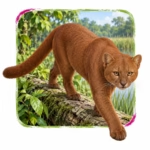
Ocelot Fact Highlight
From the full animal facts page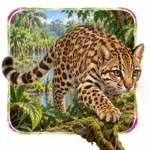
More Animal Comparisons
Pick another animal matchup and keep exploring. Compare appearances, habitats, diets, abilities, and surprising differences.





Make an Animal Story
Create a rainforest adventure about a day-shift Jaguarundi and a night-shift Ocelot!
Source notes: References used for this comparison. See more See less
Try Another Matchup
Explore this comparison →