
Lion vs Jaguar: Living Big-Cat Species Comparison
Lions and jaguars are powerful relatives in genus Panthera, but modern wild populations live on opposite sides of the Atlantic and never meet naturally. Lions are generally much larger, taller, and more social, with mostly plain tawny adult coats, male manes, tail tufts, flexible prides, and a strong association with open African landscapes. Jaguars are smaller but more compact, solitary, covered in central-spotted rosettes, closely tied to many American forests and wetlands, superb in water, and equipped with unusually robust jaws. Both roar, ambush prey, raise cubs, defend large home ranges, and need protection from habitat loss, prey depletion, conflict, and illegal killing.
About Lion
- Type Mammal
- Diet Obligate carnivore taking mainly medium and large mammals such as wildebeest, zebra, antelope, buffalo, deer, and wild pigs, while also scavenging or hunting smaller prey; both sexes hunt, alone or cooperatively depending on prey and circumstances
- Group Lion (Panthera leo), a roaring cat in genus Panthera
- Known for A very large, broad-chested big cat with a tawny coat, powerful forelegs, rounded head, dark tail tuft, and strong sex differences; adult males normally carry a mane and often weigh roughly 150–250 kilograms while adult females commonly weigh about 100–180 kilograms, with substantial regional and individual variation
- Special skill Pride cooperation, group territorial defense, a far-carrying roar, adult-male mane display, powerful forelimbs, and the ability to subdue large open-country prey through individual or coordinated attacks
About Jaguar
- Type Mammal
- Diet Opportunistic carnivore recorded eating more than 85 prey species, including peccaries, deer, capybaras, armadillos, monkeys, fish, turtles, caimans, and other reptiles, often killing with a powerful bite to the skull, neck, or shell depending on prey
- Group Jaguar (Panthera onca), a roaring cat in genus Panthera
- Known for The largest native cat in the Americas, with a low compact body, exceptionally robust skull and jaws, broad head, thick neck, short powerful limbs, large rounded paws, and golden coat marked by large blocky rosettes that usually contain one or more central spots; many adults weigh roughly 45–100 kilograms, while large wetland males can exceed 120 kilograms
- Special skill Exceptional bite and skull strength for body size, rounded swimming paws, confident movement through rivers and flooded forest, compact ambush power, central-spotted rosettes, and the ability to handle armored or aquatic prey
Lion vs Jaguar: Quick Answer
A lion is usually much larger and taller than a jaguar. Lions have mostly plain tawny coats, adult males usually grow manes, and many live in social prides across Africa or western India. Jaguars are stockier solitary cats from the Americas, with large rosettes containing central spots, exceptional swimming skill, and extremely powerful jaws for their size. They do not meet naturally in the wild.
Where Do They Fit?
Follow the branches to see how Lion and Jaguar are classified and related.
Lion vs Jaguar: Quick Comparison
| Feature | Lion | Jaguar |
|---|---|---|
| Scientific name | Panthera leo | Panthera onca |
| Typical size | Usually much taller, longer, and heavier; adult males commonly 150–250 kilograms | Shorter and stockier; many adults 45–100 kilograms, with large wetland males exceeding 120 |
| Coat clues | Mostly plain tawny adult coat, dark tail tuft, and usually a mane on mature males | Golden coat with blocky rosettes that usually contain central spots; no mane or tail tuft |
| Wild range | Mainly sub-Saharan Africa plus one wild population in western India | Americas from Mexico to northern Argentina, with occasional dispersing males in the southwestern United States |
| Social system | Flexible prides of related females and young, plus male coalitions | Normally solitary outside mating and mother-cub families, with rare male coalitions observed |
| Main habitat emphasis | Savanna, grassland, open woodland, scrub, dry forest, and semi-desert | Rainforest, flooded forest, swamp, river edge, dry forest, scrub, and savanna |
| Hunting pattern | Individuals or groups stalk and rush mainly medium-to-large hoofed prey | Solitary close ambush of mammals, reptiles, fish, and armored or aquatic prey |
| Water skill | Can swim and cross water but is not usually a wetland specialist | Powerful swimmer strongly associated with rivers, swamps, and flooded forest in many regions |
| Conservation status | Vulnerable globally | Near Threatened globally, with severe local range loss |
| Young | Cub, often raised among related pride females | Cub, raised and defended by its mother without a resident pride |
How Are Lions and Jaguars Alike?
- Lions and jaguars are mammals in family Felidae and genus Panthera, with padded paws, retractile claws, whiskers, sharp carnassial teeth, and eyes suited to hunting in low light.
- Both are stalk-and-ambush carnivores that use cover, patient approach, explosive acceleration, strong jaws, and powerful forelegs rather than a long-distance chase.
- Both can roar because their throat and voice anatomy differs from that of continuously purring smaller cats, and both also use quieter close-contact sounds.
- Both give birth to spotted cubs that are blind and helpless at first, depend heavily on their mothers, play to practice hunting movements, and face high juvenile mortality.
- Both act as top predators, influence prey and scavenger communities, and are threatened by habitat fragmentation, prey loss, illegal killing, roads, and conflict near livestock.
How Are Lions and Jaguars Different?
- Lions are generally much taller and heavier than jaguars, while jaguars have a shorter, lower, more compact build with an especially broad head and thick neck.
- Adult lions are mostly plain tawny, males usually have manes, and both sexes have tail tufts; jaguars have large rosettes with central spots and neither sex grows a mane.
- Modern wild lions live in Africa and India, while jaguars live in the Americas, so the two species do not naturally share habitat.
- Lions have a flexible social system based on prides and male coalitions; jaguars are normally solitary, although rare temporary male coalitions show that “always alone” would be too absolute.
- Lions often hunt open-country hoofed animals alone or cooperatively; jaguars use dense cover and water edges to ambush an unusually broad menu including reptiles and armored prey.
- Jaguars are especially confident swimmers and may bite through a prey animal’s skull or turtle shell, while lions rely more on body size, group pressure, gripping forelegs, and throat or muzzle bites.
Lion vs Jaguar Adaptation Showdown
Big-cat adaptation showdown: Lion wins size and absolute strength because a typical adult is much taller and heavier. Speed is a tie because both make short explosive rushes and published maxima are not directly comparable. Jaguar wins stealth for its low compact body, rosette camouflage, and movement through forest and wetland cover. Lion wins social skill for pride bonds, coalitions, territorial cooperation, and some group hunting. Jaguar wins swimming for its routine use of rivers and flooded landscapes. Jaguar also wins weirdest adaptation for a remarkably robust skull and bite that can penetrate bone or reptile shell. These categories compare adaptations, not combat.
Fun Lion vs Jaguar Facts
They Live on Opposite Sides of the Atlantic
Modern lions survive naturally in sub-Saharan Africa and western India. Jaguars belong to the Americas, from Mexico to northern Argentina, with occasional dispersing males entering the southwestern United States. No present wild breeding range overlaps, and the extinct American lion was a different prehistoric Panthera lineage rather than a modern African lion population.
A Lion Pride Is a Flexible Neighborhood
A pride is not one unchanging crowd. Related lionesses and their young form the social core, members split into smaller parties and reunite, and males often cooperate in coalitions that may hold pride access or territory. Hunting can be cooperative, but females and males also hunt alone, so “only lionesses hunt” is a myth.
Jaguar Rosettes Usually Carry Dots Inside
A jaguar’s flank rosettes are often larger and blockier than a leopard’s and commonly contain one or more small central spots. The pattern breaks up the cat’s outline among leaves, stems, shade, and reflected water. Each side is individually recognizable in photographs used for noninvasive population surveys.
The Jaguar Has a Bone-Piercing Hunting Tool
A jaguar’s broad skull, thick jaw muscles, and stout canine teeth create extraordinary force for its body size. Depending on the prey, it may bite through the skull between the ears, clamp the neck, or pierce a turtle shell. This does not make a jaguar universally “stronger” than the much larger lion; bite mechanics and whole-body power are different comparisons.
Black Panthers Can Be Jaguars Too
In the Americas, black panther commonly means a melanistic jaguar rather than a separate species. Extra dark pigment makes the coat appear black, but the central-spotted rosettes usually remain visible in suitable light. Melanism occurs more often in some moist forest populations and does not turn the jaguar into a different kind of cat.
Lion vs Jaguar Quiz
- Which cat usually lives in prides? Answer: The lion.
- Which cat has rosettes that usually contain central spots? Answer: The jaguar.
- Which animal is normally larger? Answer: The lion.
- Where do wild jaguars live? Answer: In the Americas, mainly from Mexico through Central and South America.
- Do lions and jaguars naturally meet in the wild today? Answer: No. Their present wild ranges do not overlap.
Lion vs Jaguar FAQ
Which is bigger, a lion or jaguar?
A lion is normally much bigger. Adult male lions often weigh roughly 150–250 kilograms, while many adult jaguars weigh about 45–100 kilograms, although large Pantanal males can exceed 120 kilograms.
Which has the stronger bite, a lion or jaguar?
A jaguar has an exceptionally powerful bite relative to its body size and uses it in unusual skull- or shell-piercing attacks. A lion is much larger and has greater absolute whole-body power, so one vague “stronger” label hides two different measurements.
Would a lion and jaguar fight in nature?
No normal wild encounter occurs because modern lions live in Africa and India while jaguars live in the Americas. This page compares adaptations, not a staged battle.
Is a jaguar a kind of leopard?
No. Jaguar is Panthera onca and leopard is Panthera pardus. A jaguar is stockier and usually has larger rosettes with central spots.
Can lions and jaguars swim?
Both can swim. Jaguars use rivers, swamps, and flooded forests much more routinely and are the stronger wetland specialists.
Animal Words to Know
- Pride: A flexible social unit of related lionesses and young, associated with one or more males at different times.
- Coalition: Two or more animals, often male lions, that cooperate in travel, territory, or competition.
- Rosette: A flower-like ring or cluster of dark coat markings.
- Melanism: A genetic increase in dark pigment that can produce a black jaguar while leaving its rosettes faintly visible.
- Apex predator: A predator near the top of its food web, normally hunted by no other species as a regular adult prey item.
Lion and Jaguar Big-Cat Activity
Lion and Jaguar Big-Cat Activity
Draw an adult male lion and male jaguar at the same scale. Make the lion larger, with a mane, plain tawny coat, tail tuft, and a pride on an African grassland. Give the jaguar a broad head, compact body, and rosettes with central spots beside an American rainforest river. Label mane, rosettes, pride, solitary, Africa, Americas, and swimming.
Meet Each Animal
Want the full fact file? Here are quick highlights from each animal’s own facts page.
Lion Fact Highlight
From the full animal facts page
Jaguar Fact Highlight
From the full animal facts page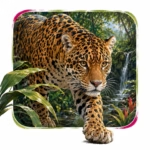
More Animal Comparisons
Pick another animal matchup and keep exploring. Compare appearances, habitats, diets, abilities, and surprising differences.





Make an Animal Story
Turn this lion vs jaguar comparison into a pride-and-Pantanal mystery with our free Animal Story Generator.
Source notes: References used for this comparison. See more See less
Try Another Matchup
Explore this comparison →