
Magpie vs Crow: True-Magpie-to-Crow Corvid-Genus Comparison
Magpies and crows are close relatives, not unrelated look-alikes. A true magpie belongs to genus Pica, while the birds commonly called crows belong mainly to genus Corvus; both sit inside the intelligent songbird family Corvidae alongside ravens, rooks, jays, nutcrackers, and choughs. True magpies are usually lighter and instantly recognizable by a very long graduated tail and pied black-and-white pattern. Crows are generally heavier, shorter-tailed, and mostly black or black-and-gray. Because both names cover several species—and “magpie” is reused for unrelated birds—this page uses Pica magpies and crow-named Corvus species, with black-billed or Eurasian magpies and American or carrion crows as representative examples.
About Magpie
- Type Bird
- Diet Flexible omnivore eating insects, beetles, grubs, worms, spiders, seeds, grain, fruit, berries, carrion, scraps, ticks, small vertebrates, and sometimes other birds’ eggs or nestlings; the mix changes with species, place, season, and opportunity, and animal prey is not the whole diet
- Group Here magpie means the true magpies of genus Pica in the crow family Corvidae, especially the familiar Eurasian, black-billed, yellow-billed, Oriental, and related long-tailed species; “magpie” is also attached to unrelated birds, so this page does not treat the Australian magpie, magpie-robin, or every magpie-named bird as a Pica magpie
- Known for A very long graduated or diamond-shaped tail, pied black-and-white plumage in the best-known species, blue-green or purple iridescence, broad rounded wings, a sturdy bill, chattering calls, food caching, and conspicuous stick nests; a representative black-billed magpie is about 45–60 centimeters long but only about 145–210 grams because the tail supplies so much of the length
- Special skill The extremely long layered tail works as a visible steering and balance surface during abrupt turns and ground movement. True magpies also cache surplus food, inspect changes in familiar places, mob predators, use many calls, and in species such as the black-billed magpie build a bulky thorny stick nest with a rooflike dome and one or more side entrances.
About Crow
- Type Bird
- Diet Opportunistic omnivore taking insects, earthworms, grain, seeds, nuts, fruit, shellfish, fish, eggs, small animals, carrion, human scraps, and many other locally available foods; diet varies by species and habitat, and describing every crow as either only a scavenger or only a predator is inaccurate
- Group Here crow means the medium-to-large species of genus Corvus commonly called crows, such as the American, carrion, hooded, fish, house, jungle, Torresian, and northwestern crows; Corvus also contains birds called ravens and rooks, so “crow” is a useful common-name group rather than a perfectly separate scientific branch
- Known for A heavier compact body, broad wings with fingered tips, a comparatively short fan-shaped or gently rounded tail, strong straight-to-slightly-curved bill, mostly black or black-and-gray plumage, cawing calls, flexible problem solving, communal roosts, and bold use of farms and cities; an American crow is about 40–53 centimeters long and roughly 316–620 grams
- Special skill Different crows demonstrate different cognitive specializations. Wild American crows can remember a dangerous human face and spread the warning socially, while New Caledonian crows manufacture hooked plant tools to extract hidden prey. These named examples show the potential of Corvus but should not be assigned automatically to every crow species.
Magpie vs Crow: Quick Answer
A true magpie is a long-tailed member of genus Pica, usually pied black and white with metallic blue-green gloss. A crow is a generally heavier, shorter-tailed member of genus Corvus commonly colored black or black and gray. Their total lengths can overlap because so much of a magpie is tail, but representative crows weigh two or three times as much. Both are adaptable omnivorous corvids that cache food, use complex calls, mob threats, learn quickly, and may live in pairs, families, flocks, or roosts.
Where Do They Fit?
Follow the branches to see how Magpie and Crow are classified and related.
Magpie vs Crow: Quick Comparison
| Feature | True Magpie | Crow |
|---|---|---|
| Scientific scope | Genus Pica within family Corvidae | Corvus species commonly called crows; Corvus also includes ravens and rooks |
| Representative birds | Eurasian and black-billed magpies | Carrion and American crows |
| Body clue | Lighter body with an exceptionally long graduated tail | Heavier body with a shorter fan-shaped or rounded tail |
| Typical color | Black and white with blue-green or purple iridescence in familiar Pica species | Mostly black, although some species have gray, white, or brown areas |
| Representative size | Black-billed magpie: 45–60 cm and about 145–210 g | American crow: 40–53 cm and about 316–620 g |
| Flight silhouette | Broad wings followed by a long diamond-shaped tail | Broad fingered wings and a much shorter squared, fan, or rounded tail |
| Nest clue | Many Pica magpies build a large stick nest with a thorny dome | Usually an open stick cup high in a tree, although species and sites vary |
| Voice | Rapid chatter, cackle, rattle, whistle, and alarm notes | Caws and many softer rattles, knocks, clicks, and species-specific calls |
| Diet | Opportunistic omnivore with insects often important | Opportunistic omnivore with a broad locally changing menu |
| Memory trick | Magpie: metallic pied feathers plus a mighty long tail | Crow: compact dark corvid with a comparatively short tail |
How Are Magpies and Crows Alike?
- True magpies and crows are passerine songbirds in family Corvidae, so they share strong feet, a versatile bill, forward-facing attention, complex calls, prolonged learning, and flexible behavior.
- Both are opportunistic omnivores that forage on the ground and in trees, eat plant and animal foods, investigate carrion or scraps, and hide surplus food in caches for later.
- Both can form lasting pairs or family groups, cooperate in nest defense and chick care, recruit neighbors with alarm calls, mob owls or other threats, and gather socially outside the breeding season.
- Both live successfully in many farm, village, suburban, and urban-edge landscapes, where memory and caution help them exploit new food while avoiding people, traffic, pets, and unfamiliar objects.
- Both have been burdened by myths about stealing shiny objects, bad luck, or malicious behavior; real birds collect food and nest material for practical reasons, and neither species group should be trapped, poisoned, fed, or harassed.
How Are Magpies and Crows Different?
- A true magpie belongs to genus Pica; a crow belongs to a Corvus species commonly called a crow. They share the wider family Corvidae but are separate evolutionary branches.
- A magpie’s very long graduated tail may contribute more than half its outline and makes sharp steering obvious. A crow has a shorter fan-shaped, squared, or rounded tail attached to a deeper, heavier body.
- Familiar true magpies are sharply pied black and white with metallic blue, green, or purple reflections. Many crows appear all black, although hooded crows and several island or tropical species show gray, white, or brown patterning.
- Representative total lengths overlap, but a black-billed magpie at about 145–210 grams is much lighter than an American crow at roughly 316–620 grams; one ruler measurement therefore hides the body-mass difference.
- Many Pica magpies build a conspicuous stick nest surrounded by a thorny dome and side entrance. American and carrion crows generally construct an open stick cup, although crow nesting sites and materials vary.
- True Pica magpies occupy Eurasia, northwestern Africa, and western North America. Crow-named Corvus species span a much wider set of Old World, North American, Caribbean, Australian, New Guinean, and island regions.
Magpie vs Crow Adaptation Showdown
Long-tailed corvid versus heavy-built corvid showdown: Crow wins typical size because true magpies can match a crow’s head-to-tail length only by adding an enormous tail, while representative crows carry two or three times the body mass. Speed is a tie because both are agile fliers and published figures are not standardized genus-wide trials. Crow wins strength cautiously for the heavier torso and bill of representative species, not from a staged encounter. Stealth is a tie: a crow’s dark body can vanish in canopy shadow, while a magpie’s disruptive black-white pattern and iridescence work among branches, sky gaps, and broken light. Social behavior is a tie because Pica and Corvus species both show pair bonds, families, alarm networks, flocks, and roosts with substantial species variation. Swimming is a tie because either bird may bathe, wade, or make a short emergency crossing, but neither is aquatic. Crow wins strangest adaptation only through named Corvus examples: American crows socially learn dangerous faces and New Caledonian crows manufacture hooked tools. Magpies remain formidable problem solvers, and intelligence is not reduced to one trophy. These fields compare adaptations, not combat.
Fun Magpie vs Crow Facts
Magpies and Crows Share the Corvid Family Tree
True magpies in Pica and crows in Corvus belong to family Corvidae, along with ravens, rooks, jays, nutcrackers, treepies, and choughs. Their common ancestor helps explain shared caching, mobbing, curiosity, flexible feeding, and vocal learning. The names still matter: a magpie is not a juvenile crow, and a crow does not grow a magpie tail.
A Magpie Can Look Crow-Length Without Being Crow-Heavy
Cornell measurements place a black-billed magpie around 45–60 centimeters long and 145–210 grams, while an American crow is about 40–53 centimeters but roughly 316–620 grams. The magpie can win the ruler because its tail is enormous; the crow wins the scale because its chest, wings, bill, and torso are much more massive.
Many True Magpies Put a Roof on Their Nest
A black-billed magpie pair may spend weeks assembling an outer ball of thorny sticks around a mud-lined cup. Openings in the side allow the adults to enter, while the dome may reduce attacks by large owls, ravens, or crows. The design varies and can look untidy from outside, but the inner nursery is carefully built.
The Australian Magpie Is Not a True Magpie
Australia’s famous black-and-white songster is Gymnorhina tibicen in family Artamidae, close to butcherbirds and currawongs rather than to Pica magpies. Similar pied colors inspired the reused common name. This is convergent resemblance, not proof that every bird called magpie belongs to one genus.
Some Crows Share a Memory of Dangerous Faces
Experiments with wild American crows used distinctive human masks during capture and later observations. Crows remembered the threatening face, scolded it long afterward, and uninvolved birds learned the warning socially. Other work shows New Caledonian crows making hooked tools, but these named abilities should not be copied onto every Corvus species without evidence.
Magpie vs Crow Quiz
- What bird family contains true magpies and crows? Answer: Corvidae.
- Which bird usually has the much longer graduated tail? Answer: The true magpie.
- Why can a magpie equal a crow’s length but weigh much less? Answer: Much of the magpie’s measured length is its tail.
- Do Australian magpies belong to genus Pica? Answer: No. They belong to family Artamidae and are not true corvid magpies.
- What did mask experiments show about American crows? Answer: They can remember a dangerous human face and spread that warning socially.
Magpie vs Crow FAQ
Is a magpie a type of crow?
A true magpie and a crow are close corvid relatives, but a Pica magpie is not a Corvus crow. Both belong to family Corvidae. Everyday language sometimes calls the entire family the crow family, which can make “type of crow” sound true at one level while hiding the separate genera.
Which is bigger, a magpie or a crow?
A crow is generally heavier and more robust. A black-billed magpie can be longer than an American crow from bill to tail tip, but it weighs far less because its extraordinary tail adds so many centimeters. Species, sex, age, and condition still affect measurements.
How can I tell a magpie from a crow?
Within the ranges of familiar Pica magpies, look for a sharply pied black-and-white body, metallic wing and tail gloss, and a tail much longer than the body. A familiar crow is heavier, mostly black or black-gray, and has a shorter fan-shaped tail. Always check local species because names and colors vary.
Are magpies or crows smarter?
Science does not provide one fair family-wide intelligence score. Both solve problems, remember places, cache food, respond to social information, and adjust to people. Particular experiments reveal particular skills—such as face learning in American crows—not a universal ranking of every species.
Do magpies really steal shiny things?
Controlled tests do not support the popular idea that Eurasian magpies are irresistibly attracted to shiny objects. A curious bird may inspect or carry an unfamiliar item, but food, nest material, safety, and previous experience matter. Never offer litter or small objects to wild birds.
Animal Words to Know
- Corvidae: The songbird family containing crows, true magpies, ravens, rooks, jays, and close relatives.
- Pica: The genus containing the true long-tailed magpies compared on this page.
- Corvus: The genus containing crows, ravens, and rooks; common names do not divide it perfectly.
- Graduated tail: A tail whose central feathers extend farther than the outer feathers, creating a layered diamond or taper.
- Cache: A hidden food store saved for a later meal.
Magpie and Crow Detective Activity
Magpie and Crow Detective Activity
Draw a Eurasian magpie and carrion crow at the same scale. Give the magpie black-and-white plumage, a slim bill, and a very long graduated tail. Make the crow heavier and entirely black, with a thicker bill and shorter fan-shaped tail. Add a domed stick nest for the magpie and an open cup nest for the crow. Label corvid, plumage, bill, tail, nest, and call.
Meet Each Animal
Want the full fact file? Here are quick highlights from each animal’s own facts page.
Magpie Fact Highlight
From the full animal facts page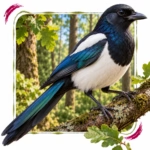
Crow Fact Highlight
From the full animal facts page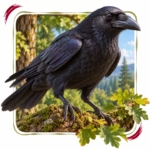
More Animal Comparisons
Pick another animal matchup and keep exploring. Compare appearances, habitats, diets, abilities, and surprising differences.



Make an Animal Story
Turn this magpie vs crow comparison into a long-tail and dark-wing corvid mystery with our free Animal Story Generator.
Source notes: References used for this comparison. See more See less
Try Another Matchup
Explore this comparison →