
Magpie vs Kookaburra for Kids: Warble or Laugh?
The Australian Magpie and Laughing Kookaburra are familiar, loud Australian birds that defend territories and live in family groups. Their similar size hides a major family difference. The magpie is a ground-feeding songbird related to butcherbirds, not to Northern Hemisphere magpies. The kookaburra is a giant kingfisher that watches from a perch and drops onto prey.
About Australian Magpie
- Type Large Australian songbird
- Diet Omnivore with a strong insect diet
- Group Butcherbird family, Artamidae
- Known for Black-and-white plumage, rich warbling carols, ground foraging, and seasonal nest defense
- Special skill Produces complex musical songs across a wide pitch range and can mimic many other sounds
About Laughing Kookaburra
- Type Large terrestrial kingfisher
- Diet Carnivore and insectivore
- Group Kingfisher family, Alcedinidae
- Known for A rolling laugh-like territorial chorus and a large prey-grabbing bill
- Special skill Pounces from a perch and strikes larger prey against a branch or the ground before swallowing
Quick Answer
Quick answer: An Australian Magpie is a black-and-white songbird that walks across open ground, probes for insects, and sings flute-like warbles and group carols. A Laughing Kookaburra is a stockier brown-and-white kingfisher with a huge bill, a laugh-like territorial chorus, and a perch-and-pounce hunting style. Both use trees for nesting and territories for family life, but their bodies, songs, food, and nests are different.
Australian Magpie vs Laughing Kookaburra: Quick Comparison
| Feature | Australian Magpie | Laughing Kookaburra |
|---|---|---|
| Scientific name | Gymnorhina tibicen | Dacelo novaeguineae |
| Bird family | Artamidae, the butcherbirds and allies | Alcedinidae, the kingfishers |
| Adult length | About 36 to 44 cm | About 40 to 45 cm |
| Appearance | Black and white with a pale pointed bill and chestnut eye | Brown and white with a dark eye stripe, huge bill, and barred rufous tail |
| Main sound | Flute-like warbling, duets, and group carolling | A rising and falling laugh-like family chorus |
| Main feeding style | Walks and listens or probes for invertebrates in soil and grass | Waits on a perch, then pounces and may bash larger prey |
| Main food | Insects, larvae, worms, spiders, small animals, fruit, seeds, and scraps | Insects, worms, crustaceans, frogs, lizards, small snakes, mammals, and birds |
| Social life | Stable territorial pair or group, sometimes with many members | Breeding pair with older offspring that often help raise chicks |
| Nest | Open bowl of sticks high in a tree | Bare chamber in a tree hollow or arboreal termite mound |
| Eggs | Usually three to five blue-green eggs with brown blotches | Usually two to four plain white eggs |
How Magpies and Kookaburras Are Alike
- Both are medium-large Australian birds that live successfully in parks and gardens.
- Both defend the same territory throughout much or all of the year.
- Both communicate with loud group calls that can carry through woodland.
- Both eat many insects and help remove invertebrates from open ground.
- Both may live with relatives that help defend the territory or care for young.
How Magpies and Kookaburras Are Different
- The Australian Magpie is a songbird related to butcherbirds, while the Laughing Kookaburra is a kingfisher.
- The magpie usually searches while walking, while the kookaburra watches from a perch and pounces.
- The magpie has a narrower bill for probing and picking, while the kookaburra has a broad powerful prey-grabbing bill.
- Magpies build open stick nests, while kookaburras nest inside hollows or tree termite mounds.
- Magpie eggs are blue or green and blotched, while kookaburra eggs are plain white.
Magpie vs Kookaburra Adaptation Showdown
Adaptation showdown: Laughing Kookaburra wins size because it is usually stockier and can reach about 45 cm, near the top of the Australian Magpie’s 36 to 44 cm range. Speed is a Tie because fair matched flight-speed data are unavailable. Laughing Kookaburra wins strength because its large bill and strong neck help it seize and strike comparatively large prey. Laughing Kookaburra wins stealth because it waits quietly on a branch, blends with bark, and drops suddenly onto prey. Social behavior is a Tie because magpies maintain stable territorial groups while kookaburra families cooperate in incubation, feeding, and defense. Swimming is a Tie because neither is an aquatic hunting specialist despite the kookaburra’s kingfisher relatives. Laughing Kookaburra wins weirdest because a whole family can produce a coordinated laugh-like territorial chorus and older siblings may stay to help raise the next brood.
Fun Australian Magpie vs Laughing Kookaburra Facts
A Magpie That Is Not a Crow
The Australian Magpie is unrelated to the black-and-white magpies of Europe and North America. It belongs with Australian butcherbirds and currawongs.
A Song Across Four Octaves
Australian Magpie calls include soft warbles, flute-like phrases, alarms, mimicry, duets, and loud group carolling. Their pitches can span several octaves.
Swooping Is Temporary and Uncommon
During nesting season, a small minority of male magpies make warning flights at people they see as threats near a nest.
The Laugh Is a Boundary Sign
A kookaburra’s famous call is not laughter caused by a joke. Family members join a chorus that advertises and defends their territory.
A Kingfisher Away From Fish
Laughing Kookaburras belong to the kingfisher family, but they usually hunt on land. They drop from branches onto insects and small vertebrates.
Magpie vs Kookaburra Quiz
- Which bird belongs to the kingfisher family? Answer: The Laughing Kookaburra.
- How does an Australian Magpie usually find insects? Answer: It walks over the ground, listening, looking, and probing soil or grass.
- What does a kookaburra’s laugh-like chorus communicate? Answer: It advertises and defends the family’s territory.
- Where does a Laughing Kookaburra nest? Answer: In a tree hollow or a chamber in an arboreal termite mound.
- Are most Australian Magpies seasonal swoopers? Answer: No. Only a small minority swoop at people near a nest.
Australian Magpie vs Laughing Kookaburra FAQ
Is an Australian Magpie a crow?
No. It belongs to the butcherbird family, while Northern Hemisphere magpies belong to the crow family.
Is a kookaburra really laughing?
No. The sound is a territorial call, often performed as a coordinated family chorus.
Which bird is bigger?
They overlap in length, but the Laughing Kookaburra is generally stockier and can be slightly longer.
Do kookaburras mainly eat fish?
No. Laughing Kookaburras mostly take insects and small land animals by pouncing from a perch.
What should a person do near a defensive magpie?
Move calmly away from the nesting area, protect eyes and head, follow local warning signs, and never throw objects or disturb the nest.
Animal Words to Know
- Carolling: A loud musical duet or group song used by Australian Magpies to advertise territory.
- Territory: An area defended because it contains food, nest sites, or other resources.
- Cooperative breeding: A system in which birds other than the parents help care for young.
- Perch hunter: An animal that watches from a resting place before dropping or flying toward prey.
- Arboreal termite mound: A termite nest built above the ground on a tree, sometimes used by nesting kookaburras.
Compare Two Backyard Bird Jobs
Compare Two Backyard Bird Jobs
Draw exactly one adult Australian Magpie and exactly one adult Laughing Kookaburra at honest relative scale, with the kookaburra slightly bulkier. Label the magpie’s black-and-white plumage, pale pointed bill, long legs, open stick nest, ground insects, and carolling posture. Label the kookaburra’s dark eye stripe, huge bill, bark-colored back, barred tail, tree hollow, and pounce path. Add a small seasonal-safety reminder without drawing a swoop or attack. Watch wild birds from a distance and never feed, chase, touch, or disturb a nest.
Meet Each Animal
Want the full fact file? Here are quick highlights from each animal’s own facts page.
Australian Magpie Fact Highlight
From the full animal facts page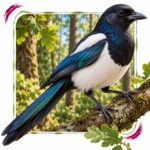
Laughing Kookaburra Fact Highlight
From the full animal facts page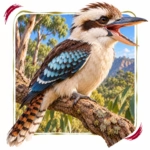
More Animal Comparisons
Pick another animal matchup and keep exploring. Compare appearances, habitats, diets, abilities, and surprising differences.



Make an Animal Story
Send a flute-voiced magpie and a laughing perch hunter through an Australian backyard mystery with our free Animal Story Generator.