
Megalodon vs Great White Shark: Extinct vs Living Shark Comparison
Megalodon and the great white were both large predatory mackerel sharks in the order Lamniformes, but Megalodon was not simply an oversized great white and was not its direct ancestor. Megalodon belonged to the extinct otodontid lineage, while the living great white belongs to Lamnidae. Fossil teeth and rare vertebrae show that Megalodon was much larger, but no complete skeleton is known, so its exact length, weight, fin positions, and body shape remain scientific reconstructions rather than direct observations.
About Megalodon
- Type Extinct Cartilaginous Fish
- Diet Carnivore; whales and other marine mammals, large fishes, sea turtles, and sharks inferred from teeth, bite marks, and associated fossils
- Group Megatoothed Shark (Otodus megalodon; Family Otodontidae)
- Known for Enormous serrated teeth, giant estimated body size, replaceable tooth rows, a cartilage skeleton, worldwide marine fossils, predation on large marine animals, probable regional endothermy, and major scientific uncertainty about its complete shape
- Special skill Growing to gigantic size and replacing huge serrated teeth throughout life
About Great White Shark
- Type Cartilaginous Fish
- Diet Carnivore; fishes, rays, smaller sharks, squid, marine mammals, seabirds, turtles, crustaceans, and carrion depending on age and opportunity
- Group Mackerel Shark (Carcharodon carcharias; Family Lamnidae)
- Known for A muscular torpedo-shaped body, broad serrated teeth, regional endothermy, powerful burst swimming, countershading, long migrations, keen senses, live birth, and an important apex-predator role
- Special skill Keeping parts of its body warmer than the surrounding sea and accelerating in powerful hunting bursts
Megalodon vs Great White Shark: Quick Answer
Megalodon was an extinct megatoothed shark that disappeared about 3.6 million years ago. Large individuals are often reconstructed at roughly 15–20 metres long, while recent vertebra-based research proposes a possible maximum near 24.3 metres as a working hypothesis. A living great white commonly reaches up to about 6.4 metres. Great whites are faster and more agile in observed burst swimming, but Megalodon was far larger and more powerful.
Where Do They Fit?
Follow the branches to see how Megalodon and Great White Shark are classified and related.
Megalodon vs Great White Shark: Quick Comparison
| Feature | Megalodon | Great White Shark |
|---|---|---|
| Status | Extinct for about 3.6 million years | Living but naturally slow-growing and widely protected |
| Scientific name | Otodus megalodon | Carcharodon carcharias |
| Family | Otodontidae, the extinct megatoothed sharks | Lamnidae, the living mackerel sharks |
| Length | Estimated; large forms often reconstructed around 15–20 m, with a recent possible maximum near 24.3 m | Usually smaller; verified guidance places adults up to about 6.4 m |
| Body shape | Unknown in detail; recent work suggests a more elongated body than a scaled-up great white | Known torpedo-shaped body built for powerful bursts |
| Largest teeth | Fossil teeth can approach 18 cm along their longest dimension | Broad triangular serrated teeth, much smaller than Megalodon’s |
| Main evidence | Mostly fossil teeth, plus rarer vertebrae, bite marks, and coprolites | Living observations, tagging, genetics, anatomy, teeth, and modern skeletons |
| Food | Large marine mammals, fishes, turtles, and sharks inferred from fossils | Fish and rays when young; larger sharks also eat marine mammals and scavenge whales |
| Swimming | Inferred to be an efficient giant cruiser; exact speeds are model-based | Observed as an agile long-distance migrant capable of fast bursts |
| Relationship | Same shark order as the great white, but a separate extinct family | Not a descendant or miniature version of Megalodon |
How Were Megalodon and Great White Sharks Alike?
- Both were cartilaginous fishes in the mackerel-shark order Lamniformes.
- Both had streamlined bodies, multiple rows of replaceable teeth, five gill slits, and skin covered with dermal denticles.
- Both used broad triangular serrated teeth to cut food, although Megalodon’s teeth were much larger.
- Both occupied high positions in marine food webs and ate a range of large prey.
- Evidence indicates both could keep important body regions warmer than the surrounding seawater.
How Were Megalodon and Great White Sharks Different?
- Megalodon is extinct, while the great white survives in temperate and subtropical seas today.
- Megalodon belonged to Otodontidae, while the great white belongs to Lamnidae.
- Megalodon was several times longer and many times heavier than a typical adult great white.
- Megalodon’s appearance and performance must be estimated from incomplete fossils, while great whites can be measured, tagged, filmed, and studied alive.
- Recent reconstructions suggest Megalodon may have been more elongated, while the great white has a stocky torpedo shape suited to rapid bursts.
Megalodon vs Great White Shark Showdown
Shark showdown: Megalodon wins size and strength by an enormous margin. The great white takes speed, stealth, and swimming agility because its burst performance, countershading, turning, and migrations are observed in living animals, whereas Megalodon performance is reconstructed from models. Social behavior is a tie because great whites are usually solitary and Megalodon’s social life is unknown. Megalodon wins our weirdest-fact prize because almost its entire popular image—from total length to fin placement—must be rebuilt from giant teeth, scattered vertebrae, and comparisons with other sharks.
Fun Megalodon vs Great White Shark Facts
Megalodon Was Not a Giant Great White
The two sharks share the order Lamniformes, but they sit in different families. Megalodon belongs to the extinct megatoothed Otodontidae, while great whites belong to Lamnidae with mako, porbeagle, and salmon sharks. Similar serrated teeth reflect similar cutting jobs, not a direct parent-and-child lineage.
A Cartilage Skeleton Leaves a Fossil Puzzle
Shark skeletons are made mostly of cartilage, which usually decays before fossilizing. Megalodon is therefore known mainly from mineralized teeth and a smaller number of calcified vertebrae. Scientists scale and compare those remains, but different methods produce different body estimates.
The Possible Maximum Is Still a Hypothesis
A 2025 study estimated one partial Belgian vertebral column’s owner at about 16.4 metres and proposed that unusually large Danish vertebrae could represent a shark near 24.3 metres. Rediscovery and study of those Danish vertebrae in 2026 strengthened the physical evidence, but the calculation still depends on assumptions and awaits a more complete skeleton.
Great Whites Are Partly Warm-Bodied
A great white uses blood-vessel heat exchangers to retain warmth in swimming muscles, the brain, eyes, and internal organs. This regional endothermy helps it remain active in cooler seas. Chemical evidence from fossils suggests Megalodon also maintained body temperatures above the surrounding water.
Extinction Was Probably a Combination
Megalodon’s youngest accepted fossils are about 3.6 million years old. Ocean cooling, changing whale communities and prey ranges, loss or movement of productive habitat, and competition with other predators including early great whites may all have contributed. Scientists do not have evidence for one simple final cause.
Megalodon vs Great White Shark Quiz
- Is Megalodon still alive? Answer: No; it disappeared about 3.6 million years ago.
- What kind of Megalodon fossil is found most often? Answer: Teeth.
- Did Megalodon belong to the same shark family as the great white? Answer: No; both are lamniform sharks but belong to different families.
- Which shark can scientists tag and observe alive? Answer: The great white shark.
- Why is Megalodon’s exact size uncertain? Answer: No complete skeleton is known, so scientists must estimate it from teeth, vertebrae, and comparisons.
Megalodon vs Great White Shark FAQ
Which was bigger, Megalodon or the great white shark?
Megalodon was far bigger. Great whites reach about 6.4 metres in authoritative modern guidance, while large Megalodons are reconstructed at roughly 15–20 metres and one recent working hypothesis allows a possible maximum near 24.3 metres.
Was Megalodon a giant great white shark?
No. The two belonged to the same broad order, Lamniformes, but Megalodon was an otodontid and the great white is a lamnid. Megalodon’s complete body shape remains unknown.
Is Megalodon still alive in the deep ocean?
No reliable evidence supports that idea. Its youngest accepted teeth are about 3.6 million years old, and modern oceans have produced no fresh teeth, bodies, DNA, feeding traces, or verified sightings.
Did great white sharks make Megalodon extinct?
Competition with the emerging great white lineage may have added pressure, but extinction probably involved several changes in climate, habitat, prey, and competing predators. One cause has not been proved.
Did Megalodon and great whites ever fight?
Their lineages overlapped late in Megalodon’s history, but no fossil shows a direct fight. Scientists can study shared prey and possible competition without inventing a battle result.
Animal Words to Know
- Lamniformes: The shark order containing Megalodon, great whites, makos, and several other living or extinct groups.
- Otodontidae: The extinct megatoothed-shark family containing Megalodon.
- Lamnidae: The living mackerel-shark family containing great whites, makos, porbeagles, and salmon sharks.
- Cartilage: Flexible supporting tissue that forms most of a shark’s skeleton and rarely fossilizes well.
- Working hypothesis: A testable scientific explanation or estimate that may change with new evidence.
Megalodon and Great White Evidence Activity
Megalodon and Great White Evidence Activity
Draw a measured great white shark beside a dotted reconstructed outline of Megalodon. Do not simply enlarge the great white because Megalodon’s exact body shape is uncertain. Add evidence cards showing a giant fossil tooth, fossil vertebra, and bitten whale bone for Megalodon, then a photograph, tag, and measured skeleton for the living shark. Label fossil, observation, estimate, tooth, extinct, and living.
Meet Each Animal
Want the full fact file? Here are quick highlights from each animal’s own facts page.
Megalodon Fact Highlight
From the full animal facts page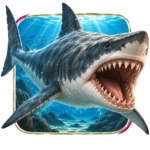
Great White Shark Fact Highlight
From the full animal facts page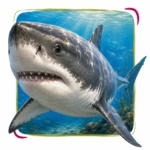
More Animal Comparisons
Pick another animal matchup and keep exploring. Compare appearances, habitats, diets, abilities, and surprising differences.






Make an Animal Story
Turn this Megalodon vs great white comparison into an evidence-filled prehistoric ocean adventure with our free Animal Story Generator.
Source notes: References used for this comparison. See more See less
Try Another Matchup
Explore this comparison →