
Mockingbird vs Robin for Kids
Northern Mockingbirds and American Robins are familiar lawn and park birds, but they belong to different songbird families. The mockingbird is a slim gray Mimidae bird with a long tail, white wing flashes, and an enormous library of copied sounds. The robin is a heavier Turdidae thrush with an orange breast, rounder body, and strong straight flight. Both eat insects and fruit and build open cup nests, yet their songs, seasonal diets, nest materials, territories, and winter social lives tell very different stories.
About Northern Mockingbird
- Type Bird
- Diet Omnivore
- Group Mockingbird; family Mimidae
- Known for Copying many sounds, singing long sequences, flashing white wing patches, and defending a territory
- Special skill Learning new sounds throughout life and building a repertoire of around 200 songs
About American Robin
- Type Bird
- Diet Omnivore
- Group Thrush; family Turdidae
- Known for A warm orange breast, cheery whistles, lawn running, earthworm hunting, and winter flocks
- Special skill Running, stopping, and scanning the soil for earthworms and other invertebrates
Quick Answer
Quick answer: The American Robin is heavier and usually broader-winged, with an orange breast and a strong connection to lawns, worms, and large winter flocks. The Northern Mockingbird is slimmer and gray, flashes white wing patches, guards territories year-round, and can learn around 200 songs during its life. Both are omnivorous ground-foraging songbirds that eat insects and fruit and raise chicks in open cup nests. This comparison uses the Northern Mockingbird and American Robin as the exact North American species.
Northern Mockingbird vs American Robin: Quick Comparison
| Feature | Northern Mockingbird | American Robin |
|---|---|---|
| Scientific identity | Mimus polyglottos | Turdus migratorius |
| Bird family | Mimidae | Turdidae |
| Published adult length | About 21-26 cm | About 20-28 cm |
| Published adult mass | About 45-58 g | About 77-85 g |
| Published wingspan | About 31-35 cm | About 31-40 cm |
| Adult appearance | Slim gray body, long tail, and bold white wing and tail patches | Round gray-brown body, warm orange breast, dark head, and yellow bill |
| Main habitat | Open lawns and fields mixed with shrubs, hedges, and thickets | Lawns, parks, fields, woodlands, forests, mountains, and tundra |
| Seasonal food | Mostly insects in summer and fruit in fall and winter | Invertebrates and fruit, with much fruit in fall and winter |
| Nest | Twig cup lined with grasses and other materials, usually in a shrub or tree | Grass-and-twig cup reinforced with mud, usually in a tree or on a structure |
| Social life | Usually alone or in a territorial pair all year | Breeding pairs, then often large fall and winter flocks |
How Are Northern Mockingbirds and American Robins Alike?
- Both are medium-sized North American songbirds often seen running or hopping across lawns and parks.
- Both eat many insects and earthworms as well as a wide variety of fruit.
- Both use trees or shrubs for open cup nests and raise naked, helpless chicks.
- Both live comfortably in towns, suburbs, parks, farms, and wilder habitats with useful plants and open ground.
- Both sing to communicate and become territorial around their nesting areas.
How Are Northern Mockingbirds and American Robins Different?
- The mockingbird belongs to Mimidae, while the robin is a thrush in Turdidae.
- The robin is much heavier at about 77-85 grams, while the mockingbird weighs about 45-58 grams even though their lengths overlap.
- A mockingbird is slim and gray with flashing white wing patches, while a robin is rounder with a warm orange breast.
- A mockingbird copies many sounds and may learn around 200 songs, while a robin is known for clear repeated whistles.
- Mockingbirds stay alone or paired and defend territories through the year, while robins often gather in large fall and winter flocks.
Northern Mockingbird vs American Robin Showdown
Adaptation showdown: American Robin wins size because it is substantially heavier and reaches a broader wingspan, although the length ranges overlap. Speed is a Tie because a fair same-condition race is not available. American Robin wins whole-body strength as the clearly heavier, rounder bird; this is not a fight prediction. Stealth is a Tie because both forage openly and lack a matched concealment benchmark. American Robin wins social behavior for its large fall and winter flocks, while mockingbirds usually remain alone or paired. Swimming is a Tie because neither is a specialized swimmer. Northern Mockingbird wins weirdest for continuing to learn sounds and building a lifetime repertoire of around 200 songs.
Fun Northern Mockingbird vs American Robin Facts
A Lifetime Song Library
Northern Mockingbirds keep adding sounds to their repertoires as they grow older. A male may learn around 200 songs during his life. He groups repeated phrases into long performances that can sound like many different birds taking turns in one tree.
White Wing Flags
A resting Northern Mockingbird looks mostly gray, but flight reveals bold white patches in the wings and white outer tail feathers. On the ground it may lift and spread its wings, flashing those patches while hunting or displaying.
The Menu Changes with the Seasons
Northern Mockingbirds eat mainly insects during summer, then mostly fruit in fall and winter. American Robins also switch toward fruit when cold weather makes worms and insects harder to find. A lawn bird’s menu is not the same all year.
A Robin Builds with Mud
A female American Robin presses grass and twigs into a cup, then strengthens the outside with soft mud gathered from worm castings. She finishes the inside with fine dry grass. The mud makes a firm bowl without bricks or cement.
Winter Robins Hide in a Crowd
Robins may seem to vanish from lawns in winter, but many remain nearby. They spend more time in trees, eat fruit, and gather in large feeding and sleeping flocks. Finding berry-covered trees can reveal dozens that were invisible on empty lawns.
Northern Mockingbird vs American Robin Quiz
- Which bird may learn around 200 songs? Answer: The Northern Mockingbird.
- Which bird has a warm orange breast? Answer: The American Robin.
- Which bird is much heavier? Answer: The American Robin.
- What strengthens an American Robin’s nest cup? Answer: Soft mud.
- When do robins often gather in large flocks? Answer: In fall and winter.
Northern Mockingbird vs American Robin FAQ
Is a mockingbird a kind of robin?
No. The Northern Mockingbird belongs to family Mimidae, while the American Robin is a thrush in family Turdidae.
Which is bigger, a mockingbird or a robin?
The American Robin is the heavier bird at about 77-85 grams. Their length ranges overlap, but the robin also reaches a broader maximum wingspan.
Do mockingbirds really copy other birds?
Yes. Their songs imitate many birds and other sounds, and they continue adding new material throughout life. A male may learn around 200 songs.
Do robins hear worms underground?
Robins stop and stare at the ground with the head tilted while searching. They use several senses and visual clues, so it is safer than saying hearing alone explains every catch.
Why is swimming a tie?
Neither bird is adapted as a swimmer, and the cited species accounts do not offer a matched swimming comparison. The tie avoids inventing an unsupported winner.
Animal Words to Know
- Repertoire: The complete collection of songs or sounds an individual can perform.
- Thrush: A member of the songbird family Turdidae, which includes the American Robin.
- Territory: An area an animal claims and defends from others.
- Invertebrate: An animal without a backbone, such as an earthworm, beetle, or snail.
- Brood: A group of young birds raised from one set of eggs.
Map a Lawn Bird Mystery
Map a Lawn Bird Mystery
Draw one adult Northern Mockingbird and one adult American Robin at honest relative scale on a park map. Add six stations: singing wire, berry hedge, worm lawn, shrub nest, mud nest, and winter roost tree. Make clue cards for gray with white wing patches, orange breast, 200-song repertoire, seasonal fruit, mud cup, and large flock. Match each clue to Mockingbird, Robin, or Both, then explain the three ties.
Meet Each Animal
Want the full fact file? Here are quick highlights from each animal’s own facts page.
Northern Mockingbird Fact Highlight
From the full animal facts page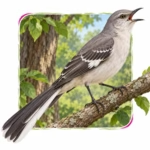
American Robin Fact Highlight
From the full animal facts page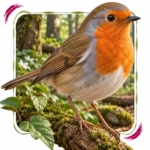
More Animal Comparisons
Pick another animal matchup and keep exploring. Compare appearances, habitats, diets, abilities, and surprising differences.

Make an Animal Story
Send a master mimic and an orange-breasted lawn explorer into a musical adventure with our free Animal Story Generator.