
Moose vs Deer: Living Cervid Species-to-Representative Comparison
A moose is the world’s largest living deer, so “moose versus deer” really compares one extraordinary deer with a smaller representative. This page uses the white-tailed deer for that second side. Moose are vastly taller and heavier, with long wading legs, an overhanging muzzle, throat bell, tiny tail, solitary habits, and broad palmate bull antlers. White-tailed deer are slimmer and more compact, with a pointed muzzle, flag-like white tail, smaller social groups, and main-beam buck antlers. Both are cervids, browsing ruminants, capable swimmers, and mothers of spotted young.
About Moose
- Type Mammal
- Diet Browsing herbivore eating willow, birch, aspen, maple, fir, shrubs, buds, twigs, bark, leaves, grasses, sedges, horsetails, and aquatic plants; it often reaches above or wades below the feeding zone used by smaller deer
- Group Moose (Alces alces; some authorities split North American forms as Alces americanus)
- Known for The largest living deer, with exceptionally long legs, towering shoulders, a heavy dark body, large overhanging muzzle, small tail, shoulder hump, and hanging throat bell; adult bulls commonly stand about 1.7–2.1 meters at the shoulder and weigh roughly 380–700 kilograms, with some Alaskan bulls larger, while cows are smaller and only bulls normally grow broad palmate antlers
- Special skill Extremely long legs for deep snow and wading, spreading cloven hooves that support travel over soft ground, strong swimming, prehensile upper lip and broad muzzle for stripping browse, thick insulating coat, large shoulder muscles, annually renewed palmate bull antlers, and a rumen adapted to fibrous woody and aquatic plants
About White-Tailed Deer
- Type Mammal
- Diet Selective browsing herbivore eating leaves, buds, twigs, forbs, fruits, nuts, fungi, crops, and smaller amounts of grass according to region and season; its shorter reach keeps much feeding closer to the ground than a moose’s
- Group White-tailed deer (Odocoileus virginianus), used here as a familiar representative deer
- Known for A highly variable medium-sized deer with a slim body, delicate-looking legs, pointed muzzle, large ears, and a much longer tail whose white underside flashes when raised; mature northern bucks may stand around 0.8–1 meter at the shoulder and weigh roughly 70–140 kilograms, does are smaller, and only bucks normally grow branching antlers
- Special skill White flag tail, spotted fawn camouflage, compact agility through edge cover, sensitive nose and ears, quick bounding escape, annually renewed buck antlers with tines rising from a main beam, split hooves, seasonal coat, and a four-chambered ruminant stomach
Moose vs White-Tailed Deer: Quick Answer
A moose is a deer—the largest living species in the family. Compared with the white-tailed deer used here as the familiar reference, a moose is much taller and heavier, with very long legs, a broad muzzle, a throat bell, a tiny tail, and wide palmate antlers on adult bulls. A white-tail is smaller and slimmer, with a pointed face, longer flag-like tail, and branching main-beam antlers on bucks.
Where Do They Fit?
Follow the branches to see how Moose and White-Tailed Deer are classified and related.
Moose vs White-Tailed Deer: Quick Comparison
| Feature | Moose | White-Tailed Deer |
|---|---|---|
| Family relationship | The largest living species of deer | A smaller deer species used as the familiar comparison reference |
| Scientific name | Alces alces, with some authorities recognizing Alces americanus in North America | Odocoileus virginianus |
| Relative size | About 1.7–2.1 meters at the shoulder; large bulls may weigh 700 kilograms or more | Often about 0.8–1 meter at the shoulder; large northern bucks may approach 140 kilograms |
| Face and throat | Large overhanging muzzle and hanging bell or dewlap | Narrow pointed muzzle and no moose-like throat bell |
| Legs and tail | Extremely long legs and a very short tail | Shorter, finer legs and a longer tail with white underside |
| Male antlers | Usually broad and palmate in mature bulls, with projecting tines | Branching main beams rather than broad palms |
| Social pattern | Usually solitary except cow-calf bonds and temporary rut contact | Often forms small doe-family, bachelor, or seasonal groups |
| Wetland skill | Powerful swimmer and deep wader that feeds on aquatic plants | Can swim well and use wetlands but usually feeds in shallower or drier edge habitat |
| Young | Calf, often one or two depending on condition and population | Fawn, commonly one or two with local and age variation |
| Heat response | Highly cold-adapted and vulnerable to heat stress | Occupies a much broader climate range, including warm temperate and tropical regions |
How Are Moose and Deer Alike?
- A moose and a white-tailed deer are both cervids with split hooves, side-set eyes, mobile ears, keen smell, and four-chambered ruminant stomachs.
- Adult males normally grow bone antlers under nourishing velvet, shed the velvet after growth, use hard antlers during the rut, and cast them before starting another set.
- Both browse woody and leafy plants, chew cud, swim, move quietly through dense habitat, and change their diets and movements with the seasons.
- Both mothers hide or guard spotted young, and both can be unpredictable and defensive around babies, dogs, food, roads, or close observers.
- Both shape plant communities, feed predators and scavengers, spread nutrients, carry parasites and disease, and require habitat connections across human landscapes.
How Are Moose and Deer Different?
- Moose are the largest living deer and may weigh several times more than a white-tailed deer, with shoulders high above a person’s head in the largest bulls.
- A moose has an overhanging bulbous muzzle, throat bell, shoulder hump, and tiny tail; a white-tail has a pointed muzzle and a longer tail with brilliant white underside.
- Mature bull moose usually grow broad palm-like antlers, while white-tailed bucks grow branching antlers with tines rising from curved main beams.
- Moose use exceptionally long legs to cross deep snow and wade for aquatic plants; white-tails use a smaller agile build to dash and bound through broken woodland and edge cover.
- Moose are usually solitary, whereas white-tails more often form small family, bachelor, or seasonal groups even though neither species remains in one permanent herd structure.
- Moose are strongly cold-adapted and can overheat in surprisingly cool weather; white-tailed deer occupy climates from boreal Canada into tropical parts of the Americas.
Moose vs Deer Adaptation Showdown
Wetland cervid adaptation showdown: Moose wins size and absolute strength because it is the largest living deer. Speed is a tie: both can sprint fast enough to outrun a person, and exact maximums vary. Camouflage is a tie because a dark moose vanishes in bog forest while a white-tail’s seasonal coat and compact outline suit woodland edges. White-tailed deer wins group-level sociality because it more often forms family and bachelor groups; moose are usually solitary. Moose wins swimming for long-distance water travel, deep wading, and underwater feeding. Moose also wins weirdest adaptation for palm-shaped antlers, a grasping upper lip, and a dangling throat bell whose full function remains uncertain. These categories compare adaptations, not combat.
Fun Moose vs Deer Facts
The Moose Is Already a Deer
Family Cervidae contains moose, elk, reindeer, muntjacs, white-tailed deer, and many other species. Moose occupy their own genus, Alces, but remain true deer. The everyday phrase “moose versus deer” usually means a moose beside a smaller deer such as a white-tail, not a biological split between moose and the family.
Long Legs Open Two Dining Rooms
A moose can step through deep snow and wade far into a pond because its legs are much longer than those of a white-tail. Its broad muzzle and grasping upper lip pull willow twigs above the ground and aquatic plants below the surface. That lets the animal feed in zones a smaller deer reaches less easily.
Palmate Antlers Begin as Soft Velvet
A bull’s growing antlers are living bone supplied by blood vessels inside velvet skin. By late summer the bone hardens, blood supply ends, and the bull rubs away the velvet. Mature moose antlers broaden into palms, but young bulls may carry simple spikes or forks before age and nutrition allow a wide rack.
Moose Can Overheat in Cool Weather
A thick coat and large cold-adapted body conserve heat so efficiently that a moose must begin cooling itself at temperatures people may consider mild. Shade, cool forest, wind, and water become important summer refuges. Warming conditions can also intensify parasites and shift suitable habitat northward or uphill.
The Bell Is Still a Biological Puzzle
Both male and female moose may carry a hanging flap of skin and hair beneath the throat called a bell or dewlap, though bulls usually have the larger one. Scientists have proposed roles in scent, display, or communication, but no single explanation fully settles its function.
Moose vs Deer Quiz
- Is a moose a deer? Answer: Yes. It is the largest living member of family Cervidae.
- Which animal has broad palmate antlers on mature males? Answer: The moose.
- Which animal raises a white tail like a flag? Answer: The white-tailed deer.
- Why are a moose’s legs so useful? Answer: They help it cross deep snow, wade through wetlands, and reach different feeding zones.
- What is a young moose called? Answer: A calf.
Moose vs Deer FAQ
Is a moose a type of deer?
Yes. Moose belong to the deer family Cervidae. They are the only living members of genus Alces and are the largest living deer.
Which is bigger, a moose or deer?
A moose is much larger than the white-tailed deer shown here, but “deer” includes the moose itself. A large bull moose can weigh several times as much as a large whitetail buck.
How do moose antlers differ from deer antlers?
Mature bull moose usually develop broad palms with projecting tines. A white-tailed buck’s antlers remain branching beams without a large solid palm. Young, unhealthy, or poorly nourished bulls may have much smaller racks.
Can moose swim?
Yes. Moose are powerful swimmers and wade into lakes and ponds to feed on aquatic vegetation or cool down. White-tailed deer can swim too, but aquatic feeding is much more characteristic of moose.
Are moose safe to approach?
No. Moose can charge with little warning, especially cows with calves and bulls during the rut. Keep the distance required locally, control dogs, never feed them, and place a sturdy object between you and a charging moose while moving away.
Animal Words to Know
- Palmate: Broad and flattened like the palm of a hand, as in a mature bull moose’s antler.
- Bell: The hanging flap of skin and hair beneath a moose’s throat, also called a dewlap.
- Browse: Leaves, shoots, twigs, bark, and other woody plant food eaten by an herbivore.
- Ruminant: A hoofed herbivore that ferments food in a multi-chambered stomach and chews cud.
- Thermal refuge: A cooler place such as shade or water that helps an animal avoid heat stress.
Moose and White-Tailed Deer Activity
Moose and White-Tailed Deer Activity
Draw a bull moose and white-tailed buck on the same ground line. Make the moose tower over the deer, with long legs, a broad overhanging muzzle, a throat bell, tiny tail, and palmate antlers beside a wetland. Give the deer a pointed muzzle, branching antlers, and a long white flag tail at a forest edge. Label size, muzzle, antlers, tail, wetland, and woodland.
Meet Each Animal
Want the full fact file? Here are quick highlights from each animal’s own facts page.
Moose Fact Highlight
From the full animal facts page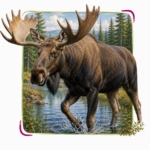
White-Tailed Deer Fact Highlight
From the full animal facts page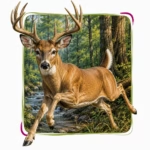
More Animal Comparisons
Pick another animal matchup and keep exploring. Compare appearances, habitats, diets, abilities, and surprising differences.

Make an Animal Story
Turn this moose vs deer comparison into a deep-snow and pondweed mystery with our free Animal Story Generator.
Source notes: References used for this comparison. See more See less
Try Another Matchup
Explore this comparison →