
Newt vs Toad for Kids: Smooth Newt and Common Toad
A Smooth Newt and a Common Toad are both amphibians, but their shapes and pond lives are easy to separate. The slender newt keeps a long tail as an adult and swims with side-to-side waves. The broader toad has no adult tail, walks on short back legs, carries defensive toxins in skin glands, and lays long strings of spawn.
About Smooth Newt
- Type Amphibian
- Diet Carnivore
- Group Newt and salamander family, Salamandridae
- Known for A long tail, spotted orange belly, and male breeding crest
- Special skill Swims with its tail and wraps each egg separately inside a pond-plant leaf
About Common Toad
- Type Amphibian
- Diet Carnivore
- Group True toad family, Bufonidae
- Known for Warty-looking skin, poison glands, and spring pond migrations
- Special skill Produces defensive skin toxins and follows remembered routes to breeding water
Quick Answer
Quick answer: The Smooth Newt is a small, slender, tailed amphibian that reaches about 10 centimetres and wraps single eggs in leaves. The Common Toad is broader and often heavier, reaches roughly 8 to 13 centimetres, has dry-looking warty skin and poison glands, and lays eggs in long jelly strings.
Smooth Newt vs Common Toad: Quick Comparison
| Feature | Smooth Newt | Common Toad |
|---|---|---|
| Scientific name | Lissotriton vulgaris | Bufo bufo |
| Adult length | Up to about 10 cm | About 8 to 13 cm |
| Adult tail | Long and flattened for swimming | No tail |
| Skin | Smooth in water and velvety on land | Dry-looking, bumpy, and warty |
| Breeding look | Male grows a continuous wavy crest | Male remains smaller and clasps the female |
| Eggs | Laid one at a time and folded into plant leaves | Laid in long jelly strings with two egg rows |
| Larvae | Feathery external gills and front legs appear before back legs | Dark tadpoles without external feathery gills; back legs appear first |
| Movement | Writhing swim powered by the tail | Usually walks or makes short hops and swims with the legs |
| Defense | Hides, swims away, and may release unpleasant skin secretions | Powerful toxins in skin glands discourage predators |
| Seasonal life | Breeds in ponds, then shelters in damp places on land | Migrates to deep ancestral ponds, then spends much of the year on land |
How Newts and Toads Are Alike
- Both are amphibians with moist living skin and no scales, fur, or feathers.
- Both usually breed in fresh water during spring.
- Both begin life as aquatic larvae and transform into air-breathing young.
- Both eat insects, slugs, worms, and other small invertebrates.
- Both spend much of the nonbreeding season hidden in damp places on land.
How Newts and Toads Are Different
- An adult Smooth Newt has a long tail, while an adult Common Toad has no tail.
- Male Smooth Newts grow a wavy breeding crest, while Common Toads never do.
- Newts fold individual eggs inside leaves, while toads lay long strings of spawn.
- Newt larvae have feathery external gills and grow front legs first, while toad tadpoles grow back legs first.
- Common Toads have stronger defensive toxins and migrate faithfully to traditional breeding ponds.
Newt vs Toad Adaptation Showdown
Adaptation showdown: Common Toad wins size because females can reach about 10 to 13 cm and have a much bulkier body than a Smooth Newt. Smooth Newt wins speed because its flattened tail provides agile propulsion in pond water. Common Toad wins strength because its sturdy body, short powerful limbs, and toxic skin resist many predators. Stealth is a Tie because both use dull earth colors and shelter under cover. Social behavior is a Tie because both are mainly solitary but gather for breeding. Smooth Newt wins swimming because its body and tail remain specialized for aquatic movement throughout adulthood. Smooth Newt wins weirdest for growing a male breeding crest and carefully folding each tiny egg into a living leaf.
Fun Smooth Newt vs Common Toad Facts
An Egg in a Leaf
A female Smooth Newt lays eggs one at a time. She uses her hind feet to fold a soft aquatic leaf around each jelly-covered egg, giving it a small protective wrapper.
Spawn Like Long Necklaces
Common Toads lay eggs in long double-rowed jelly strings, often winding them around pond plants. This looks very different from clumped frogspawn or single newt eggs.
A Crest for Spring
During the breeding season, a male Smooth Newt develops a wavy crest running along the back and tail. Outside the pond season, the crest shrinks away.
The Walk Back to Water
Common Toads often return along traditional routes to the same breeding ponds. On warm damp spring nights, large numbers may travel together and cross dangerous roads.
Different Leg Order
Smooth Newt larvae grow front legs before the back legs. Common Toad tadpoles follow the familiar frog pattern and develop their back legs first.
Newt vs Toad Quiz
- Which adult keeps a long tail? Answer: The Smooth Newt.
- Which amphibian lays eggs in long strings? Answer: The Common Toad.
- What does a male Smooth Newt grow in breeding season? Answer: A wavy crest along the back and tail.
- Which larva grows front legs first? Answer: The Smooth Newt larva.
- Why do many predators avoid Common Toads? Answer: Their skin glands contain powerful defensive toxins.
Smooth Newt vs Common Toad FAQ
Is a newt a type of toad?
No. Newts are salamander relatives with adult tails, while toads are tailless amphibians in a different family.
Which is bigger?
A Common Toad is usually much bulkier and may be slightly longer than a Smooth Newt.
Can both animals live out of water?
Yes. Adults spend much of the year on land, but they need damp shelter and usually return to fresh water to breed.
Do toads give people warts?
No. Touching a toad does not cause human warts, but wild amphibians should be left undisturbed.
Why does a Smooth Newt have a tail?
The flattened tail pushes against water and helps the newt steer while swimming.
Animal Words to Know
- Amphibian: A vertebrate with moist skin whose life often includes aquatic larvae and land-living adults.
- Metamorphosis: A major body change from larva to juvenile or adult.
- Spawn: The jelly-covered eggs laid in water by frogs, toads, or some other animals.
- Crest: A raised ridge of skin that male Smooth Newts grow for the breeding season.
- Toxin: A poisonous substance made by a living organism for defense or another purpose.
Decode Two Pond Life Cycles
Decode Two Pond Life Cycles
Draw exactly one adult Smooth Newt and exactly one adult Common Toad at honest relative scale. Build two four-stage life-cycle wheels using egg, larva, new young, and adult cards. Show single leaf-wrapped newt eggs, string-like toadspawn, feathery newt-larva gills, and dark toad tadpoles. Observe ponds quietly without people handling amphibians or spawn.
Meet Each Animal
Want the full fact file? Here are quick highlights from each animal’s own facts page.
Smooth Newt Fact Highlight
From the full animal facts page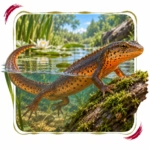
Common Toad Fact Highlight
From the full animal facts page
More Animal Comparisons
Pick another animal matchup and keep exploring. Compare appearances, habitats, diets, abilities, and surprising differences.






Make an Animal Story
Send a crested Newt and a pond-migrating Toad through a rainy-night adventure with our free Animal Story Generator.