
Okapi vs Giraffe: Close Giraffid Species-to-Genus Comparison
Okapis and giraffes are not look-alikes, but they are one another’s closest living relatives and the only surviving branches of family Giraffidae. Both are African browsing ruminants with cloven hooves, long dark tongues, ossicones, seven neck vertebrae, spotted or striped camouflage, and an unusual pacing walk. A giraffe is vastly taller and usually social in open country; an okapi is shorter, darker, mainly solitary, and built to disappear in Congo rainforest understory.
About Okapi
- Type Mammal
- Diet Leaves, buds, twigs, young shoots, ferns, fruits, fungi, and other forest plants, selected with the flexible tongue; an okapi is a browsing ruminant that regurgitates and rechews cud, and it may visit mineral-rich clay or salty places
- Group Okapi (Okapia johnstoni), the only living species in genus Okapia and the only living giraffid outside genus Giraffa; no subspecies are currently recognized
- Known for A compact, deep-chested giraffid about 1.8–2.5 meters long and roughly 210–350 kilograms, standing near 1.5 meters at the shoulder, with a velvety dark reddish-brown coat, white lower legs, bold dark horizontal stripes on the rump and upper legs, large independently movable ears, a long dark prehensile tongue, cloven hooves, and a sloping back; adult males normally have short skin-covered ossicones, while females usually have hair whorls instead
- Special skill Shadow-dark oily fur that sheds rainforest water, disruptive leg stripes, large ears that rotate independently, a dark grasping tongue long enough for feeding and grooming, a sensitive sense of smell, cloven hooves, a pacing walk that moves both legs on one side in sequence, a four-chambered ruminant stomach, and short male ossicones
About Giraffe
- Type Mammal
- Diet Leaves, buds, flowers, fruits, seedpods, and shoots browsed mainly from trees and shrubs such as acacias and related thorny plants; giraffes use the lips and long flexible tongue to select food and are ruminants that later bring up and chew cud
- Group Giraffes (genus Giraffa), represented for close visual comparison by an adult Masai giraffe (Giraffa tippelskirchi); the IUCN taxonomic framework recognized four living giraffe species in 2025: Masai, northern, reticulated, and southern giraffes
- Known for The tallest living land mammals, with adult males of the largest populations approaching about 5.5–5.7 meters and 1,900 kilograms while females are shorter and lighter, supported by extremely long legs, a neck with seven greatly elongated vertebrae, a sloping back, cloven hooves, a spotted coat whose pattern differs by species and individual, a dark prehensile tongue, large eyes and ears, and skin-covered ossicones in both sexes
- Special skill Extreme height for high browsing and long-distance vision, seven elongated neck vertebrae, long legs and a rotary gallop, a high-pressure heart-and-vessel system with valves and tight lower-leg tissues that manage gravity, long dark tongues and tough lips for thorny browse, patterned camouflage, ossicones, excellent eyesight, a pacing walk, and ruminant digestion
Okapi vs Giraffe: Quick Answer
The giraffe is the towering open-country relative, reaching roughly 5.5–5.7 meters in the largest adult males and living in loose, changing social groups. The okapi is a compact rainforest giraffid standing about 1.5 meters at the shoulder, usually living alone in the Democratic Republic of the Congo. An okapi’s stripes do not make it a zebra: both animals belong to Giraffidae and share grasping tongues, cloven hooves, ossicones, ruminant digestion, and a pacing walk.
Where Do They Fit?
Follow the branches to see how Okapi and Giraffe are classified and related.
Okapi vs Giraffe: Quick Comparison
| Feature | Okapi | Giraffe |
|---|---|---|
| Scientific group | Okapia johnstoni, the sole living species of its genus | Genus Giraffa, now divided into four recognized living species |
| Family | Giraffidae | Giraffidae |
| Selected adult size clue | About 1.8–2.5 m long, 210–350 kg, and near 1.5 m at the shoulder | Largest adult males approach about 5.5–5.7 m tall and 1,900 kg |
| Coat pattern | Dark body with pale lower legs and horizontal rump-and-leg stripes | Light background with brown patches whose shapes vary by species and individual |
| Ossicones | Normally obvious only in adult males; females usually show hair whorls | Present in both sexes, usually larger and balder on top in mature males |
| Wild home | Dense rainforest in the Democratic Republic of the Congo | Savannas, woodlands, shrublands, and dry forests across parts of sub-Saharan Africa |
| Social pattern | Mainly solitary except breeding and mother-calf care | Flexible fission-fusion society with changing groups and lasting relationships |
| Feeding level | Understory leaves, shoots, ferns, fruits, and fungi | Higher tree and shrub leaves, buds, flowers, fruits, and seedpods |
| Shared movement clue | Often paces, moving the legs on one side together during a walk | Also paces while walking, then uses a rotary gallop when running |
| Conservation clue | Endangered and restricted to one country | Four species now require separate population and threat assessments |
How Are Okapis and Giraffes Alike?
- Both are hoofed mammals in family Giraffidae; together, Okapia and Giraffa are the family’s only living genera.
- Both are African herbivores that browse leaves and shoots with long, dark, prehensile tongues and flexible lips.
- Both are ruminants with multi-chambered stomachs, regurgitate cud for more chewing, and walk on two main hoofed toes.
- Both have seven neck vertebrae, sloping backs, large ears, excellent senses, patterned coats, and skin-covered bony structures called ossicones.
- Both often use a lateral pacing walk in which the front and rear legs on the same side move together, then change gait to run.
How Are Okapis and Giraffes Different?
- An okapi stands near 1.5 meters at the shoulder and has a moderately long neck; an adult male giraffe can stand more than three times as tall overall.
- Okapis are one species found only in Congo rainforests; Giraffa contains four recognized species spread through separated African savannas, woodlands, shrublands, and dry forests.
- An okapi has a dark oily body coat and zebra-like horizontal leg stripes; a giraffe has a lighter coat divided into large brown patches.
- Obvious ossicones normally occur only on male okapis, whereas female and male giraffes both have them, with mature males usually developing heavier tops.
- Okapis usually live alone and depend on hearing, scent, and camouflage in dense vegetation; giraffes form flexible social networks and use height and keen vision across more open landscapes.
- Okapis browse mainly within the forest understory; giraffes can reach foliage several meters above ground, although both choose food across more than one height.
Okapi vs Giraffe Adaptation Showdown
Giraffid adaptation showdown: Giraffe wins typical size by a huge margin and wins speed because giraffes have a documented fast rotary gallop, while no equally dependable standardized maximum is available for wild okapis. Giraffe wins strength as a cautious inference from much greater body mass and powerful kicks, not from a contest. Okapi wins stealth for its shadow-dark waterproof coat, disruptive stripes, solitary habits, and forest hearing. Giraffe wins teamwork for fission-fusion social networks; okapis still communicate and mothers care closely for calves. Swimming is a tie because neither is aquatic and there is no fair like-for-like performance test. Giraffe wins weirdest adaptation for a circulatory system that must move blood up a neck around two meters long without flooding the lower legs or starving the brain. These categories compare adaptations, not combat.
Fun Okapi vs Giraffe Facts
One Living Family Has Only Two Branches
Okapis and giraffes are the only living members of Giraffidae. Their shared ancestor split into lineages that eventually produced a compact forest browser and the tallest land mammal. DNA research places their common ancestor roughly 11–12 million years ago, although fossil giraffids once included many other shapes and ranges. The okapi is therefore not a zebra-deer mixture—it is a true giraffid.
The Stripes Are Forest Camouflage, Not Zebra Proof
An okapi’s pale horizontal bands break its rump and legs into separate shapes among shafts of light, trunks, leaves, and shadow. The coat’s dark background blends with rainforest gloom, and its oily texture helps shed water. Young okapis may also use the bold rear pattern as a visual guide when following their mothers, which is why zoo educators sometimes call them “follow-me stripes.”
Both Necks Still Contain Seven Main Vertebrae
A giraffe does not gain its long neck by adding dozens of ordinary neck bones. Like an okapi and most other mammals, it has seven cervical vertebrae, but each giraffe vertebra can be dramatically elongated. Okapis keep a shorter, more maneuverable neck that works beneath branches, while giraffes raise the same basic seven-bone plan toward treetop browse.
Ossicones Reveal a Family Pattern and a Sex Difference
Ossicones begin as cartilage and later fuse to the skull while remaining covered by skin. Adult male okapis normally carry a short pair, but females usually have rounded hair whorls instead. Both female and male giraffes have ossicones; mature males often wear the hair away and build extra bone through years of growth and head-to-neck contact.
The Giraffe Side of the Family Now Has Four Species
For centuries, classifications often placed all giraffes in one species with several subspecies. After years of genomic, geographic, and skull research, the IUCN taxonomic framework recognized four species in 2025: Masai, northern, reticulated, and southern giraffes. This page compares the okapi with the genus as a whole, so exact pattern, range, size, and conservation status vary among those four species.
Okapi vs Giraffe Quiz
- What animal family contains both the okapi and giraffes? Answer: Giraffidae.
- Which animal lives naturally only in the Democratic Republic of the Congo? Answer: The okapi.
- Do okapi stripes mean it is closely related to a zebra? Answer: No. It is the giraffe’s closest living relative.
- Which animal usually lives in flexible, changing social groups? Answer: The giraffe.
- How many living giraffe species does the current IUCN framework recognize? Answer: Four: Masai, northern, reticulated, and southern giraffes.
Okapi vs Giraffe FAQ
Is an okapi a type of giraffe?
An okapi is not one of the four giraffe species, but it is their closest living relative. Okapia and Giraffa are separate genera inside family Giraffidae, whose only living members are the okapi and giraffes.
Is an okapi related to a zebra?
Not closely. Its leg stripes resemble a zebra’s pattern because stripes can be useful camouflage, not because the animals share a recent ancestor. Zebras belong to horse family Equidae; okapis belong to giraffe family Giraffidae.
Why is a giraffe so much taller than an okapi?
Long legs and greatly elongated neck vertebrae let giraffes browse high foliage and see over open habitat. The okapi’s shorter body is easier to maneuver beneath rainforest vegetation. Each design fits a different feeding zone and landscape.
Do okapis and giraffes have horns?
They have ossicones, permanent bony structures covered by skin rather than keratin-sheathed true horns. Both giraffe sexes usually have them. In okapis, they are normally obvious only in adult males, while females usually have hair whorls.
Would an okapi and giraffe meet in the wild?
Ordinarily no. Okapis are restricted to dense forests in the Democratic Republic of the Congo, while wild giraffe populations inhabit more open habitats elsewhere across fragmented parts of sub-Saharan Africa. This page compares relatives, not a natural encounter or fight.
Animal Words to Know
- Giraffidae: The hoofed-mammal family whose only living members are okapis and giraffes.
- Ossicone: A permanent skin-covered bony structure on the head of a giraffid.
- Prehensile: Able to grasp or wrap around something, as an okapi or giraffe tongue can grasp leaves.
- Ruminant: A hoofed herbivore that ferments plant food in a multi-chambered stomach and rechews cud.
- Fission-fusion: A social system in which animals split apart and join groups whose membership changes over time.
Okapi and Giraffe Scale Activity
Okapi and Giraffe Scale Activity
Draw an okapi and giraffe on the same ground line and at the same scale. Make the okapi much shorter, with a dark reddish-brown body, striped legs, large ears, and a rainforest background. Give the giraffe a very long neck, patch-patterned coat, ossicones, and a savanna woodland background. Add a bracket around both animals labeled “giraffids.” Label height, neck, coat, ears, browser, and habitat.
Meet Each Animal
Want the full fact file? Here are quick highlights from each animal’s own facts page.
Okapi Fact Highlight
From the full animal facts page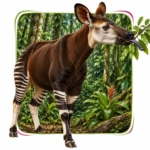
Giraffe Fact Highlight
From the full animal facts page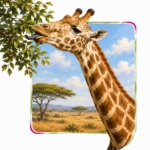
More Animal Comparisons
Pick another animal matchup and keep exploring. Compare appearances, habitats, diets, abilities, and surprising differences.


Make an Animal Story
Turn this okapi vs giraffe comparison into a striped-rainforest and spotted-savanna family mystery with our free Animal Story Generator.
Source notes: References used for this comparison. See more See less
Try Another Matchup
Explore this comparison →