
Olm vs Axolotl: Aquatic Salamander Species Comparison
Olms and Axolotls are aquatic salamanders that keep larval features as adults, including external gills. They are still very different animals. The Olm, Proteus anguinus, is a long, pale cave specialist from underground Europe. Its eyes are reduced and often covered by skin. The Axolotl, Ambystoma mexicanum, is a broader lake-and-canal salamander from Xochimilco in Mexico City. Wild Axolotls are dark brown or olive and mottled; the famous pale pink form is common in captivity, not the normal wild color.
About Olm
- Type Living
- Diet Carnivore; swallows small cave crustaceans, insect larvae, worms, snails and other aquatic invertebrates
- Group Fully aquatic cave salamander and the only species in genus Proteus (Proteus anguinus)
- Known for Long pale body, covered or reduced eyes, tiny limbs, red external gills, cave senses and an exceptionally slow life
- Special skill Lives without useful sight by combining smell, taste, touch, water-motion sensing and sensitivity to faint electrical fields
About Axolotl
- Type Living
- Diet Carnivore; suction-feeds on worms, insect larvae, crustaceans, mollusks and small fish
- Group Fully aquatic mole salamander that normally remains in its larval-looking form as an adult (Ambystoma mexicanum)
- Known for Broad head, large feathery external gills, finned tail, permanent aquatic life and powerful tissue regeneration
- Special skill Regrows complete limbs and can repair its tail, spinal cord and parts of the brain and heart with little scarring
Olm vs Axolotl: Quick Answer
An Olm is a slender, pale salamander shaped by life in completely dark European cave water. It has tiny limbs, reduced eyes and many nonvisual senses. An Axolotl is shorter and sturdier, with a broad head and large feathery gills. Wild ones are dark and mottled in Xochimilco. Axolotls are especially famous for regrowing complex body parts, while olms stand out for extreme longevity and slow metabolism.
Where Do They Fit?
Follow the branches to see how Olm and Axolotl are classified and related.
Olm vs Axolotl: Quick Comparison
| Feature | Olm | Axolotl |
|---|---|---|
| Scientific name | Proteus anguinus | Ambystoma mexicanum |
| Adult length | Usually about 20-30 cm; exceptional individuals approach 40 cm | Usually about 15-30 cm; around 23 cm is common |
| Body shape | Very slender, eel-like body with tiny limbs and 3 front toes | Stout body, broad head, stronger limbs and 4 front toes |
| Natural color | Usually pinkish-white, though a rare dark form exists | Wild type is dark brown or olive with mottling and gold speckles |
| Eyes | Reduced and usually covered by skin in the pale form | Small but visible, lidless eyes |
| External gills | Three small red feathery tufts on each side | Three large feathery branches on each side |
| Wild home | Underground limestone waters in the Dinaric karst of Europe | Freshwater canals and wetlands of Xochimilco in Mexico City |
| Food | Small cave crustaceans and other aquatic invertebrates | Worms, insect larvae, crustaceans, mollusks and small fish |
| Famous adaptation | Cave senses, slow metabolism and possible century-long lifespan | Regeneration of limbs and other complex tissues |
| Conservation | Vulnerable because cave-water habitat is limited and easily polluted | Critically Endangered in the wild despite being common in captivity |
How Are Olms and Axolotls Alike?
- Both are salamanders that remain fully aquatic throughout normal adult life.
- Both keep external gills and a tail fin after reaching breeding age.
- Both use suction to pull small animal prey into the mouth.
- Both can absorb oxygen through the skin as well as using gills and simple lungs.
- Both face serious threats in their small, sensitive wild freshwater habitats.
How Are Olms and Axolotls Different?
- Olms live in dark European cave water, while Axolotls are native to open lake and canal habitat in Mexico City.
- An Olm is long and threadlike with tiny limbs; an Axolotl is shorter, broader and more robust.
- The pale Olm’s eyes are reduced and hidden by skin, while the Axolotl has visible lidless eyes.
- Olms are naturally pale in most populations, while wild Axolotls are normally dark and mottled.
- The Olm is famous for cave survival and extreme longevity; the Axolotl is famous for rapid, complex regeneration.
Olm vs Axolotl Adaptation Showdown
- Size – Olm: Exceptional olms can approach 40 cm, while Axolotls longer than about 30 cm are unusual.
- Speed – Tie: Both are usually slow, energy-saving swimmers, and no reliable matched race gives either an advantage.
- Strength – Axolotl: Its broader head, sturdier body and more developed limbs give it greater short-range power.
- Stealth – Olm: Its pale body and silent, unhurried movements suit lightless cracks where vision cannot reveal it.
- Social – Olm: Olms often rest in loose groups under stones, while Axolotls are generally more independent.
- Swimming – Tie: Both use side-to-side tail waves and small limbs to move through calm freshwater.
- Weirdest – Olm: It may live for a century, navigates without useful eyesight and can survive extraordinary gaps between meals.
Fun Olm vs Axolotl Facts
An Adult That Keeps Baby Traits
Both species reach breeding age while keeping external gills and other larval features, a pattern called paedomorphosis.
Eyes Beneath the Skin
In the common pale Olm, tiny reduced eyes lie beneath the skin and cannot form normal images.
A Very Long Life
Careful estimates suggest an average Olm lifespan near 69 years and a possible maximum beyond 100 years.
Wild Axolotls Are Dark
The natural wild Axolotl is brown or olive with dark mottling; pale pink leucistic animals were bred in captivity.
A Regeneration Champion
An Axolotl can rebuild a missing limb with bone, muscle, nerves, skin and blood vessels in the right arrangement.
Olm vs Axolotl Quiz
Which salamander lives in European caves? A) Olm B) Axolotl C) Both Answer: A) Olm
What color are wild Axolotls usually? A) Dark brown or olive and mottled B) Bright blue C) Snow white only Answer: A) Dark brown or olive and mottled
Which animal has reduced eyes often covered by skin? A) Olm B) Axolotl C) Both Answer: A) Olm
What are Axolotls especially famous for? A) Regrowing complex body parts B) Flying C) Building dams Answer: A) Regrowing complex body parts
What feature do both adults keep? A) External gills B) Feathers C) Shells Answer: A) External gills
Olm vs Axolotl FAQ
Are Olms and Axolotls the Same Animal?
No. They are salamanders from different families, continents and habitats, although both remain aquatic and keep larval traits as adults.
Are Wild Axolotls Pink?
Usually not. Wild Axolotls are dark brown or olive with mottling. Pink leucistic forms are especially common in captivity.
Can an Olm See?
The common pale Olm has tiny reduced eyes covered by skin. It detects light but cannot form detailed images and depends on other senses.
Can an Axolotl Regrow Anything?
No. It has extraordinary regenerative powers, including complete limbs and several other tissues, but regeneration still has biological limits.
Which Species Is More Endangered?
The wild Axolotl is Critically Endangered and restricted to Xochimilco. The Olm is Vulnerable across fragmented European cave systems.
Animal Words to Know
- Aquatic: Living in water.
- External gills: Feathery breathing organs projecting from the outside of the head.
- Karst: A landscape where water dissolves limestone and forms caves and underground streams.
- Leucistic: Having reduced pigment, often creating pale skin while the eyes stay dark.
- Paedomorphosis: Becoming an adult while keeping body features normally seen in larvae.
Design Two Aquatic Salamander Habitats
Design Two Aquatic Salamander Habitats
Divide a page into a dark limestone cave pool and a planted Xochimilco canal. Draw one long pale Olm with tiny limbs and hidden eyes in the cave, then one dark mottled Axolotl with a broad head and large gills in the canal. Add five labels showing how body shape, color and senses fit each habitat.
Meet Each Animal
Want the full fact file? Here are quick highlights from each animal’s own facts page.
Olm Fact Highlight
From the full animal facts page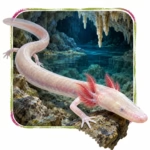
Axolotl Fact Highlight
From the full animal facts page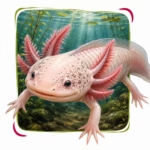
More Animal Comparisons
Pick another animal matchup and keep exploring. Compare appearances, habitats, diets, abilities, and surprising differences.






Make an Animal Story
Create an underwater mystery about an eyeless cave Olm and a regenerating wild Axolotl!
Source notes: References used for this comparison. See more See less
Try Another Matchup
Explore this comparison →