
Pangolin vs Anteater: Convergent Specialist Insect-Eater Comparison
Pangolins and anteaters are not close cousins. Pangolins belong to order Pholidota and live in Africa and Asia; anteaters belong to order Pilosa within Xenarthra and live in the Americas. Their long snouts, lack of teeth, powerful digging claws, keen smell, sticky tongues, and ant-and-termite diets evolved independently because they solve similar feeding problems. The giant pangolin wears keratin armor and curls into a ball; the giant anteater wears coarse hair, raises up with defensive claws, and is a strong swimmer.
About Pangolin
- Type Mammal
- Diet Only ants and termites, including adults, larvae, and eggs selected by species and season; the giant pangolin tears nests with heavy claws, probes with a very long narrow tongue coated in sticky saliva, swallows prey without chewing, and uses a muscular stomach plus swallowed grit to process food
- Group Giant pangolin (Smutsia gigantea), used as the measurable pangolin example because “pangolin” covers eight living species in order Pholidota—four African and four Asian species with different sizes, tails, habitats, and climbing abilities
- Known for The largest living pangolin, roughly 1.1–1.8 meters from snout to tail tip and often over 30 kilograms with exceptional reports approaching 40 kilograms, with an elongated low body, narrow toothless head, tiny eyes, no obvious outer ear flaps, powerful forelimbs and claws, column-like hind limbs, a thick tail, and overlapping brown keratin scales covering the head, back, flanks, limbs, and tail while the belly and inner surfaces remain softly haired and unarmored
- Special skill Overlapping keratin scales, tight ball-curling defense, strong front claws, reinforced eyelids, closable nostrils and protected ear openings, keen smell, no teeth, an extremely long sticky tongue whose muscular apparatus reaches deep into the torso, a muscular grinding stomach, claw-protecting wrist-edge walk, powerful burrowing, nocturnal behavior, and a heavy tail that braces the body
About Anteater
- Type Mammal
- Diet Almost entirely ants and termites found by smell; powerful claws open a small part of a nest, and a tongue about 60 centimeters long flicks as fast as roughly 150 times per minute to collect insects with sticky saliva before the animal moves on, limiting exposure to biting or stinging defenders
- Group Giant anteater (Myrmecophaga tridactyla), used as the measurable anteater example because four living anteater species occupy family Myrmecophagidae: the giant anteater, silky anteater, northern tamandua, and southern tamandua
- Known for The largest anteater, about 1.8–2.4 meters long including its enormous tail and roughly 27–45 kilograms, with coarse gray-brown hair, a striking diagonal black shoulder stripe edged in white, white forelegs, a tiny tubular mouth at the end of an exceptionally long snout, no teeth, small eyes and ears, muscular forelimbs with long curved claws, hind feet planted normally, and an immense shaggy tail that can cover the body
- Special skill An acute sense of smell, massive forelimbs and curved claws, front-knuckle walking that protects claw tips, a narrow toothless mouth, a 60-centimeter sticky tongue anchored behind the jaw region to the sternum, rapid tongue cycling, muscular stomach digestion, bristly insulating hair, a tail used as shade, blanket, balance, and swimming rudder, flexible day-or-night activity, and the ability to gallop, climb, and swim
Pangolin vs Anteater: Quick Answer
A pangolin is the world’s only scale-covered mammal, while an anteater is a furry American xenarthran. They are unrelated specialist insect eaters shaped by convergent evolution. This row compares the giant pangolin of Africa with the giant anteater of Central and South America: both are toothless, solitary mammals with strong claws and extremely long sticky tongues, but only the pangolin rolls into an armored ball and only the selected anteater has a huge shaggy tail and well-documented swimming ability.
Where Do They Fit?
Follow the branches to see how Pangolin and Anteater are classified and related.
Pangolin vs Anteater: Quick Comparison
| Feature | Pangolin (Giant Pangolin) | Anteater (Giant Anteater) |
|---|---|---|
| Scientific name | Smutsia gigantea | Myrmecophaga tridactyla |
| Broader group | Order Pholidota; one of eight pangolin species | Order Pilosa, suborder Vermilingua; one of four anteater species |
| Main range | West and Central Africa | Central and South America |
| Selected adult size | Roughly 1.1–1.8 m long and usually over 30 kg, possibly near 40 kg | About 1.8–2.4 m long including tail and 27–45 kg |
| Body covering | Overlapping keratin scales above; soft belly remains unscaled | Coarse hair with a black-and-white diagonal shoulder stripe and giant shaggy tail |
| Threat response | Curls into a tight ball protected by scales and may brace with the tail | Usually escapes; can rear on hind legs and tail and sweep powerful claws if cornered |
| Front-foot walk | Turns the long claws inward and bears weight along the outer wrist or curled foot | Folds the claws into the palms and bears weight on the front knuckles |
| Tongue clue | Very long tongue apparatus extends deep through the chest and anchors in the abdomen | About 60 cm long and linked behind the jaw region toward the sternum |
| Young rider | Pup commonly rides at the base of the mother’s tail | Pup rides on the mother’s back, with coat patterns aligning |
| Swimming clue | Some pangolin species swim, but giant-pangolin performance is poorly documented | Giant anteaters are capable swimmers and may use the snout above water |
How Are Pangolins and Anteaters Alike?
- Both are warm-blooded mammals that give live birth, nurse their young, and usually produce a single pup at a time.
- Both specialize in ants and termites, find nests largely by smell, rip openings with strong forelimbs, and gather prey with a long tongue coated in sticky saliva.
- Both have greatly reduced toothless mouths, swallow insects without chewing, and rely on muscular stomach action to crush and digest food.
- Both protect long front claws while walking, spend much of adult life alone, and avoid lingering at a defended insect colony.
- Both show convergent evolution: similar feeding challenges produced similar tools even though their ancestors and home continents are very different.
How Are Pangolins and Anteaters Different?
- Pangolins are pholidotans from Africa and Asia and are more closely related to carnivorans than to anteaters; anteaters are American xenarthrans related to sloths and armadillos.
- A pangolin’s back, flanks, and tail carry overlapping keratin scales; a giant anteater has coarse hair, a bold shoulder stripe, and a sweeping shaggy tail.
- A threatened pangolin curls its head and soft belly inside an armored ball; a cornered giant anteater may stand upright, balance with its tail, and defend itself using curved claws.
- The giant pangolin used here is mainly a nocturnal forest and forest-savanna animal; giant anteaters use a wider mix of grassland, savanna, wetland, shrubland, and forest and may shift between day and night.
- A pangolin mother commonly carries her pup near the tail base; a giant-anteater pup rides high on its mother’s back for many months.
- Giant anteaters are documented capable swimmers and occasional fast gallopers; equivalent maximum speed and swimming performance remain poorly measured for the secretive giant pangolin.
Pangolin vs Anteater Adaptation Showdown
Specialist insect-eater adaptation showdown: Anteater wins typical total length for the selected giant species, although their body masses overlap and “pangolin” includes much smaller species. Anteater wins speed because a giant anteater can gallop rapidly while no dependable giant-pangolin maximum has been measured. Strength is a tie: the anteater has formidable forelimbs, while the pangolin combines heavy claws, tail bracing, and armor, with no standardized test. Pangolin wins stealth for nocturnal, burrowing, exceptionally elusive behavior. Teamwork is a tie because both adults are mainly solitary and mothers care for one pup. Anteater wins swimming because this ability is directly documented in giant anteaters; giant-pangolin performance is poorly known. Pangolin wins weirdest adaptation for living keratin armor plus a tongue mechanism anchored deep in the abdomen. These categories compare adaptations, not combat.
Fun Pangolin vs Anteater Facts
Similar Tools Evolved on Opposite Sides of the World
Pangolins and anteaters did not inherit their insect-eating toolkit from a recent shared ancestor. Pangolins belong to Pholidota and share a deeper branch with carnivoran mammals; anteaters belong to Xenarthra beside sloths and armadillos. Ant and termite nests independently favored long snouts, reduced teeth, sticky tongues, strong claws, sensitive noses, and stomachs that crush food. This repeated solution is convergent evolution.
Pangolin Armor Is Made from the Same Protein as Nails
Each pangolin scale is built mostly from keratin, the tough protein in human fingernails, hair, and many animal claws. Scales overlap like roof tiles over the upper body and tail but do not cover the soft belly. When danger arrives, muscles pull the body into a ball so the armored surfaces face outward and the vulnerable head and abdomen vanish inside.
Both Are Toothless, but Their Tongues Run on Different Rigging
Neither selected animal has teeth. A giant anteater’s roughly 60-centimeter tongue moves rapidly through a tiny mouth and is supported by muscles extending toward the sternum. A pangolin’s tongue apparatus passes even farther back through the chest and anchors near the pelvis or abdominal wall, depending on species. Sticky saliva traps insects, while a muscular stomach handles the crushing that teeth no longer perform.
Claw-Saving Walks Look Similar but Are Not Identical
Long digging claws would wear down if pressed flat against soil all day. A giant pangolin curls the foreclaws inward and places weight along the outer edge of the wrist or foot. A giant anteater folds the claws into its palms and steps on the front knuckles. Both solutions protect sharp nest-opening tools, but each evolved from a different limb and ancestry.
The Babies Choose Different Family Transport
A pangolin pup is born with soft scales that harden soon after birth. Once old enough to accompany its mother, it grips near the base of her tail and rides above the ground. A giant-anteater pup climbs onto its mother’s back; its black-and-white stripe lines up with hers, making one larger broken outline while the youngster travels and learns to forage.
Pangolin vs Anteater Quiz
- Are pangolins and anteaters close relatives? Answer: No. Their similar feeding tools evolved independently.
- What covers a pangolin’s upper body? Answer: Overlapping scales made mainly of keratin.
- Which selected animal has a huge shaggy tail and black shoulder stripe? Answer: The giant anteater.
- What two insects form almost all of both animals’ diets? Answer: Ants and termites.
- Where does each baby usually ride? Answer: A pangolin pup rides near its mother’s tail base; a giant-anteater pup rides on its mother’s back.
Pangolin vs Anteater FAQ
Is a pangolin a kind of anteater?
No. “Scaly anteater” is an old common nickname, not a close family relationship. Pangolins belong to order Pholidota in Africa and Asia. True anteaters belong to order Pilosa in the Americas and are relatives of sloths and armadillos.
Why do pangolins and anteaters look similar?
Both specialize in breaking into ant and termite nests. Natural selection independently favored narrow snouts, powerful claws, keen smell, toothless mouths, sticky tongues, and muscular stomachs. Similar adaptations evolving separately are called convergent evolution.
Can pangolin scales stop every predator?
No. Curling protects the soft head and belly from many natural attacks, but scales are not magic armor and humans can pick up a curled animal. All pangolin species are threatened by illegal hunting and trade. Never approach, touch, buy, or move a wild pangolin.
Which has the longer tongue, a pangolin or anteater?
There is no fair single answer across all species and measurement methods. A giant anteater’s tongue is about 60 centimeters long. Some pangolin tongues and their internal supporting apparatus are extraordinarily long relative to the body, but exposed length and whole apparatus are often mixed in popular claims.
Would a pangolin and anteater meet in the wild?
No. Pangolins live naturally in Africa and Asia, while anteaters live in Central and South America. This page uses a giant pangolin and giant anteater to compare convergent adaptations, not to imagine a meeting or fight.
Animal Words to Know
- Convergent evolution: The separate evolution of similar traits in unrelated groups facing similar challenges.
- Keratin: A tough structural protein forming pangolin scales, mammal hair, human nails, and many claws.
- Myrmecophagy: Specialization for eating ants and termites.
- Pholidota: The mammal order containing all eight living pangolin species.
- Xenarthra: The American mammal group containing anteaters, sloths, and armadillos.
Pangolin and Anteater Adaptation Activity
Pangolin and Anteater Adaptation Activity
Draw a giant pangolin beside a giant anteater. Give the pangolin overlapping scales, a long tail, strong claws, and a partly curled pose in an African forest. Give the anteater coarse fur, a black shoulder stripe, knuckle-walking front feet, and a huge shaggy tail in South America. Show that both are toothless insect-eaters with long sticky tongues, although they are not close relatives. Label scales, fur, claws, tongue, Africa, and South America.
Meet Each Animal
Want the full fact file? Here are quick highlights from each animal’s own facts page.
Pangolin Fact Highlight
From the full animal facts page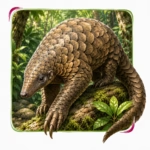
Anteater Fact Highlight
From the full animal facts page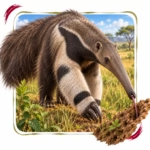
More Animal Comparisons
Pick another animal matchup and keep exploring. Compare appearances, habitats, diets, abilities, and surprising differences.





Make an Animal Story
Turn this pangolin vs anteater comparison into an armored-scale and shaggy-tail insect-hunt mystery with our free Animal Story Generator.
Source notes: References used for this comparison. See more See less
Try Another Matchup
Explore this comparison →