
Platypus vs Echidna: Living Monotreme Species Comparison
Platypuses and short-beaked echidnas are monotremes, an ancient mammal lineage whose living members lay eggs. Both grow fur, make milk without nipples, sense electrical signals, and hatch tiny vulnerable young. A platypus is a streamlined freshwater hunter with webbed feet, a broad sensitive bill, and a paddle-like tail. An echidna is a spiny land digger with powerful claws, a narrow beak, and a long sticky tongue for ants and termites.
About Platypus
- Type Mammal
- Diet Carnivore feeding mainly on aquatic insect larvae, worms, freshwater shrimp and crayfish, snails, and other small bottom-dwelling animals
- Group Platypus (Ornithorhynchus anatinus; Family Ornithorhynchidae)
- Known for Streamlined semiaquatic monotreme with dense waterproof fur, broad rubbery electro-sensitive bill, tiny eyes, closable ear grooves and nostrils, short legs, webbed forefeet, clawed hindfeet, and broad flattened tail
- Special skill Closing its eyes, ears, and nostrils underwater and detecting tiny electrical and pressure signals from moving prey with sensors in its bill
About Echidna
- Type Mammal
- Diet Insectivore specializing in ants and termites, plus other small invertebrates reached by tearing into nests, logs, litter, and soil
- Group Short-beaked Echidna (Tachyglossus aculeatus; Family Tachyglossidae)
- Known for Stocky terrestrial monotreme with coarse fur, protective keratin spines, small eyes, narrow toothless beak, tiny mouth, long sticky tongue, short powerful limbs, and broad claws especially suited to digging
- Special skill Digging rapidly downward, wedging under roots or rocks, curling to present sharp spines, and flicking a long sticky tongue into insect colonies
Platypus vs Echidna: Quick Answer
A platypus is the swimming monotreme: it hunts underwater with webbed forefeet and an electro-sensitive bill. A short-beaked echidna is the digging monotreme: it breaks into ant and termite nests with strong claws, gathers prey with a sticky tongue, and protects itself with spines. Both are mammals that lay leathery eggs and feed milk to their hatchlings even though neither mother has nipples.
Where Do They Fit?
Follow the branches to see how Platypus and Echidna are classified and related.
Platypus vs Echidna: Quick Comparison
| Feature | Platypus | Short-beaked Echidna |
|---|---|---|
| Scientific name | Ornithorhynchus anatinus | Tachyglossus aculeatus |
| Monotreme lifestyle | Semiaquatic freshwater hunter | Terrestrial insect-eating digger |
| Body covering | Extremely dense waterproof fur | Fur mixed with protective spines |
| Snout | Broad soft bill with many sensors | Long narrow beak and tiny mouth |
| Feet | Webbed forefeet for paddling and claws for land | Broad powerful claws for excavation |
| Main food | Aquatic invertebrates gathered underwater | Ants, termites, and other small invertebrates |
| Egg care | Mother curls around one to three eggs in a nesting burrow | Mother carries one egg in a temporary pouch |
| Young | Drinks milk from skin patches in a burrow | Drinks milk in the pouch, then waits in a nursery burrow |
| Defense | Escape, burrow, and a venomous ankle spur in adult males | Dig down, wedge in place, curl, and expose spines |
| Electroreception | Highly developed for underwater hunting | Present but much less elaborate |
How Are Platypuses and Echidnas Alike?
- Both are monotremes, the only living mammals that reproduce by laying eggs.
- Both have fur, are warm-blooded, breathe air, and feed milk to their young.
- Neither mother has nipples; milk reaches specialized skin or hairs and is lapped by the hatchling.
- Both have electroreceptors in the skin of the bill or beak, although platypus sensing is far more extensive.
- Both are usually solitary, dig or use burrows, and have young commonly called puggles in informal speech.
How Are Platypuses and Echidnas Different?
- Platypuses hunt in fresh water, while short-beaked echidnas forage mainly on land.
- A platypus has waterproof fur, a flattened tail, and webbed forefeet; an echidna has spines, a short tail, and powerful digging claws.
- The platypus bill is broad and packed with underwater sensors; the echidna beak is narrow and works with a long sticky tongue.
- A platypus mother incubates eggs in a nesting burrow; an echidna mother places her single egg in a temporary pouch.
- Adult male platypuses have venom-delivering ankle spurs; echidnas rely mainly on spines, digging, curling, and wedging.
- Platypuses eat varied aquatic invertebrates, while short-beaked echidnas specialize strongly in ants and termites.
Platypus vs Echidna Adaptation Showdown
Monotreme adaptation showdown: Echidna wins size because the largest short-beaked echidnas outweigh most platypuses, and it wins strength through powerful excavation and anchoring. Platypus wins speed in water, stealth while hunting with its face sealed, swimming, and weirdest fact for combining electroreception with a venomous spur in adult males. Social skill is a tie because both normally forage alone. These categories compare survival adaptations, not combat.
Fun Platypus vs Echidna Facts
Only Five Monotreme Species Live Today
The living monotremes are one platypus species and four echidna species: the short-beaked echidna plus three long-beaked echidnas. All survive in Australia or New Guinea and nearby islands. They are not half-reptile mixtures; they are fully mammalian members of a very old evolutionary branch.
Monotreme Milk Arrives Without Nipples
Platypus and echidna mothers make true mammalian milk but have no nipples. Milk is released through openings in mammary skin and collects along special grooves or hairs, where the tiny young laps it. The changing milk supplies water, energy, immune protection, and nutrients as the hatchling grows.
A Platypus Hunts With Electricity
Muscle and nerve activity in worms, shrimp, and insect larvae produces tiny electrical fields. Receptors across the platypus bill detect those fields, while pressure-sensitive receptors help judge movement and distance. This lets the animal hunt after closing its eyes, ears, and nostrils during a dive.
An Echidna Builds a Temporary Pouch
A female short-beaked echidna develops a temporary pouch-like fold during breeding. She transfers one small leathery egg into it. After hatching, the young drinks milk there until its spines begin to emerge, when the mother moves it to a nursery burrow and returns periodically to feed it.
Puggle Is a Nickname, Not a Scientific Stage
People often call a baby platypus or echidna a puggle, and the word is useful in kid-friendly writing. Scientists and wildlife agencies also use plain descriptions such as young, hatchling, or juvenile. Puggle should be treated as a popular informal term, not a formal taxonomic or developmental label.
Platypus vs Echidna Quiz
- What unusual reproductive trait do both animals share? Answer: They are mammals that lay eggs.
- Which animal hunts underwater? Answer: The platypus.
- What does a short-beaked echidna mainly eat? Answer: Ants and termites.
- How do monotreme babies drink milk without nipples? Answer: They lap milk released onto specialized skin or hairs.
- Which animal has a temporary pouch for one egg? Answer: The short-beaked echidna.
Platypus vs Echidna FAQ
Are platypuses and echidnas related?
Yes. Both are monotremes, the egg-laying branch of mammals, but they belong to different living families.
Do platypuses and echidnas really lay eggs?
Yes. Their small leathery eggs hatch into very undeveloped young that then depend on their mother’s milk.
Is an echidna a porcupine?
No. Their spines evolved separately. Echidnas are monotremes, while porcupines are placental rodents.
Can echidnas swim?
They can cross water, but the platypus is the true swimming specialist with webbed forefeet, waterproof fur, and an aquatic hunting system.
Are platypuses venomous?
Adult males have hollow ankle spurs connected to venom glands. The spur is a defensive and breeding-season weapon, not a tool for catching prey.
Animal Words to Know
- Monotreme: A mammal in the egg-laying lineage containing platypuses and echidnas.
- Electroreception: The ability to detect weak electrical fields produced by living things.
- Semiaquatic: Spending substantial time both in water and on land.
- Keratin: The tough protein that forms echidna spines, claws, hair, and human fingernails.
- Puggle: A popular informal name for a young platypus or echidna.
Platypus and Echidna Monotreme Activity
Platypus and Echidna Monotreme Activity
Draw a platypus swimming in a creek and a short-beaked echidna digging near an ant nest. Give the platypus a broad bill, webbed front feet, dense fur, and a flat tail. Give the echidna spines, a narrow beak, a long tongue, and strong claws. Add an egg beside each nest and label monotreme, bill, webbing, spines, burrow, and egg-laying mammal.
Meet Each Animal
Want the full fact file? Here are quick highlights from each animal’s own facts page.
Platypus Fact Highlight
From the full animal facts page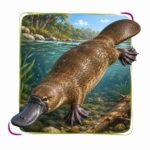
Echidna Fact Highlight
From the full animal facts page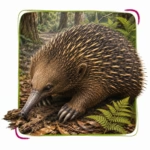
More Animal Comparisons
Pick another animal matchup and keep exploring. Compare appearances, habitats, diets, abilities, and surprising differences.


Make an Animal Story
Turn this platypus vs echidna comparison into an egg-laying mammal mystery with our free Animal Story Generator.
Source notes: References used for this comparison. See more See less
Try Another Matchup
Explore this comparison →