
Possum vs Sugar Glider: Living Australian Arboreal Marsupial Species Comparison
The common brushtail possum and sugar glider are nocturnal Australian marsupials that climb trees, shelter in hollows, carry joeys in pouches, and eat varied plant foods. The brushtail possum is cat-sized, mostly solitary, and climbs with powerful claws plus a gripping tail. The sugar glider is tiny, highly social, and has a membrane from wrist area to ankle that turns a leap into a controlled glide. This page uses one precise possum species because possum is a broad name for many marsupials.
About Possum
- Type Mammal
- Diet Flexible herbivore and occasional omnivore; leaves, shoots, flowers, fruit, nectar, bark, fungi, and in urban areas many other available foods
- Group Common Brushtail Possum (Trichosurus vulpecula; Family Phalangeridae)
- Known for Cat-sized arboreal marsupial with thick gray, brown, copper, or blackish fur, large pointed ears, pink nose, strong curved claws, grasping hands and feet, and a long bushy prehensile tail with a partly naked gripping underside
- Special skill Climbing with strong claws, opposable gripping digits, and a prehensile tail that curls around branches like a safety support
About Sugar Glider
- Type Mammal
- Diet Omnivore; nectar, pollen, sap, acacia gum, eucalyptus exudates, insects, spiders, and other small invertebrates according to season and habitat
- Group Sugar Glider (Petaurus breviceps; Family Petauridae)
- Known for Tiny nocturnal gliding marsupial with blue-gray to brown-gray fur, cream underside, dark stripe from forehead along back, large forward-facing eyes, rounded ears, sharp claws, long bushy steering tail, and a patagium stretching from each fifth finger to ankle
- Special skill Stretching a skin membrane into an airfoil to glide up to about 50 metres, steering with limbs and tail, then raising the nose and feet for a controlled trunk landing
Possum vs Sugar Glider: Quick Answer
A common brushtail possum is the heavyweight climber: it is several kilograms, has a partly prehensile bushy tail, and moves through branches with strong hands, feet, and claws. A sugar glider weighs only about 100–160 grams and stretches a skin membrane between its limbs to glide as far as about 50 metres. Brushtails are mainly solitary, while sugar gliders often sleep together in social clans.
Where Do They Fit?
Follow the branches to see how Possum and Sugar Glider are classified and related.
Possum vs Sugar Glider: Quick Comparison
| Feature | Common Brushtail Possum | Sugar Glider |
|---|---|---|
| Scientific name | Trichosurus vulpecula | Petaurus breviceps |
| Family | Phalangeridae | Petauridae |
| Body size | Cat-sized and commonly several kilograms | Rat-sized and about 100–160 grams |
| Movement | Climbs, walks, runs, and jumps between nearby supports | Climbs and glides up to about 50 metres |
| Tail | Thick and bushy with a partly naked gripping underside | Long and furry for steering and stability, not a grasping hook |
| Gliding membrane | Absent | Patagium stretches from each fifth finger to ankle |
| Main food | Leaves, flowers, fruit, shoots, nectar, bark, and fungi | Nectar, pollen, sap, gum, insects, and other invertebrates |
| Day shelter | Tree hollow, log, roof space, or another dark den | Leaf-lined nest shared inside a tree hollow |
| Social life | Mostly solitary and territorial | Social clan of adults and young |
| Usual litter | Usually one joey | Often twins |
How Are Possums and Sugar Gliders Alike?
- Both are Australian marsupials in the order Diprotodontia and carry very small newborn joeys in pouches.
- Both are nocturnal tree climbers with grasping feet, strong claws, large eyes, sensitive ears, and bushy tails.
- Both shelter by day in tree hollows and depend on mature forests with connected canopy and suitable den sites.
- Both eat plant foods such as blossoms or nectar and may use scent and loud calls to communicate.
- Both can live near people in some places but are protected wildlife in Australia and should not be fed or handled.
How Are Possums and Sugar Gliders Different?
- A common brushtail possum is more than ten times heavier than a sugar glider.
- The sugar glider has a patagium for gliding; the brushtail possum has no flight membrane and climbs or jumps.
- A brushtail’s tail has a naked gripping section underneath; a sugar glider’s furry tail acts mainly as a rudder and stabilizer.
- Brushtails eat many leaves, shoots, fruit, and flowers; sugar gliders rely more on nectar, sap, gum, pollen, and insects.
- Common brushtails are mainly solitary, while sugar gliders form social clans that share a nest hollow.
- The brushtail is widespread across Australia; revised taxonomy restricts Petaurus breviceps to eastern Australia east of the Great Dividing Range.
Possum vs Sugar Glider Adaptation Showdown
Forest-canopy adaptation showdown: Common brushtail possum wins size and strength through its cat-sized body, powerful limbs, claws, and gripping tail. Sugar glider wins speed between separated trees, stealth, social coordination, and weirdest fact because its membrane transforms a downward leap into a steered glide of up to about 50 metres. Swimming is a tie because either animal can cross water if necessary, but neither is aquatic. These categories compare survival adaptations, not combat.
Fun Possum vs Sugar Glider Facts
A Sugar Glider Glides Rather Than Flies
The patagium is a thin skin membrane stretching from the fifth finger to the ankle on each side. A sugar glider leaps from a height and spreads all four limbs, creating an airfoil that slows descent and carries it forward. It cannot flap upward like a bat or bird, so every glide trades height for horizontal distance.
Sugar Gliders Became Three Species
A 2021 taxonomic study separated animals formerly grouped as Petaurus breviceps into the sugar glider, Krefft’s glider, and savanna glider. The name sugar glider now applies to a much smaller eastern range on the coastal side of the Great Dividing Range. Many older books, pet guides, and maps still show the former combined distribution.
A Brushtail Tail Can Grip a Branch
The common brushtail’s long tail is furry above but has a less-furred friction surface underneath near the tip. It can curl around a branch to steady the animal while climbing or reaching. The tail is a safety support, not a hand that can perform every task or hold the possum indefinitely without help from its feet.
Sugar Glider Clans Share a Bedroom
Several adults and their young may sleep together in a leaf-lined tree hollow. Shared warmth lowers the energy needed to stay warm, while grooming and scent marking maintain clan relationships. Group members still defend their nesting territory from unfamiliar sugar gliders, so social does not mean welcoming every visitor.
Possum Does Not Mean Opossum
Australian possums and gliders belong to Australasian marsupial groups within Diprotodontia. American opossums belong to the separate order Didelphimorphia. European settlers reused a similar-sounding name after seeing Australian marsupials, but a brushtail possum is not simply an opossum with the first letter removed.
Possum vs Sugar Glider Quiz
- Which animal is much larger? Answer: The common brushtail possum.
- What is the sugar glider’s flight membrane called? Answer: A patagium.
- Can a sugar glider flap upward like a bird? Answer: No; it glides downward and forward.
- Which animal commonly sleeps in a social clan? Answer: The sugar glider.
- Why do many older sugar-glider maps show a larger range? Answer: They combined three species that were separated in a 2021 taxonomic study.
Possum vs Sugar Glider FAQ
Is a sugar glider a possum?
It is a gliding possum relative and an Australian diprotodont marsupial, but it belongs to Petauridae rather than the common brushtail’s family Phalangeridae.
Which possum does this page compare?
It uses the common brushtail possum, Trichosurus vulpecula, because possum alone can refer to many different species.
Can common brushtail possums glide?
No. They climb and jump using claws, gripping feet, and a partly prehensile tail but have no patagium.
How far can a sugar glider glide?
About 50 metres under suitable conditions, although actual distance depends on height, trees, wind, route, and the individual.
Do sugar gliders make easy pets?
No. They are nocturnal, social, long-lived wild animals with specialized diets, space, companionship, veterinary, and legal needs. Wild gliders should never be captured or handled.
Animal Words to Know
- Patagium: The skin membrane a glider stretches between its limbs to create an airfoil.
- Prehensile: Able to grasp or wrap around an object.
- Arboreal: Living or spending much of life in trees.
- Clan: A social group of related or familiar sugar gliders sharing a territory and nest.
- Taxonomy: The scientific practice of identifying, naming, and classifying living things.
Possum and Sugar Glider Activity
Possum and Sugar Glider Activity
Draw a common brushtail possum climbing a eucalyptus trunk and a much smaller sugar glider gliding between two trees. Give the possum a sturdy body, pointed ears, grasping feet, and a bushy tail. Show the glider with its limbs spread and the skin membrane between them open like a sail. Label marsupial, nocturnal, tree hollow, climbing, gliding, membrane, and tail.
Meet Each Animal
Want the full fact file? Here are quick highlights from each animal’s own facts page.
Possum Fact Highlight
From the full animal facts page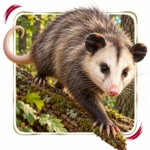
Sugar Glider Fact Highlight
From the full animal facts page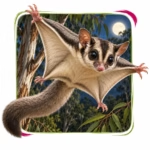
More Animal Comparisons
Pick another animal matchup and keep exploring. Compare appearances, habitats, diets, abilities, and surprising differences.

Make an Animal Story
Turn this possum vs sugar glider comparison into a moonlit climb-and-glide adventure with our free Animal Story Generator.
Source notes: References used for this comparison. See more See less
Try Another Matchup
Explore this comparison →