
Potoroo vs Bandicoot for Kids: Two Night Gardeners
A Long-nosed Potoroo and Southern Brown Bandicoot are small Australian marsupials that hide in dense cover and dig for dinner after dark. They can look alike at first, but they are not close versions of the same animal. The potoroo is a rat-kangaroo relative that bounds on large hind feet. The bandicoot belongs to a different marsupial order and usually gallops on all four feet.
About Long-nosed Potoroo
- Type Small hopping marsupial
- Diet Omnivore with a strong taste for fungi
- Group Rat-kangaroo family, Potoroidae
- Known for Digging up underground fungi with a long nose and strong forefeet
- Special skill Spreads helpful fungal spores after eating underground fungi
About Southern Brown Bandicoot
- Type Small digging marsupial
- Diet Omnivore
- Group Bandicoot family, Peramelidae
- Known for Rapid breeding and funnel-shaped feeding holes
- Special skill Digs rapidly for insects and roots while a rear-opening pouch keeps soil away from joeys
Quick Answer
Quick answer: The Long-nosed Potoroo is a small rat-kangaroo relative with large hind feet, a long tapered nose, and a forward-opening pouch. It often hops and eats many underground fungi. The Southern Brown Bandicoot is a stockier four-footed digger with a shorter pointed snout, a backward-opening pouch, and an extremely short pregnancy. Both are nocturnal omnivores that turn over soil while searching for food.
Long-nosed Potoroo vs Southern Brown Bandicoot: Quick Comparison
| Feature | Long-nosed Potoroo | Southern Brown Bandicoot |
|---|---|---|
| Scientific name | Potorous tridactylus | Isoodon obesulus |
| Marsupial branch | Order Diprotodontia; rat-kangaroo family Potoroidae | Order Peramelemorphia; bandicoot family Peramelidae |
| Body size | Up to about 41 cm long, not counting the tail | About 28 to 36 cm long, not counting the tail |
| Face | Long tapering nose with a small naked patch at the tip | Pointed but shorter snout with small rounded ears |
| Movement | Bounds on larger hind feet and can move on all fours slowly | Runs and gallops mainly on all four feet |
| Main food | Underground fungi, roots, tubers, seeds, fruits, and invertebrates | Insects, earthworms, fungi, roots, bulbs, seeds, and other plant food |
| Digging clue | Small scratchings and nose holes while searching for fungi | Neat cone-shaped holes made while probing for food |
| Pouch direction | Opens forward like other kangaroo relatives | Opens backward to help keep digging soil out |
| Young | Usually one joey after a pregnancy of about 30 days | Often 2 to 6 joeys after a pregnancy of about 12 to 16 days |
| Day shelter | A hidden nest or form under dense vegetation | A grass-lined nest concealed under thick ground cover |
How Potoroos and Bandicoots Are Alike
- Both are small Australian marsupials with pointed snouts and pouches.
- Both are mainly nocturnal and shelter in dense vegetation during the day.
- Both use strong front claws to dig for food in soil and leaf litter.
- Both eat mixed diets that can include fungi, plant parts, insects, and other invertebrates.
- Both help ecosystems by turning over and aerating soil as they forage.
How Potoroos and Bandicoots Are Different
- A potoroo is a diprotodont rat-kangaroo relative, while a bandicoot belongs to the separate order Peramelemorphia.
- The potoroo often bounds on enlarged hind feet, while the bandicoot usually runs and gallops on all four feet.
- A potoroo’s pouch opens forward, while a bandicoot’s pouch opens backward to keep out soil.
- A Long-nosed Potoroo usually raises one joey, while a Southern Brown Bandicoot may have several joeys in a litter.
- Potoroo pregnancies last about a month, while Southern Brown Bandicoot pregnancies can last only 12 to 16 days.
Potoroo vs Bandicoot Adaptation Showdown
Adaptation showdown: Size is a Tie because the animals overlap in body size, even though a Long-nosed Potoroo may reach a slightly greater length. Long-nosed Potoroo wins speed because its large hind feet produce powerful bounds, while the bandicoot uses a lower four-footed gallop. Strength is a Tie because both have strong digging forefeet suited to small bodies. Stealth is a Tie because both are nocturnal, brown, quiet, and dependent on dense ground cover. Social behavior is a Tie because both are usually solitary outside mating and mother-young contact. Swimming is a Tie because neither is a water specialist. Long-nosed Potoroo wins weirdest for finding underground fungi and spreading their spores through the forest like a tiny hopping gardener.
Fun Long-nosed Potoroo vs Southern Brown Bandicoot Facts
A Fungi-Finding Nose
Long-nosed Potoroos sniff out underground fruiting bodies of fungi, sometimes called truffles. After eating them, the potoroos deposit living spores elsewhere in their droppings.
Forest Partners
Many underground fungi connect with tree roots and help trees gather water and minerals. By spreading fungal spores, potoroos can help rebuild these useful forest partnerships.
One of the Shortest Pregnancies
A Southern Brown Bandicoot pregnancy lasts only about 12 to 16 days. The tiny newborns then crawl to the pouch and continue developing while attached to teats.
A Dirt-Smart Pouch
A Southern Brown Bandicoot’s pouch opens toward the rear. That direction helps stop loose soil from being shoveled into the pouch while the mother digs.
Two Ways to Dash
A startled potoroo bounds with powerful hind legs like a tiny kangaroo. A bandicoot has larger hind legs too, but it usually uses an uneven four-footed gallop.
Potoroo vs Bandicoot Quiz
- Which animal is a rat-kangaroo relative? Answer: The Long-nosed Potoroo.
- Which animal has a backward-opening pouch? Answer: The Southern Brown Bandicoot.
- What special food do Long-nosed Potoroos often dig up? Answer: Underground fungi.
- How does a bandicoot usually run? Answer: It gallops on all four feet.
- What do both animals do to the soil while feeding? Answer: They dig and turn it over, which can aerate it.
Long-nosed Potoroo vs Southern Brown Bandicoot FAQ
Is a potoroo a bandicoot?
No. A potoroo is a rat-kangaroo relative in Diprotodontia, while a bandicoot is in Peramelemorphia.
Which animal is bigger?
Their sizes overlap. The Long-nosed Potoroo can be slightly longer, but both are small marsupials.
Do potoroos eat only fungi?
No. Fungi are important, but potoroos also eat roots, tubers, seeds, fruits, insects, and other small invertebrates.
Why does a bandicoot’s pouch open backward?
It helps keep soil away from the joeys while their mother digs for food.
Are these animals active in daytime?
They are mainly nocturnal and usually spend the day hidden in nests or dense vegetation.
Animal Words to Know
- Fungal spore: A tiny reproductive cell that can grow into a new fungus.
- Invertebrate: An animal without a backbone, such as an insect or earthworm.
- Nocturnal: Mainly active at night.
- Order: A major scientific group that contains related animal families.
- Soil aeration: The opening of spaces in soil so air and water can move through it.
Read the Night Digger Clues
Read the Night Digger Clues
Draw exactly one adult Long-nosed Potoroo and exactly one adult Southern Brown Bandicoot at honest relative scale. Give each a paper trail of clues: nose shape, foot size, movement, food holes, pouch direction, and number of joeys. Match each clue to the correct animal, then compare how both aerate soil. Observe wildlife from a respectful distance and never dig into nests or handle animals.
Meet Each Animal
Want the full fact file? Here are quick highlights from each animal’s own facts page.
Long-nosed Potoroo Fact Highlight
From the full animal facts page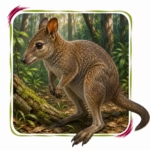
Southern Brown Bandicoot Fact Highlight
From the full animal facts page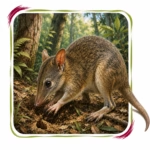
More Animal Comparisons
Pick another animal matchup and keep exploring. Compare appearances, habitats, diets, abilities, and surprising differences.





Make an Animal Story
Send a fungi-finding Potoroo and a busy Bandicoot on a moonlit garden quest with our free Animal Story Generator.