
Red Deer vs White-tailed Deer: Deer Species Comparison
Red Deer, Cervus elaphus, and White-tailed Deer, Odocoileus virginianus, live naturally on opposite sides of the Atlantic. A Red Deer is usually larger, with a short tail, a pale rump patch and, in mature stags, tall antlers that can form a crown of tines. A White-tailed Deer has a broad tail with a dazzling white underside and antlers whose points rise from forward-curving main beams. Both species vary greatly by sex, age, region and food supply.
About Red Deer
- Type Living
- Diet Herbivore and ruminant
- Group Western red deer species (Cervus elaphus)
- Known for Large body, creamy rump patch, roaring autumn stags and tall branching antlers that may form a crown
- Special skill A stag’s far-carrying roar advertises his presence across open ground during the autumn rut
About White-tailed Deer
- Type Living
- Diet Herbivore and ruminant
- Group American deer species (Odocoileus virginianus)
- Known for A broad tail with a brilliant white underside that flashes upward when the deer is alarmed
- Special skill Raises its broad tail like a white flag while bounding through cover when danger is detected
Red Deer vs White-tailed Deer: Quick Answer
Red Deer are generally the larger species. Mature stags can carry tall, many-tined antlers and roar during the rut. White-tailed Deer are usually smaller and more lightly built. Their best clue is the long broad tail: when alarmed, they lift it to expose a bright white underside. Both are ruminant plant eaters, regrow antlers each year and can swim well.
Where Do They Fit?
Follow the branches to see how Red Deer and White-tailed Deer are classified and related.
Red Deer vs White-tailed Deer: Quick Comparison
| Feature | Red Deer | White-tailed Deer |
|---|---|---|
| Scientific name | Cervus elaphus | Odocoileus virginianus |
| Native range | Europe, western Asia and a small part of North Africa | From southern Canada through much of the Americas into northern South America |
| Adult size | Usually larger; British stags commonly weigh about 100-180 kg, but populations vary | Usually smaller; northern bucks can be large, while tropical and island deer may be much smaller |
| Tail and rump | Short reddish-buff tail above a large cream rump patch | Longer broad tail, brown above and bright white below, lifted when alarmed |
| Male antlers | Long branching beams; mature antlers may end in a cluster called a crown | Main beams curve forward, with individual tines rising upward |
| Young | A calf, usually spotted when very young | A fawn with reddish-brown fur and white camouflage spots |
| Alarm style | May bark and run with the pale rump visible | Often snorts, stamps and raises the tail’s white underside |
| Breeding sound | Stags give powerful roars during the autumn rut | Bucks use grunts, snorts and wheezes rather than a red stag’s roar |
| Social pattern | Can form large herds, often separated by sex outside the rut | Usually solitary or in small family and temporary groups |
| Habitat | Forest, woodland edges, open hills, moors and grassland | Forest edges, brush, farms, grassland, wetlands and suburbs |
How Are Red and White-tailed Deer Alike?
- Both are hoofed mammals in the deer family Cervidae.
- Both are herbivorous ruminants that browse leaves, shoots and woody plants and also graze.
- Males of both species grow bony antlers, shed them and regrow a new set each year.
- Young of both species begin life with pale spots that help them blend into sun-dappled cover.
- Both can run, leap and swim to cross habitats or escape danger.
How Are Red and White-tailed Deer Different?
- Red Deer are generally larger and heavier, although body sizes vary widely within both species.
- A Red Deer has a short tail and broad cream rump patch; a White-tailed Deer has a longer tail with a white underside.
- Mature red stag antlers may finish in a crown, while a white-tailed buck’s tines rise from forward-curving beams.
- Red Deer naturally live in Eurasia and North Africa; White-tailed Deer are native to the Americas.
- Red Deer often make larger herds, while White-tailed Deer more often use small, loose groups or live alone.
Red Deer vs White-tailed Deer Adaptation Showdown
- Size – Red Deer: Most red deer populations are larger than most white-tailed deer, especially when mature males are compared; regional ranges still overlap.
- Speed – Tie: Both can sprint and leap through difficult ground, and different published estimates do not provide a fair shared race.
- Strength – Red Deer: A mature stag’s greater average mass, heavy neck and larger antler structure require more total power; this is not a fight prediction.
- Stealth – White-tailed Deer: Its smaller body, quiet movement and use of thick edge cover help it stay hidden until it suddenly bounds away.
- Social – Red Deer: Red Deer can gather in much larger herds, while white-tails usually form smaller and looser groups.
- Swimming – Tie: Both are capable swimmers, but no controlled comparison shows that either species consistently outperforms the other.
- Weirdest – White-tailed Deer: It can flip up its tail to reveal a bright moving flag that signals a predator has been noticed and helps deer follow through cover.
Fun Red Deer vs White-tailed Deer Facts
A Tail That Flashes
The White-tailed Deer’s tail is brown above but brilliant white underneath. When raised, it becomes a bouncing signal that is easy to follow through brush.
The Red Stag’s Roar
During the autumn rut, a mature red stag roars to advertise his size and challenge rivals. Other deer can hear the sound from far across a valley.
Antlers Built in One Season
Both species grow an entirely new set of antlers each year. Soft velvet supplies blood while they grow, then the hard antlers are shed after breeding season.
Spots Become Camouflage
A newborn calf or fawn lies very still while its mother feeds nearby. Pale spots copy patches of sunlight on leaves and grass.
One Species, Many Sizes
A northern White-tailed Deer may be several times heavier than one from a tropical or island population. Red Deer also differ greatly across regions and habitats.
Red Deer vs White-tailed Deer Quiz
Which species is usually larger? A) Red Deer B) White-tailed Deer C) They are always equal Answer: A) Red Deer
Which deer lifts a broad white-backed tail when alarmed? A) Red Deer B) White-tailed Deer C) Neither Answer: B) White-tailed Deer
What sound is a red stag famous for during the rut? A) Roaring B) Chirping C) Hissing Answer: A) Roaring
Do deer keep the same antlers forever? A) Yes B) No, males shed and regrow them C) Only white-tails do Answer: B) No, males shed and regrow them
Where are White-tailed Deer native? A) The Americas B) Australia C) Antarctica Answer: A) The Americas
Red Deer vs White-tailed Deer FAQ
Are Red Deer and White-tailed Deer the same species?
No. Red Deer are Cervus elaphus, while White-tailed Deer are Odocoileus virginianus.
Which deer is bigger?
Red Deer are generally larger. However, males exceed females, and both species vary greatly among regions, so individual sizes can overlap.
Why does a White-tailed Deer raise its tail?
The flashing white underside shows that danger was detected and can help other deer, especially fawns, follow through thick cover.
Do female deer grow antlers?
Females normally do not grow antlers in either species, although rare exceptions occur because of unusual hormone conditions.
Can both deer swim?
Yes. Both can cross rivers and lakes, although neither spends most of its life in water.
Animal Words to Know
- Antler: A branching bony structure that is shed and regrown, unlike a permanent horn.
- Cervid: A member of the deer family Cervidae.
- Ruminant: An animal that brings partly digested plant food back up and chews it as cud.
- Rut: The seasonal breeding period when deer males display and compete.
- Tine: One pointed branch of an antler.
Make a Deer Signal Flipbook
Make a Deer Signal Flipbook
Draw a calm White-tailed Deer on the first card with its brown tail lowered. On the next cards, lift the tail until its white underside flashes. On a second strip, draw a red stag opening its mouth to roar. Add antler and rump clues, then explain which signal is visual and which is a sound.
Meet Each Animal
Want the full fact file? Here are quick highlights from each animal’s own facts page.
Red Deer Fact Highlight
From the full animal facts page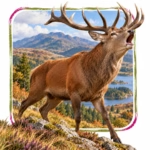
White-tailed Deer Fact Highlight
From the full animal facts page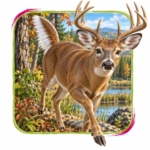
More Animal Comparisons
Pick another animal matchup and keep exploring. Compare appearances, habitats, diets, abilities, and surprising differences.




Make an Animal Story
Create a deer story about a roaring Red Deer and a white-tail flashing a secret woodland signal!
Source notes: References used for this comparison. See more See less
Try Another Matchup
Explore this comparison →