
Red-Tailed Hawk vs Peregrine Falcon for Kids
A Red-Tailed Hawk and a Peregrine Falcon are both raptors, but the word raptor does not make them close members of one bird family. The hawk is Buteo jamaicensis in family Accipitridae. It has broad rounded wings and searches open ground for many mammals. The Peregrine is Falco peregrinus in family Falconidae. It has long pointed wings and often catches birds in the air with a spectacular stoop. Their body size, wing shape, food, nests, and flight strategies show two successful ways to hunt from the sky.
About Red-Tailed Hawk
- Type Bird
- Diet Carnivore
- Group Buteo hawk; family Accipitridae
- Known for Broad rounded wings, an adult red tail, thermal soaring, and watching fields from perches
- Special skill Riding thermals on broad wings and making a slow controlled dive toward ground prey
About Peregrine Falcon
- Type Bird
- Diet Carnivore
- Group Falcon; family Falconidae
- Known for Long pointed wings, dark facial marks, worldwide travel, and an extremely fast hunting stoop
- Special skill A high-altitude hunting stoop that may reach about 320 km/h (200 mph)
Quick Answer
Quick answer: The Red-Tailed Hawk is generally longer and broader-winged, although published masses overlap with the largest Peregrines. It usually watches open ground for mammals and descends in a controlled dive. The Peregrine Falcon is shorter-winged in span but more streamlined, eats mostly birds, and wins speed with a hunting stoop that may reach about 320 km/h (200 mph). The hawk builds a stick nest; the falcon usually makes a shallow scrape on a cliff or tall structure.
Red-Tailed Hawk vs Peregrine Falcon: Quick Comparison
| Feature | Red-Tailed Hawk | Peregrine Falcon |
|---|---|---|
| Scientific identity | Buteo jamaicensis | Falco peregrinus |
| Raptor family | Accipitridae | Falconidae |
| Published adult length | About 45-65 cm | About 36-49 cm |
| Published adult mass | About 690-1,460 g | About 530-1,600 g; sexes differ greatly |
| Published wingspan | About 114-133 cm | About 100-110 cm |
| Flight shape | Broad rounded wings and a short wide tail | Long pointed wings and a longer tapered look |
| Main habitat and range | Open habitats across much of North America and beyond | Open cliffs, coasts, cities, and migration routes worldwide except Antarctica |
| Main foods | Mostly mammals, plus birds, snakes, and carrion | Mostly birds, plus some bats and occasional other prey |
| Hunting style | Perch watching, thermal soaring, and a slow controlled dive | High watching perch, aerial pursuit, and a very fast stoop |
| Nest | Builds or repairs a large stick nest | Usually makes a shallow scrape on a high ledge without building a stick nest |
How Are Red-Tailed Hawks and Peregrine Falcons Alike?
- Both are daytime raptors with hooked bills, strong feet, curved talons, sharp eyesight, and powerful flight.
- Both often watch from a high perch before beginning a hunt.
- Both eat animal foods and may catch birds, although birds make up far more of the Peregrine’s usual menu.
- Both form breeding pairs, defend nesting areas, lay eggs, and raise helpless chicks.
- Both can live near people by using tall trees, cliffs, towers, bridges, or buildings when suitable habitat is available.
How Are Red-Tailed Hawks and Peregrine Falcons Different?
- The Red-Tailed Hawk belongs to Accipitridae, while the Peregrine belongs to Falconidae.
- The hawk is usually longer with a broader wingspan, while Peregrine mass overlaps because large females can be heavier than small hawks.
- The hawk has broad rounded wings and a short wide tail, while the Peregrine has long pointed wings and a streamlined shape.
- Red-Tailed Hawks eat many ground mammals, while Peregrines specialise in catching birds in the air.
- The hawk builds a stick nest and makes a controlled descent, while the Peregrine scrapes a bare ledge and uses an extremely fast stoop.
Red-Tailed Hawk vs Peregrine Falcon Showdown
Adaptation showdown: Red-Tailed Hawk wins size for its greater published length and wingspan, while the page notes that mass overlaps and the largest Peregrines can outweigh smaller hawks. Peregrine Falcon wins speed because its hunting stoop may reach about 320 km/h (200 mph), far beyond the hawk’s controlled descent. Strength is a Tie because the hawk’s ground-prey grip and the falcon’s aerial strike are different tasks with no matched test. Stealth is a Tie because both hunt from watchful positions but use different approaches. Social behavior is a Tie because both are mainly solitary or paired and defend nesting areas. Swimming is a Tie because neither is aquatic and no fair performance comparison exists. Red-Tailed Hawk wins weirdest for supplying the dramatic scream commonly borrowed for other movie raptors.
Fun Red-Tailed Hawk vs Peregrine Falcon Facts
A Hawk Is Not a Falcon
Both birds are raptors, but they belong to different families and even different orders in the cited guide. The Red-Tailed Hawk is an accipitrid with broad Buteo wings. The Peregrine is a falconid with pointed wings. Similar hunting jobs can evolve in separate branches of the bird family tree.
Wing Shape Matches the Job
Broad rounded wings help a Red-Tailed Hawk circle on rising air and stay aloft while scanning open land. The Peregrine’s long pointed wings and streamlined body suit fast travel, aerial pursuit, and steep stoops. Shape matters as much as colour when identifying a distant raptor.
Not Every Dive Is a Stoop
A Red-Tailed Hawk usually drops toward ground prey in a slow, controlled dive with its legs ready. A Peregrine may begin far above a flying bird, fold into a steep stoop, and then grab or strike the prey. Calling both movements a dive hides an important difference.
One Builds, One Scrapes
A Red-Tailed Hawk pair stacks and lines sticks in a tree, on a cliff, or on a structure. Peregrines usually do not build a stick nest. They make a shallow scrape in gravel or other loose material on a cliff ledge, bridge, tower, or skyscraper.
The Hawk Voices the Movies
The Red-Tailed Hawk’s raspy scream sounds so dramatic that filmmakers often use it when many kinds of hawks or eagles appear. Peregrines have their own calls, including sharp alarm notes. Watching with your ears can reveal when a soundtrack and picture do not match.
Red-Tailed Hawk vs Peregrine Falcon Quiz
- Which bird belongs to family Falconidae? Answer: The Peregrine Falcon.
- Which bird has broader, more rounded wings? Answer: The Red-Tailed Hawk.
- Which bird usually eats more ground mammals? Answer: The Red-Tailed Hawk.
- What is the Peregrine’s high-speed hunting dive called? Answer: A stoop.
- Which bird normally builds a large stick nest? Answer: The Red-Tailed Hawk.
Red-Tailed Hawk vs Peregrine Falcon FAQ
Is a Red-Tailed Hawk a falcon?
No. It belongs to family Accipitridae. A Peregrine belongs to family Falconidae.
Which is bigger, a Red-Tailed Hawk or Peregrine Falcon?
Red-Tailed Hawk wins overall body length and wingspan in the cited measurements, but mass overlaps because large female Peregrines can outweigh smaller Red-Tailed Hawks.
Which is faster?
Peregrine Falcon wins. Its hunting stoop may reach about 320 kilometres per hour, or 200 miles per hour. That is a dive figure, not ordinary cruising speed.
Do they hunt the same prey?
Their diets overlap, but Red-Tailed Hawks eat many mammals, while Peregrines specialise in catching birds in flight.
Why are strength, stealth, social behavior, and swimming ties?
The birds use different hunting tools, both are mainly solitary or paired, neither is aquatic, and matched tests do not support clean winners for those categories.
Animal Words to Know
- Accipitrid: A bird in family Accipitridae, including many hawks, eagles, and kites.
- Falconid: A bird in family Falconidae, including falcons and caracaras.
- Buteo: A group of broad-winged soaring hawks that includes the Red-Tailed Hawk.
- Stoop: A steep high-speed hunting dive made by a falcon.
- Nest scrape: A shallow depression made in gravel or loose material instead of a built stick nest.
Build a Broad-Wing-or-Pointed-Wing Flight Lab
Build a Broad-Wing-or-Pointed-Wing Flight Lab
Draw two top-view wing silhouettes at published scale: a Red-Tailed Hawk with broad rounded wings spanning 114-133 centimetres and a Peregrine with pointed wings spanning 100-110 centimetres. Add thermal circles and a controlled groundward path to the hawk side. Add a high perch, level pursuit line, and steep stoop path to the falcon side. Sort cards for family, length, mass overlap, wingspan, prey, nest, speed, and Hollywood call. Mark strength, stealth, social behavior, and swimming as ties because no matched evidence supports a winner.
Meet Each Animal
Want the full fact file? Here are quick highlights from each animal’s own facts page.
Red-Tailed Hawk Fact Highlight
From the full animal facts page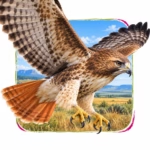
Peregrine Falcon Fact Highlight
From the full animal facts page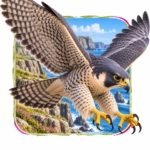
More Animal Comparisons
Pick another animal matchup and keep exploring. Compare appearances, habitats, diets, abilities, and surprising differences.



Make an Animal Story
Launch a broad-winged hawk and a pointed-winged falcon into a science-rich sky quest with our free Animal Story Generator.