
Yellow-bellied Sea Snake vs Yellow-lipped Sea Krait: Marine Snake Comparison
The Yellow-bellied Sea Snake and Yellow-lipped Sea Krait are venomous elapid snakes with valved nostrils and paddle-shaped tails, but they split marine life differently. The Yellow-bellied Sea Snake is pelagic and gives birth to live young at sea. The Yellow-lipped Sea Krait hunts among reefs but keeps broad belly scales for moving ashore, where it rests, sheds, mates, and lays eggs.
About Yellow-bellied Sea Snake
- Type Fully marine elapid snake
- Diet Fish eater
- Group Cobra family, Elapidae; true sea snake branch Hydrophiinae
- Known for A yellow belly, dark back, paddle tail, open-ocean life, and live birth at sea
- Special skill Swims forward or backward and can complete its whole life cycle without coming ashore
About Yellow-lipped Sea Krait
- Type Amphibious marine elapid snake
- Diet Mainly eel eater
- Group Cobra family, Elapidae; sea krait branch Laticaudinae
- Known for Black body bands, a yellow snout, reef hunting, and regular journeys onto land
- Special skill Uses a paddle tail underwater and broad belly scales to crawl effectively on land
Yellow-bellied Sea Snake vs Yellow-lipped Sea Krait: Quick Answer
A Yellow-bellied Sea Snake is a fully marine, open-ocean snake that is clumsy on land and gives birth to live young in the water. A Yellow-lipped Sea Krait is amphibious: it hunts eels underwater but regularly crawls onto islands and lays eggs on land. Both breathe air, have paddle tails, close their nostrils while diving, and carry potent venom, so neither should ever be touched.
Where Do They Fit?
Follow the branches to see how Yellow-bellied Sea Snake and Yellow-lipped Sea Krait are classified and related.
Yellow-bellied Sea Snake vs Yellow-lipped Sea Krait: Quick Comparison
| Feature | Yellow-bellied Sea Snake | Yellow-lipped Sea Krait |
|---|---|---|
| Scientific name | Hydrophis platurus, formerly Pelamis platurus | Laticauda colubrina |
| Marine lifestyle | Pelagic and fully aquatic | Amphibious, dividing time between sea and land |
| Adult length | Usually around 1 m; recorded to about 1.13 m | Females often around 1.5 m; males commonly 0.75 to 1 m |
| Color pattern | Dark brown or black above, bright yellow below, often with a spotted tail | Blue-gray body with dark bands and a yellow snout or upper lip |
| Main habitat | Open tropical ocean, current lines, and floating debris slicks | Coral reefs beside rocky or vegetated tropical islands |
| Movement on land | Very poor; small belly scales cannot grip ground effectively | Capable crawler with broad belly scales and a cylindrical body |
| Main prey | Small fish near the ocean surface | Mostly moray and conger eels taken from reef crevices |
| Swimming | Compressed body and paddle tail; can swim forward and backward | Paddle tail powers reef swimming, while the body remains useful ashore |
| Reproduction | Gives birth to two to six live young at sea | Returns to land and lays a clutch of eggs in a sheltered place |
| Venom safety | Highly venomous but not aggressive; never touch or strand-rescue by hand | Highly venomous and usually reluctant to bite; never touch or handle |
How Sea Snakes and Sea Kraits Are Alike
- Both are air-breathing elapid snakes adapted to hunting in warm seawater.
- Both have a flattened paddle-like tail that pushes against water.
- Both can close valved nostrils and stay underwater while searching for prey.
- Both use venom to subdue slippery fish-shaped prey and should never be handled.
- Both shed their skin and must return to the surface to breathe air.
How Sea Snakes and Sea Kraits Are Different
- The Yellow-bellied Sea Snake spends its entire life at sea, while the Yellow-lipped Sea Krait regularly comes onto land.
- The sea snake has reduced belly scales and moves poorly on land, while the sea krait retains broad belly scales for crawling.
- The sea snake gives birth to live young in water, while the sea krait lays eggs in sheltered places on land.
- The sea snake drifts and hunts near the open-ocean surface, while the sea krait searches reef cracks for eels.
- The sea snake is dark above and yellow below, while the sea krait has bold dark bands and a yellow snout.
Sea Snake vs Sea Krait Adaptation Showdown
Adaptation showdown: Yellow-lipped Sea Krait wins size because adult females commonly reach about 1.5 m, longer and heavier than a roughly 1 m Yellow-bellied Sea Snake. Speed is a Tie because reliable matched top-speed tests are unavailable. Strength is a Tie because both subdue prey mainly with venom rather than constriction. Yellow-lipped Sea Krait wins stealth because it slips through reef crevices to search for hidden eels. Yellow-lipped Sea Krait wins social behavior because individuals may gather at shared island shelters, while the sea snake’s surface clusters can simply form where currents converge. Yellow-bellied Sea Snake wins swimming because its entire compressed body, paddle tail, and even backward motion are specialized for permanent ocean life. Yellow-bellied Sea Snake wins weirdest for living, feeding, shedding, mating, and giving birth at sea while sometimes tying its body in a knot to scrape off old skin and hitchhiking organisms.
Fun Yellow-bellied Sea Snake vs Yellow-lipped Sea Krait Facts
An Entire Life at Sea
The Yellow-bellied Sea Snake is the most pelagic sea snake. It feeds, drinks fresh surface water after rain, mates, sheds, and gives birth without needing land or the seafloor.
A Two-Tone Ocean Body
Its dark back absorbs sunlight and blends with deep water from above, while its yellow underside contrasts with bright surface light from below. The tail is often spotted.
A Knot for Cleaning
A Yellow-bellied Sea Snake may press its body into a knot and slide the knot along itself. The rubbing helps loosen old skin and remove organisms growing on the scales.
A Snake With Two Travel Modes
A Yellow-lipped Sea Krait has a paddle tail for water but keeps broad belly scales that grip land. It can hunt in reefs and later crawl into a cave or under roots.
Male and Female Menus
Female Yellow-lipped Sea Kraits grow much larger and often take deeper-living conger eels. Smaller males more often hunt moray eels in shallower reef crevices.
Sea Snake vs Sea Krait Quiz
- Which animal can spend its whole life at sea? Answer: The Yellow-bellied Sea Snake.
- Which animal regularly crawls onto land? Answer: The Yellow-lipped Sea Krait.
- How do the two animals reproduce differently? Answer: The sea snake gives birth to live young at sea, while the sea krait lays eggs on land.
- What does a sea krait mainly hunt? Answer: Eels in reef crevices.
- Why should neither animal be touched? Answer: Both are venomous wild snakes, and even a calm animal may defend itself.
Yellow-bellied Sea Snake vs Yellow-lipped Sea Krait FAQ
Is a sea krait a true sea snake?
Both are marine elapids, but sea kraits form a separate amphibious branch and retain stronger land adaptations than true sea snakes.
Can a Yellow-bellied Sea Snake crawl on a beach?
It moves very poorly on land because its small belly scales and flattened marine body cannot grip like a land snake’s.
Why does a Yellow-lipped Sea Krait return to land?
It comes ashore to rest, digest, shed, mate, and lay eggs in sheltered places.
Do sea snakes have gills?
No. Like all snakes, they have lungs and must surface to breathe air.
What should I do if I see one?
Stay well away, keep others back, and alert a lifeguard or local wildlife authority. Never pick it up, push it, or try to return it by hand.
Animal Words to Know
- Pelagic: Living in the open ocean rather than on the coast or seafloor.
- Amphibious: Able to function both in water and on land.
- Elapid: A member of the venomous snake family that includes cobras, kraits, coral snakes, and sea snakes.
- Ventral scale: A scale on the underside of a snake; broad ones help many species grip land.
- Neonate: A newborn animal.
Build an Ocean Snake Adaptation Map
Build an Ocean Snake Adaptation Map
Draw exactly one adult Yellow-bellied Sea Snake and exactly one adult female Yellow-lipped Sea Krait at honest relative scale, with the krait modestly longer. Label both paddle tails and valved nostrils. Then label the sea snake’s compressed body, small belly scales, yellow underside, and live young, plus the sea krait’s dark bands, yellow lip, broad belly scales, reef eel diet, and land-laid eggs. Do not draw bites or people. Never approach, touch, handle, move, or rescue a sea snake by hand.
Meet Each Animal
Want the full fact file? Here are quick highlights from each animal’s own facts page.
Yellow-bellied Sea Snake Fact Highlight
From the full animal facts page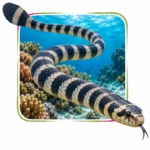
Yellow-lipped Sea Krait Fact Highlight
From the full animal facts page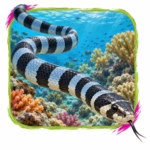
More Animal Comparisons
Pick another animal matchup and keep exploring. Compare appearances, habitats, diets, abilities, and surprising differences.





Make an Animal Story
Send a pelagic sea snake and an island-walking sea krait through a reef mystery with our free Animal Story Generator.
Source notes: References used for this comparison. See more See less
Try Another Matchup
Explore this comparison →